The Baikal Neutrino Telescope: an observatory deep in the lake
How Lake Baikal's clear water and winter ice help physicists catch neutrinos from distant space.
Cultural feature · checked 30 September 2026 · 5 min read
Published 30 September 2026
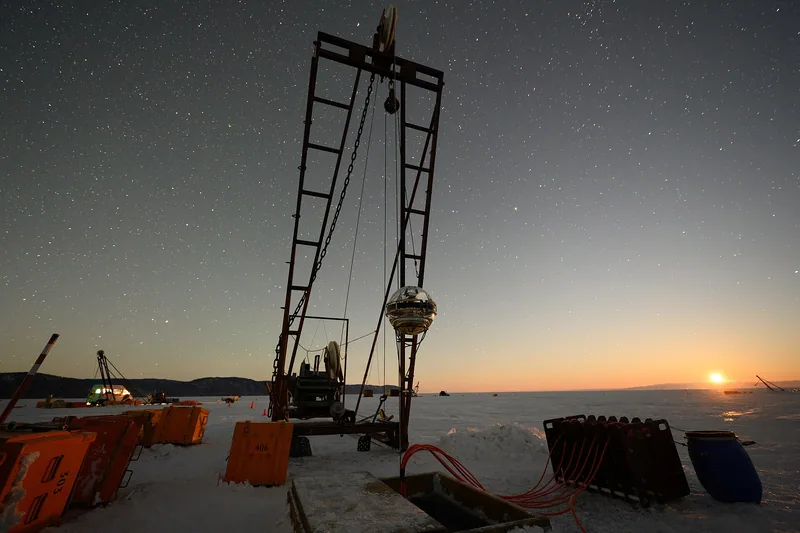

Each winter an unusual settlement appears on the ice of southern Baikal: cabins, winches, cables and people in thick overalls. More than a kilometre beneath them works Baikal-GVD, one of the largest neutrino telescopes in the world. It looks not at the sky but through the depths of water and the Earth itself, searching for traces of almost elusive particles. When the ice melts in spring the camp disappears, but the instruments stay in the dark and keep sending data ashore all year round.
Neutrinos pass through matter while barely interacting with anything, which is why they can carry information about the most powerful processes in the Universe. To notice the rare collision of such a particle with matter you need a vast volume of clean, transparent medium and darkness. Baikal offers both, and on top of that a solid winter ice sheet from which an observatory can conveniently be built. So the lake often called the pearl of Siberia has also turned out to be one of the most unusual scientific instruments in the world.
Why Baikal
When a neutrino does collide with matter, charged particles are born, and in water they leave a faint blue flash of Cherenkov light. The clarity of Baikal's water helps to catch it: according to the collaboration, the light absorption length is about 20–25 metres, and scattering is mostly forward, which preserves information about the particle's direction. From these flashes, recorded by many sensors at once, scientists reconstruct the particle's energy and path, and therefore the part of the sky it may have come from.
Depth matters just as much. The detector lies about 3.6 kilometres from shore, where the lake is around 1.1 kilometres deep, and the water above the instruments shields them from the flux of atmospheric muons. The bottom here is smooth and relatively flat, which makes it easier to anchor the equipment securely. A kilometre of water above and a solid base below: it is hard to imagine better conditions for an underwater observatory.
Strings of optical modules
The telescope is built from clusters. Each cluster consists of eight vertical strings: a central one and seven peripheral strings placed 60 metres away from it. Optical modules are fixed along the strings — sturdy sealed housings with a photomultiplier inside — with a vertical spacing of 15 metres between them. Together the modules form a three-dimensional grid that "sees" faint flashes of light in a huge volume of water around it.
The upper modules hang at a depth of about 700 metres, the lowest at about 1,240 metres. The strings are held up by buoys and can drift slightly with the currents, so the position of every module is continuously tracked by acoustic transmitters and sensors. The modules are built around photomultipliers with a 10-inch photocathode, and in 2025 a full-scale string with 20-inch devices was put into operation. The modules are grouped into sections of twelve, and each section has its own master module that collects the signals from its sensors.
Building on winter ice
Baikal usually starts to freeze at the end of January, and by mid-February the ice is roughly 40–50 centimetres thick. That is enough to set up a camp on the ice and lower equipment through holes cut in it: winter expeditions last six to eight weeks, and the ice barely moves during that time, allowing the strings to be placed precisely. The ice serves at once as building site, road and warehouse: equipment is driven across it, and strings and anchors are lowered on cables through the holes.
The weather has its say. In 2025 thin, cracked ice forced the team to close the ice camp two weeks earlier than planned, yet the expedition still managed to deploy the 14th cluster and repair two older ones. The season officially ended on 1 April 2025. Seasons like this are a reminder that working on Baikal is always a dialogue with nature, not only with machinery.
An international collaboration
The story of neutrino physics on Baikal began on 1 October 1980, when a laboratory of high-energy neutrino astrophysics was founded at the Institute for Nuclear Research of the Russian Academy of Sciences. Today Baikal-GVD is led by INR RAS and the Joint Institute for Nuclear Research in Dubna, and according to JINR in 2025 the collaboration brings together 11 institutes and organisations from four countries. Other participants include Irkutsk State University, the Limnological Institute of the Siberian Branch of the Russian Academy of Sciences and foreign partners such as the Institute of High Energy Physics in Beijing.
The first phase of the telescope, eight clusters, was completed on 13 March 2021. By spring 2024 thirteen clusters and just over 4,100 photodetectors were in operation, and the collaboration plans to reach an effective volume of about one cubic kilometre. The best place to follow the project is the official JINR and Baikal-GVD websites. The collaboration's aims are multi-messenger astronomy, the study of the properties of high-energy cosmic neutrinos and an indirect search for dark matter in our Galaxy.
Sources & context
- Baikal-GVD — The telescope (detector design)
- JINR — 2025 expedition to deploy Baikal-GVD completed
- JINR — Another Baikal-GVD construction expedition finishes (2024)
- Symmetry (MDPI) — High-Energy Neutrino Astronomy: Baikal-GVD
- Wikipedia — Baikal Deep Underwater Neutrino Telescope
A russia.direct editorial selection based on open sources. Checked 30 September 2026. Practical suggestions are a decision guide, not a promise of outcomes.
Editorial principles