The Baksan Neutrino Observatory: a laboratory inside a mountain
How physicists deep inside Mount Andyrchi in the Caucasus have spent decades catching solar neutrinos and hunting for new particles.
Cultural feature · checked 30 September 2026 · 5 min read
Published 30 September 2026
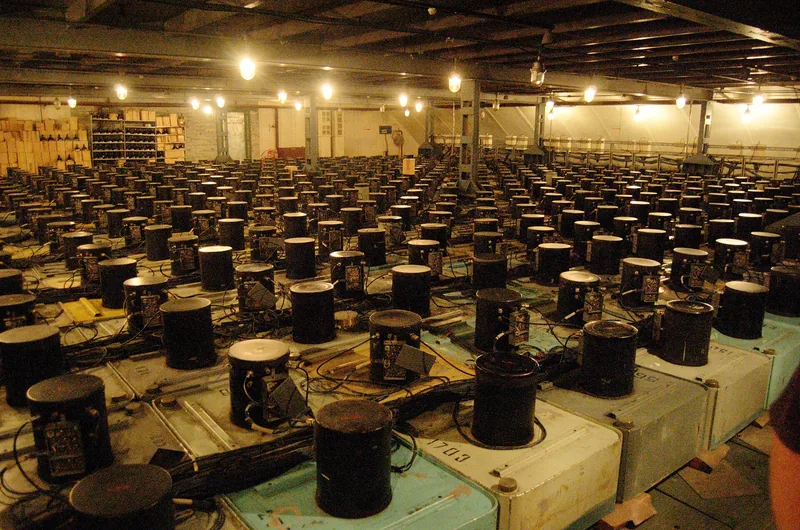

In the Baksan Gorge, on the road to Mount Elbrus, lies a small settlement with an unusual name: Neutrino. It was built for the staff of the Baksan Neutrino Observatory of the Institute for Nuclear Research of the Russian Academy of Sciences. The observatory itself is hidden inside Mount Andyrchi, which rises more than four kilometres high: two parallel horizontal tunnels, each about four kilometres long, run into its slope. The entrance sits at around 1,700 metres, and deep inside the mountain are laboratories that cosmic radiation barely reaches.
According to INR RAS, Baksan was the world's first large-scale underground laboratory, while a similar centre at Gran Sasso in Italy appeared only in 1989. Here the mountain acts as a shield: kilometres of rock damp the flux of cosmic particles that would otherwise drown out the rarest events. It is this underground silence that lets physicists study neutrinos, particles that stream through every square centimetre of our bodies by the tens of billions each second without touching anything.
Why hide inside a mountain
On the Earth's surface, detectors are constantly bombarded by muons produced when cosmic rays strike the atmosphere. According to observatory staff, about 17 muons per second reach the underground scintillation telescope from above, while from below, through the entire planet, roughly one arrives per week. The deeper the laboratory, the less of this interference. That is why Baksan's instruments are spread across different depths, from shallow to very deep, depending on how much background each experiment can tolerate.
The deepest hall, home to the gallium-germanium neutrino telescope, lies about 3.5 kilometres from the tunnel entrance. Above it are about 2,100 metres of rock, which in terms of shielding from cosmic rays is equivalent to roughly 4,700 metres of water. The observatory also has low-background laboratories and chambers, the OGRAN gravitational antenna and other facilities. On the mountainside and in the valley, surface detectors study high-energy cosmic rays.
Gallium that catches the Sun
Baksan's star is SAGE, a gallium experiment for detecting solar neutrinos. Its target is several tens of tonnes of metallic gallium: according to the Russian Academy of Sciences, about 50 tonnes of molten metal are divided among seven reactors. Occasionally a neutrino from the Sun turns a gallium-71 nucleus into radioactive germanium-71. Periodically these individual germanium atoms are chemically extracted from the multi-tonne target and counted by their decay.
The gallium method is valuable because it is sensitive to low-energy neutrinos from the Sun's main fusion reaction, the merging of protons. SAGE measurements began in 1989; in the collaboration's summary paper, covering December 1989 to December 2007 and 168 extractions, the capture rate came to about 65 SNU. The result matched those of the European gallium experiments GALLEX and GNO, and the derived neutrino flux from the proton-proton reaction agreed well with models of the Sun.
The puzzle of the missing neutrinos
To test their detectors, the gallium experiments exposed the target to artificial neutrino sources of precisely known strength. Time and again fewer neutrinos were detected than expected. This shortfall became known as the "gallium anomaly". To test it, Baksan hosted BEST, the Baksan Experiment on Sterile Transitions. A chromium-51 source with an activity of about 3.4 megacuries was placed at the centre of two nested volumes of gallium.
BEST's results, published in 2021, confirmed the anomaly: in both the inner and the outer volume, about 20–24% fewer neutrinos were counted than calculated. The authors noted that such data could be explained by electron neutrinos turning into hypothetical "sterile" neutrinos, which take no part in ordinary interactions. There is no final answer yet: according to the scientists, new series of measurements are needed before a firm conclusion can be drawn.
Supernovae and cosmic rays
The observatory's other famous instrument is the Baksan Underground Scintillation Telescope. It has been running since 1977 and sits about 300 metres below the surface. It is a multi-storey structure more than 11 metres tall on a square base 16.7 metres on each side, filled with thousands of cubic metres of scintillator. On 23 February 1987 the telescope, together with three other observatories worldwide, registered neutrinos from the supernova SN 1987A in the Large Magellanic Cloud.
Outside the mountain operates the Carpet array, a network of scintillation detectors for studying extensive air showers, in service since the 1970s. In 1989 it recorded a flare from the Crab Nebula, and in October 2022 Carpet-2 registered an unusual gamma-ray burst in the constellation Sagitta. The village of Neutrino has become noticeably quieter than in earlier times, but the observatory keeps working and remains a shared research facility for physicists.
Sources & context
- INR RAS — Baksan Neutrino Observatory
- RAS — Baksan Neutrino Observatory: a view of the stars from inside Andyrchi
- arXiv — SAGE solar neutrino measurements, 1989–2007
- arXiv — Results from the Baksan Experiment on Sterile Transitions (BEST), 2021
- Wikipedia — Baksan Neutrino Observatory
A russia.direct editorial selection based on open sources. Checked 30 September 2026. Practical suggestions are a decision guide, not a promise of outcomes.
Editorial principles