Blini: starter, skillet and a thousand years on the Russian table
How yeast-raised blini differ from thin blinchiki, how they were baked in the Russian stove and what they are served with.
Cultural feature · checked 5 October 2026 · 5 min read
Published 5 October 2026
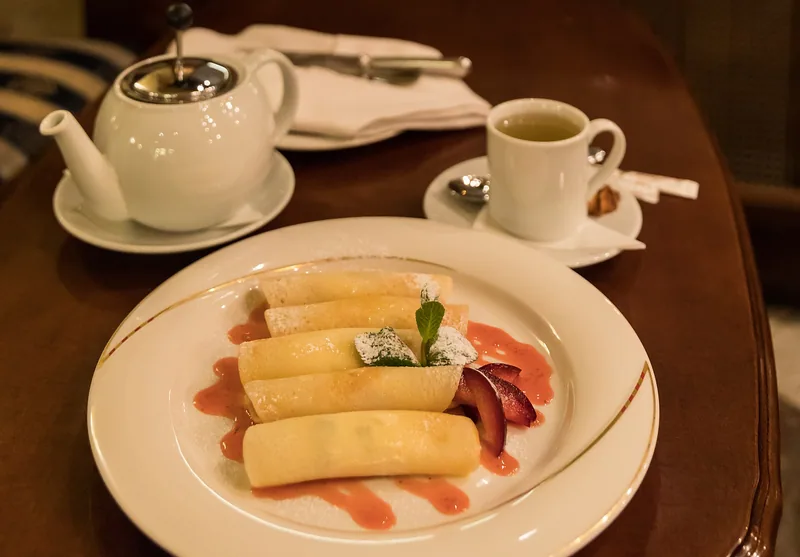

A pancake looks like the simplest dish in the world: a runny batter, a hot pan, a minute of patience. In Russian cooking, though, there is a whole craft behind that circle. Some blini rise on a yeast starter and turn out fluffy, porous, almost translucent. Others, thin and smooth, are made without yeast and wrapped around a filling. There are wheat and buckwheat blini, blini with baked-in toppings or without, eaten with sour cream, caviar or jam, and every household cook has her own way.
Linguists trace the word itself to Old Russian mlin, related to the verb molot, to grind: a blin is something made from milled grain. Food historians reckon that blini were being made in Rus no later than the ninth century, and that their forerunners were unleavened flatbreads and fritters. Flour, stoves and cookware have changed many times since then, yet the blin has remained one of the most recognisable dishes on the Russian table.
The starter: a batter that grows
Classic Russian blini are made with yeast, using the opara, or starter, method. First a thin starter of yeast, flour and warm water or milk is mixed and left to rise; then the rest goes in: more flour, eggs, melted butter, salt and sugar. The batter rises again, sometimes twice more. The culinary historian William Pokhlebkin stressed that real Russian blini were always made with a starter, and that baking soda in the batter is a fairly recent borrowing, untypical of old Russian cooking.
This unhurried process gives a special texture. A good yeast blin is soft, fluffy, light and slightly translucent, its whole surface covered in tiny pores. Those little holes are no accident: they soak up melted butter and sour cream, so the pancake ends up moist rather than dry. Cooks kept their starter recipes secret, and old folk beliefs surrounded its mixing with small rituals: by tradition, the starter was to be set by a river or a well, under the moon.
Red, white and baked in the stove
Wheat flour, considered the standard today, was not always the default. In the past blini were made from buckwheat, rye, oat, millet and even pea flour. Buckwheat blini were called red and wheat ones white. Buckwheat blini had a technique of their own: the flour was scalded with boiling water, cooled, and only then combined with yeast, milk and the remaining flour. In some regions, such as around Bryansk, buckwheat blini are still regarded as the traditional kind.
For a long time blini were not fried but baked, in the Russian stove. The pan was set over the heat: the underside browned against the metal while the top was baked by the heat of the oven chamber. Hence the expression to bake blini, still used today even though they are long since made on the hob. And the saying the first blin comes out lumpy has long been shorthand for any first, still clumsy attempt at something new.
Blinchiki, baked-in toppings and what goes alongside
Next to yeast blini live blinchiki: thin, supple pancakes made from an unleavened batter without yeast. They are cooked on one side or both and then folded into an envelope or rolled around a filling of curd cheese, meat, rice, mushrooms, jam or apples. Another old technique is blini s pripyokom, with a baked-in layer. A thin layer of chopped egg, onion, herbs, fish or curd cheese goes into the hot pan first, the batter is poured over it, and the topping bakes right into the pancake.
Blini are eaten hot, straight from the pan, most often with melted butter or sour cream. On a festive table they are joined by caviar and salted or smoked fish such as herring, salmon or sturgeon. Sweet serving is just as old: blini come with honey, jam or curd cheese. Thin blinchiki resemble French crêpes, and neighbouring peoples have similar thin pancakes too, such as the nalistniki of Belarus and Ukraine.
Sun, memory and celebration
The round golden blin has long been linked with the sun. The writer Alexander Kuprin called it a symbol of the sun, of bright days and good harvests. Some researchers believe that in pre-Christian times blini were ritual, sacrificial food. Later they took on a firm role in remembrance: blini were made for funeral meals and on days honouring the dead, and at Maslenitsa the first pancakes were by custom given to beggars or set aside for the souls of ancestors.
The great pancake festival is, of course, Maslenitsa, the week of seeing off winter, when blini are made every day and people visit each other, sons-in-law and mothers-in-law above all. Yet blini were never only festive food: they were made on ordinary days and sold on city streets. Anton Chekhov joked that while customs change, blini hold their place in Russian life just as firmly as they did a thousand years ago.
Sources & context
- Culture.RF — Blintsy, blinchiki, blini: like wheels of spring
- Znanie.Wiki (Russian Society Znanie) — Blini
- Znanie.Wiki (Russian Society Znanie) — Blin
- Wikipedia (RU) — Blini
- Wikipedia — Blini
A russia.direct editorial selection based on open sources. Checked 5 October 2026. Practical suggestions are a decision guide, not a promise of outcomes.
Editorial principles