Kapova Cave: a karst palace with Ice Age paintings
How an underground river carved a multi-level cave in the Southern Urals, where ancient people painted mammoths and horses in ochre.
Cultural feature · checked 30 September 2026 · 4 min read
Published 30 September 2026
.jpg)
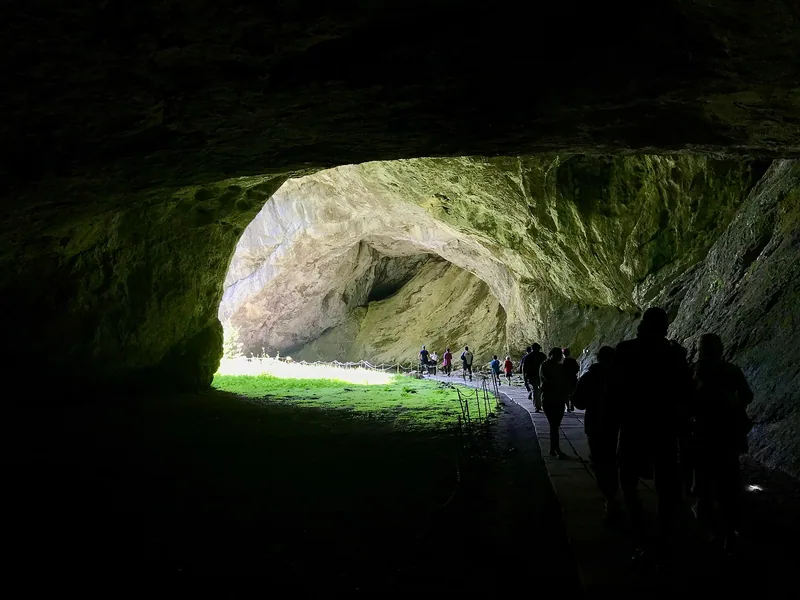
In the western foothills of the Southern Urals, where the Belaya River makes a bend, a huge arch about 30 metres high opens in a rocky slope. At its foot lies the Blue Lake, from which the Shulgan River flows. This is the entrance to Kapova Cave, known in Bashkir as Shulgan-Tash. Outside are forest, water and limestone cliffs; inside is a multi-storey labyrinth of halls and galleries.
Yet the cave's fame is not only about karst. Deep inside, where daylight never reaches, paintings made by Upper Palaeolithic people have survived. Mammoths, woolly rhinoceroses, horses and mysterious signs were drawn in red ochre many thousands of years ago. Today the cave is protected by the Shulgan-Tash Nature Reserve, and in 2025 its rock paintings were added to the UNESCO World Heritage List.
A cave carved by a river
Kapova Cave is a multi-level karst cavity created by the underground Shulgan River. The karst massif that holds it is bounded by the Belaya valley and the Shulgan canyon. Over the ages water dissolved the limestone, cutting passages at different levels: as the river sank deeper, the upper galleries drained and turned into dry halls. The result is a system of three tiers linked by steep passages.
The passages add up to more than 3.3 kilometres, the cave covers about 20,200 square metres, and its volume is about 105,000 cubic metres. Halls on the upper tier rise 7–20 metres in places and stretch up to 90 metres in length. Lower down the cave still lives with its water: there are underground lakes and siphons, fully flooded sections of passage that cavers and divers continue to explore and discover.
Mammoths painted in ochre
In January 1959 the zoologist Alexander Ryumin found ancient images on the cave walls. From 1960 they were studied systematically by an expedition led by the archaeologist Otto Bader, and in the same year the cave was protected as a monument of federal significance. Today around two hundred images and their traces are known here. Almost all are made with red ochre, sometimes outlined in charcoal, and they lie deep inside the cave, in the zone of total darkness.
The ancient artists depicted animals of the cold steppes: mammoths, woolly rhinoceroses, bison and horses. There is also a Bactrian camel, the only known example of this subject in the Palaeolithic cave art of Europe. Besides animals, the walls show human-like figures, abstract signs and geometric patterns, including the famous "Kapova trapezoids". According to UNESCO, the paintings were made roughly 20,600 to 16,500 years ago, during the Last Glacial Maximum.
A reserve for wild-hive bees
The land around the cave was placed under protection in 1958, first as a branch of the Bashkir Reserve; in 1986 Shulgan-Tash became an independent reserve. Today it covers 22,533 hectares. The reserve protects the broadleaf forests of the Southern Urals and the unique Burzyan wild-hive bee, which lives in tree hollows. Alongside it the reserve keeps alive bortnichestvo, the traditional Bashkir craft of forest beekeeping, recognised as part of the region's cultural heritage.
Since 2012 Shulgan-Tash has been part of the UNESCO Bashkir Urals Biosphere Reserve, which unites five protected areas. Rare bats, the Daubenton's bat and the pond bat, hibernate in the cave itself, and scientists have described three endemic species of springtails here. So a single place brings together several stories at once: the geology of karst, the biology of the underground world and a living tradition that ties people to the forest.
Protecting a fragile heritage
Anything that changes the underground microclimate harms the paintings: heat, humidity, people's breath, light. That is why access to the cave is governed by visitor limits calculated by scientists, and at the entrance there are boardwalks, railings and stairs so that visitors do not damage the archaeological layer. The cave is guarded around the clock by the reserve's state inspectors. To let people see the art, in 2003 restorers from the Hermitage created copies of the paintings in the Main Gallery area.
In 2025 the "Rock Paintings of Shulgan-Tash Cave" were inscribed on the UNESCO World Heritage List under criterion (iii), as outstanding testimony to the culture of Upper Palaeolithic people. The property covers 288.5 hectares, with a buffer zone of more than 4,000 hectares. Kapova Cave shows how inseparable nature and culture can be: without the river there would be no halls, and without the halls the Ice Age paintings would not have survived.
Sources & context
- UNESCO World Heritage Centre — Rock Paintings of Shulgan-Tash Cave
- Shulgan-Tash Reserve — Shulgan-Tash (Kapova) Cave
- Shulgan-Tash Reserve — About the reserve
- Russian Geographical Society — Shulgan-Tash: a lost world in the Ural Mountains
- Wikipedia — Shulgan-Tash Cave
A russia.direct editorial selection based on open sources. Checked 30 September 2026. Practical suggestions are a decision guide, not a promise of outcomes.
Editorial principles