Konstantin Tsiolkovsky: the Kaluga teacher who calculated the way to space
How a provincial teacher who lost much of his hearing as a child worked out the rocket equation, and what his house in Kaluga and the Museum of the History of Cosmonautics tell us.
Cultural feature · checked 5 October 2026 · 5 min read
Published 5 October 2026
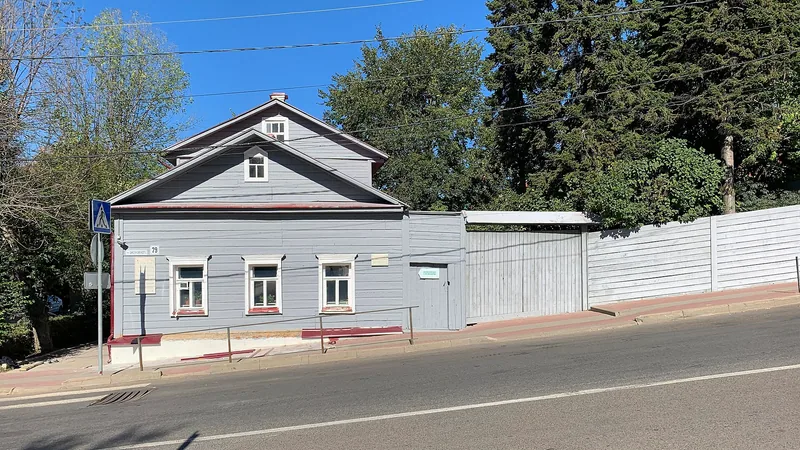

On the edge of Kaluga, not far from the Oka River, stands a small wooden house with a veranda. For almost three decades it was home to a school mathematics teacher who had struggled to hear the people around him since childhood, yet thought persistently about how humans might leave the Earth. Here Konstantin Eduardovich Tsiolkovsky wrote about airships, rockets and space flight, long before the first artificial satellite and the first cosmonaut reached orbit.
Tsiolkovsky is called one of the founders of theoretical cosmonautics. His story is remarkable not only for his scientific ideas but for how they came about: without a university or a proper laboratory, in a provincial town, between lessons and household chores. Kaluga cherishes this memory. The city is home to the scientist's memorial house-museum and to the State Museum of the History of Cosmonautics that bears his name, while nearby Borovsk has the apartment-museum where his scientific work began.
The boy who lost his hearing
Konstantin Tsiolkovsky was born on 17 September 1857 in the village of Izhevskoye in Ryazan Governorate. At the age of nine he caught scarlet fever, after which his hearing deteriorated sharply. Going to school with such an impairment was hard, and at thirteen he lost his mother. Tsiolkovsky never received a systematic education: books and stubborn self-study took its place, a habit he formed in his youth and kept for the rest of his life.
As a young man he went to Moscow and spent about three years studying on his own in a library where the philosopher Nikolai Fyodorov worked at the time. Tsiolkovsky then passed the teacher's examination and in January 1880 arrived in Borovsk to teach arithmetic and geometry at the district school. In August that year he married Varvara Evgrafovna Sokolova, and four children were born to the family during the Borovsk years. Altogether he taught for more than forty years.
Borovsk: the first experiments
The Borovsk years were when the teacher took up science in earnest. He later recalled that it was there he returned to physics experiments and serious mathematics, writing, calculating, soldering and making things a great deal. His papers reached the Russian Physical-Chemical Society and drew the attention of scientists such as Dmitri Mendeleev and Nikolai Zhukovsky. For a provincial teacher without a university education, such attention was a great and very important recognition.
Today that period is the subject of the Tsiolkovsky Apartment-Museum in Borovsk, which opened on 19 September 1997. It occupies a restored house where the family lived in 1887–1888 and shows the setting in which the teacher combined lessons with research. The museum is part of the State Museum of the History of Cosmonautics in Kaluga. In 1892 Tsiolkovsky was transferred to a post in Kaluga, and that city remained his home for the rest of his life.
The rocket equation
Tsiolkovsky's main scientific achievement concerns the rocket. The manuscript in which he derived the equation of its motion is dated 10 May 1897. The equation links the speed a rocket can gain with the speed at which gases leave its engine and with the ratio of its initial mass, fuel included, to its final mass, without fuel. It leads to a simple but harsh conclusion: to add noticeably to its speed, a rocket needs a supply of fuel that grows very quickly.
In 1903 Tsiolkovsky published Exploration of Outer Space by Means of Reaction Devices. In it he applied the equation to the question of whether a rocket could reach the speed needed for space flight, and proposed rockets running on liquid oxygen and hydrogen as well as multistage designs. He also thought about all-metal airships, space stations and a tower reaching into the sky, a forerunner of the space elevator idea. In all he left more than 400 works.
The house by the Oka and the cosmonautics museum
Tsiolkovsky bought the house in Kaluga in spring 1904 and lived there for 29 years, until 1933. At first it was a single-storey house with just one room; after a severe flood in spring 1908 it was repaired, a second floor with a study was added, and a veranda with a workshop was built on. The scientist died on 19 September 1935, and exactly a year later the memorial house-museum opened here. It preserves his rooms, study and workshop, and the yard and garden have been recreated.
Nearby, on Akademika Korolyova Street, is the State Museum of the History of Cosmonautics named after K. E. Tsiolkovsky. Yuri Gagarin laid its foundation stone on 13 June 1961, the chief designer Sergei Korolev supported the project, and the museum opened on 3 October 1967. According to the museum, its collection holds about 80,000 objects, including hardware that has been in orbit. A new second-stage building complements the historic one and houses the exhibition Rockets. Ships. People.
Sources & context
- State Museum of the History of Cosmonautics — Tsiolkovsky Memorial House-Museum
- State Museum of the History of Cosmonautics — The museum's history in people, events and dates
- State Museum of the History of Cosmonautics — Tsiolkovsky Apartment-Museum in Borovsk
- State Museum of the History of Cosmonautics — The museum building and exhibitions
- Wikipedia — Konstantin Tsiolkovsky
A russia.direct editorial selection based on open sources. Checked 5 October 2026. Practical suggestions are a decision guide, not a promise of outcomes.
Editorial principles