Kungur Ice Cave: a winter that lives inside a hill
How gypsum, water and frosty air created a cave in the Middle Urals where ice survives even in summer.
Cultural feature · checked 30 September 2026 · 5 min read
Published 30 September 2026
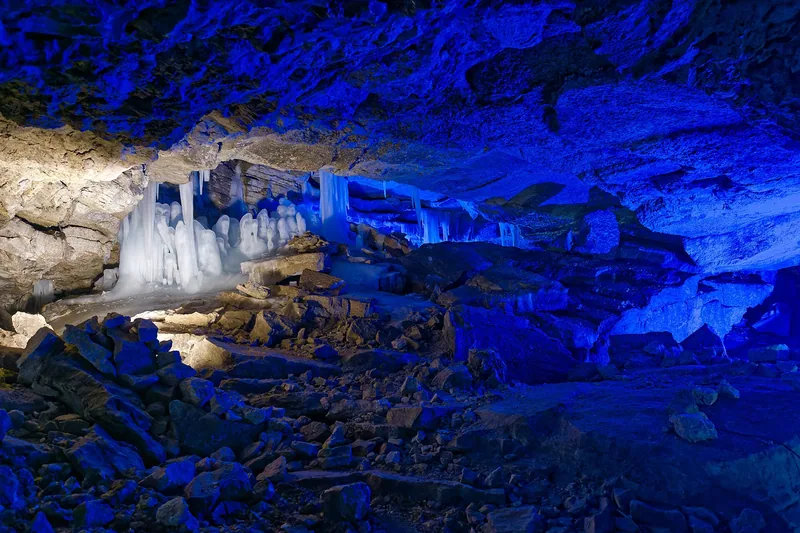

On the edge of the town of Kungur, above the right bank of the Sylva River, rises the Ice Mountain. From outside it is an ordinary wooded slope, but inside it hides one of Russia's best-known caves. Near the entrance, even in the heat of July, frost crystals glitter on the vaults and ice crusts cover the floor. It feels as if winter has simply hidden from summer underground and is waiting for its moment, and in a sense that is exactly what happens.
The Kungur Ice Cave is a rare case of geology and climate working as a team. Soluble rocks created the underground halls, and harsh Ural winters filled them with enough cold to last all year. Cartographers and academicians were already writing about the cave in the 18th century, and today scientists study its microclimate. The story of Kungur is a story of water carving stone and air turning the hollows into a natural refrigerator.
A mountain of gypsum
The Ice Mountain is made mostly of gypsum and anhydrite, with thin layers of limestone and dolomite in between. The gypsum beds accumulated here in the deep past, but the cave itself is young by geological standards: its age is estimated at 10,000–12,000 years. Gypsum and anhydrite dissolve easily in water, so underground streams gradually leached the rock, widening cracks into passages and halls. This is karst, a landscape in which water is the chief sculptor.
Over time the roofs of the hollows collapsed, giving the grottoes their present shape, with piles of fallen blocks and high domes. In all, 48 grottoes have been counted. The largest, the Geographers' Grotto, has a volume of about 50,000 cubic metres, while the Giants' Grotto, crossed by the visitor trail, holds about 45,000. Underground lakes gleam between the grottoes; the largest, the Big Underground Lake, is up to about three metres deep.
How winter gets into the cave
The secret of the ice lies in moving air. In winter heavy frosty air is drawn in through the entrance and chills the nearest grottoes: in the Diamond Grotto the temperature can fall to between −15 and −30 °C. When warm, humid air from side passages meets the frozen vaults, its excess moisture settles on them as ice crystals. That is how the famous crystals, including needle-shaped ones, grow, sparkling in torchlight like scattered jewels.
In summer the outside air is warmer and the ice melts a little, but the cold stored up over winter is enough to keep the entrance grottoes below freezing. Between the Diamond and Polar grottoes lie perennial ice layers three to four metres thick. Deeper inside the mountain the influence of the surface weakens: researchers distinguish three climatic zones with different temperature regimes. So the ice is concentrated near the entrance, while the far grottoes enjoy a steadier, milder climate.
From Remezov's sketch to precise survey
The first plan of the cave was drawn in 1703 by the cartographer Semyon Remezov. In 1733 it was examined by the naturalist Johann Georg Gmelin, who was the first to describe it as "icy". In 1770 the academician Ivan Lepyokhin visited, and during the 19th and 20th centuries researchers produced ever more detailed plans. In 1914 the cave was leased by A. T. Khlebnikov and it has been known as a place for guided visits ever since.
The cave's length is usually given as about 5.7 kilometres, yet its passages are still being refined today: researchers keep returning to survey work, checking old plans against new measurements. Regular scientific observations of the cave's climate have been carried out since 1948. Its underground lakes are home to an endemic small crustacean named after Khlebnikov, another reminder that the cave lives a life of its own.
A fragile underground climate
The ice grottoes are a very sensitive system. The ice survives thanks to a delicate balance between frosty winters, summer warmth and the movement of air through the passages. Change any one of these conditions and the temperature in the grottoes changes too, which is why scientists have been monitoring the underground microclimate for decades. For them the cave is a natural laboratory for tracing how the surface and the underground exchange heat.
The visitor trail runs for about 1.5 kilometres through the most striking grottoes. However, the cave's official website currently states that it is closed to visitors for an indefinite period, so it is worth checking the latest information before travelling. Either way, the Kungur cave remains one of the best examples in the Urals of how gypsum karst and winter air together create an underground realm of ice.
Sources & context
- Russian Geographical Society — Kungur Ice Cave
- Vokrug Sveta — Treasures of the Ice Mountain
- Uraloved — Kungur Ice Cave
- Kungur Ice Cave — official website
A russia.direct editorial selection based on open sources. Checked 30 September 2026. Practical suggestions are a decision guide, not a promise of outcomes.
Editorial principles