Lena Pillars: a stone forest above a great river
How a Cambrian seabed became a wall of limestone towers on the Lena, and how to see them by travelling upriver from Yakutsk.
Cultural feature · checked 30 September 2026 · 5 min read
Published 30 September 2026
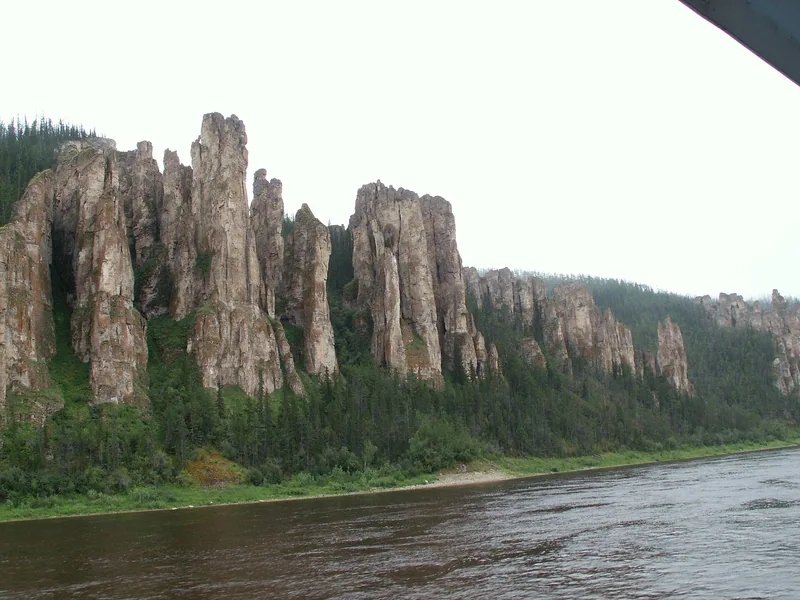

Travel up the Lena from Yakutsk and at some point the right bank stops being merely a bank. Stone towers, spires and battlements rise out of the taiga, looking now like fortress walls, now like a forest frozen in place. These are the Lena Pillars, one of the most recognisable natural sights in Yakutia and in all of Siberia. In the evening, when the low sun lights up the rocks, their colour shifts from grey to a warm ochre, and it becomes clear why travellers find it so hard to look away.
The pillars stretch along the river for many kilometres, and reference works put their height above the water at up to 220 metres. In 2012 UNESCO added Lena Pillars Nature Park to the World Heritage List, above all for its geology, which here quite literally comes to the surface. Even without the scientific details the place is easy to love: a broad, calm river, the smell of the taiga and stone figures that each seem to be waiting for a name.
A seabed turned into cliffs
The pillars are made of Cambrian limestone, rock that built up on the floor of an ancient sea more than half a billion years ago, roughly 560–540 million years back. The vertical forms themselves, researchers estimate, appeared far later, over the last few hundred thousand years, as uplift, karst and weathering began to carve up the carbonate beds. In other words, the rock here is very old, while the sculpture we see is, by geological standards, quite young, and the work on it is still going on.
UNESCO stresses the role of the sharply continental climate: the annual temperature range here approaches 100 degrees, from −60 to +40 °C. Water seeps into cracks, freezes and thaws, widening the gullies between the rocks until separate sections stand alone as pillars. Every winter and every spring this slow chisel removes a little more stone from the cliffs, so the pillars are not a frozen monument but a living, changing landscape.
A record of early life
For scientists the Lena Pillars are not just scenery but an open book. The World Heritage description notes that the park’s Cambrian deposits hold an exceptionally continuous and detailed record of how the first animals with skeletons spread across the Earth, right up to the first mass extinction. Geologists come here to follow, layer by layer, one of the most important chapters in the history of life, when new forms of organisms were rapidly appearing in the oceans.
The site also preserves some of the earliest and largest reefs in the world built by Cambrian multicellular organisms. Beneath the park lies permafrost which, according to UNESCO, reaches depths of 400–500 metres and completes the picture with thermokarst landforms. Permafrost shapes the terrain too: where it thaws, sinkholes, hollows and lakes form, adding their own distinctive relief to the stone walls.
The park and its status
The area has been protected since the mid-1990s, and in 2019 the park became a national park. UNESCO gives the World Heritage property an area of about 1.39 million hectares, although the cliffs themselves occupy only a narrow strip some 150 metres wide along the bank. The narrow strip of cliffs and the vast protected territory around it form a single whole: the taiga, the river and its tributaries shield both the pillars and those who live beside them.
The same administration now also manages other protected areas of Yakutia. The park’s official website publishes visiting rules, tourist routes and a list of the documents needed to stay on its territory, and it is worth studying them in advance. The rules are not a formality: the cliffs and slopes are fragile, and visitors’ care is the main condition for future generations to see what we see today.
Getting there by river
The pillars lie about 180 kilometres upstream from Yakutsk on the Lena. In summer, usually from June to September, river cruise ships sail there and motorboat transfers are also possible; according to the official website, cruises last 36 to 46 hours. The main stop is the Labydya section, with a wooden eco-trail and viewing platforms. The climb along the trail to the upper platforms takes some effort, but from the top you look out over the river and the endless taiga, which is reason enough for the whole journey.
There is an overland option too: drive to the village of Batamay and cross the river, over the ice in winter. In the shoulder seasons, when the river freezes or the ice breaks up, the route may be closed. Timetables, conditions and prices change from year to year, so check current information on the park’s official website, lena-pillars.ru, before you go. Whichever option you choose, bring warm clothes and insect repellent: even in summer the weather on the river is changeable, and northern nature does not forgive carelessness.
Sources & context
- UNESCO World Heritage Centre — Lena Pillars Nature Park
- Lena Pillars National Park — official website
- Wikipedia (Russian) — Lena Pillars
- RUSSPASS Magazine — Lena Pillars in Yakutia
A russia.direct editorial selection based on open sources. Checked 30 September 2026. Practical suggestions are a decision guide, not a promise of outcomes.
Editorial principles