Levitan’s Golden Autumn: follow the river with your eyes
A closer look at the 1895 painting: moving water, bright birches and the difference between recognition and attention.
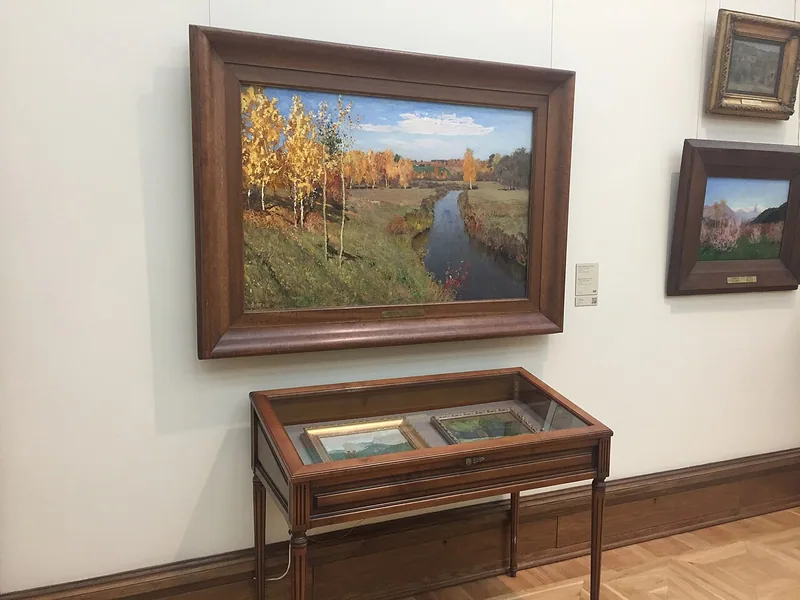

A familiar title can sometimes make a painting harder to see. Golden Autumn: we expect yellow leaves, recognise them and move on. Try staying longer. Follow the river first, examine its banks, and only then return to the brightly coloured trees.
The My Tretyakov collection record identifies Isaac Levitan, the year 1895, and oil on canvas; it records the work as a gift from Pavel Tretyakov in 1896. What follows is our invitation to look for yourself. It does not invent the artist’s words or require one correct emotional response.
Begin with the movement of your eye
Find the water in the lower part of the image. The river draws your eye into the distance, while its banks make the turn legible. Now try looking in the opposite direction, from the distance towards the foreground. The landscape stays the same, but the order in which its details appear changes.
Notice how much of your view the water occupies and how the grassy areas are arranged beside it. Trace the edge of a bank in your mind without naming the objects. This exercise brings composition into focus: not simply what is depicted, but how the parts hold your attention together.
Yellow becomes brighter beside blue
Return to the birches and compare their warm foliage with the cooler water and sky. The gallery’s commentary notes contrasting colours and freely handled brushwork. Test that observation yourself: where does an area of colour appear continuous, and where can you distinguish individual movements of the brush?
Avoid searching for one correct shade of autumn. With a reproduction, compare relationships inside the image instead: lighter and darker, warmer and cooler. Screens, photography and gallery lighting affect colour, so looking online offers an introduction rather than a substitute for encountering the original.
Familiar does not mean simple
You may recognise familiar things in this scene: a riverbank, birches and open ground. Recognition alone does not explain why you want to keep looking. Try connecting an impression to a visible detail. Instead of only saying calm, you might say that the curved bank slows your eye; instead of bright, that the pale foliage stands out against the water.
These are possible interpretations, not compulsory reactions. Another person may notice a different rhythm or mood. Comparing observations makes a conversation about painting more precise: each response has something visible to point to, while still allowing room for individual experience.
Where to look next
The gallery’s record mentions March and Fresh Wind. The Volga alongside Golden Autumn; all three date from 1895. Find them in the official catalogue and compare one aspect, such as air, movement or reflected light. You do not need to read an entire biography before beginning a meaningful comparison.
Before visiting, check where the work is currently displayed, since exhibitions and gallery arrangements change. Our illustration is a photograph taken in the Tretyakov Gallery in 2021. It provides museum context but does not establish the painting’s location today. Save the title and the artist’s name rather than relying on a room number from an old photograph.
Sources & context
- My Tretyakov — the collection record and commentary for Golden Autumn
- Tretyakov Gallery — exploring a painting
- Adavyd — the 2021 photograph and its licence
A russia.direct editorial selection based on open sources. Checked 24 September 2026. Practical suggestions are a decision guide, not a promise of outcomes.
Editorial principles