Manpupuner: seven stone giants of the Northern Urals
The weathering pillars of the Pechora-Ilych Reserve: their geology, Mansi legends and the rules for getting there.
Cultural feature · checked 30 September 2026 · 5 min read
Published 30 September 2026
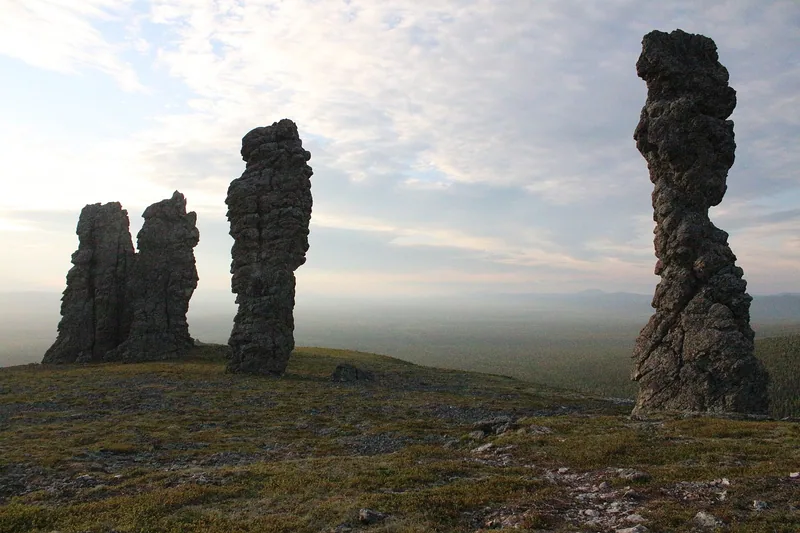

On the flat top of a mountain plateau, amid the tundra and sparse woods of the Northern Urals, stand seven stone figures. Six are lined up almost in a row; the seventh stands a little apart, as if keeping watch over the others. These are the weathering pillars of the Manpupuner plateau, one of Russia’s most famous and least accessible natural sites. In fog or low cloud the pillars’ outlines seem alive, and it is easy to see why people have long regarded them as more than rocks.
The plateau lies on the western slope of the Urals, in the Troitsko-Pechorsky District of the Komi Republic, between the upper Pechora and its tributary the Ilych. Getting here is not easy, and that is part of its value: the pillars stand within a strict nature reserve, where the silence is guarded as carefully as the stones themselves. Nobody arrives here by chance, and perhaps that is why meeting the stone figures on the open, wind-swept plateau makes such a strong impression.
What remains of ancient mountains
Reference sources give the pillars heights of 30 to 42 metres; the one standing apart is about 34 metres tall. They are made of sericite-quartzite schist, rock harder than whatever once surrounded it. Each pillar has its own unique silhouette, and from different points on the plateau their shapes change, resembling human figures, strange heads or watchtowers.
Around 200 million years ago mountains rose where the plateau is now. Rain, wind, frost and temperature swings gradually wore away the softer rock, while the tough schist survived. The slow work of weathering thus left seven outliers on the plateau that today look as though they were placed there on purpose. The process is not over: wind and frost carry on their work today, which is why treating the stones with care is not a whim but a necessity.
The name and the legends
The Mansi name Manpupuner is usually translated as “small mountain of idols”, and the pillars are also known as the Mansi Idols. For the Mansi this was a sacred place, and by tradition climbing the pillars was considered forbidden. The name captures the feeling the place evokes: the pillars really do look like figures someone has set up on the mountaintop.
Many legends have grown up around the plateau. In one, seven giants crossed the mountains to destroy the Mansi people but turned to stone in terror at the sight of the sacred mountain Yalping-Ner. In another, the giants tried to carry off a chief’s daughter until a magic shield reflected the sunlight and turned them to stone. These are legends, not history, but they are what has kept the stones alive for generations. Such stories were passed on by word of mouth and have come down to us in different versions, but in all of them the stones keep the memory of an encounter with something greater than people.
Protected by the reserve
The pillars lie within the Pechora-Ilych Nature Reserve, founded in 1930, which today covers about 721,000 hectares. Since 1935 the reserve’s headquarters have been in the village of Yaksha, and it is known, among other things, for its long-running experiment in domesticating moose. The reserve was created above all to protect the northern taiga and its inhabitants, and the stone pillars turned out to be just one, if the most famous, of its treasures.
The reserve is the core of the UNESCO World Heritage site Virgin Komi Forests, inscribed in 1995 together with Yugyd Va National Park. Manpupuner became widely known in 2008, when it was named one of the Seven Wonders of Russia. This status underlines that the pillars are part of a vast living landscape where forests, bogs and mountain rivers are no less valuable than the famous stones.
How visitors get there
Being on the reserve’s territory without permission from its administration is not allowed. Under the rules published on the reserve’s website, tourists visit the plateau on approved routes, in organised groups accompanied by reserve staff or guides from partner tour companies. There are hiking, helicopter and winter snowmobile options, each with set seasons, age limits and limits on how long visitors may stay. The strict rules exist so that the flow of visitors does not damage fragile mountain nature, which recovers very slowly.
Applications are made in advance: choose a route and an open date in the schedule, fill in the form and send the documents to the email address given on the website. Applications for the 2026 summer season opened on 1 April. Procedures and deadlines can change, so check the latest information on the official website, pechora-reserve.ru, before planning a trip. A trip like this takes preparation and patience, but it is precisely limited access that has kept the plateau almost as the Mansi saw it centuries ago.
Sources & context
- Pechora-Ilych Nature Reserve — Visiting rules
- Pechora-Ilych Nature Reserve — How to apply for a visit
- UNESCO World Heritage Centre — Virgin Komi Forests
- Living Heritage — Manpupuner
- Wikipedia — Manpupuner rock formations; Pechora-Ilych Nature Reserve
A russia.direct editorial selection based on open sources. Checked 30 September 2026. Practical suggestions are a decision guide, not a promise of outcomes.
Editorial principles