Mikhail Lomonosov: from a Pomor village to Moscow University
How the son of a northern fisherman and shipowner walked to Moscow, became Russia's first professor of chemistry and conceived a university.
Cultural feature · checked 30 September 2026 · 5 min read
Published 30 September 2026
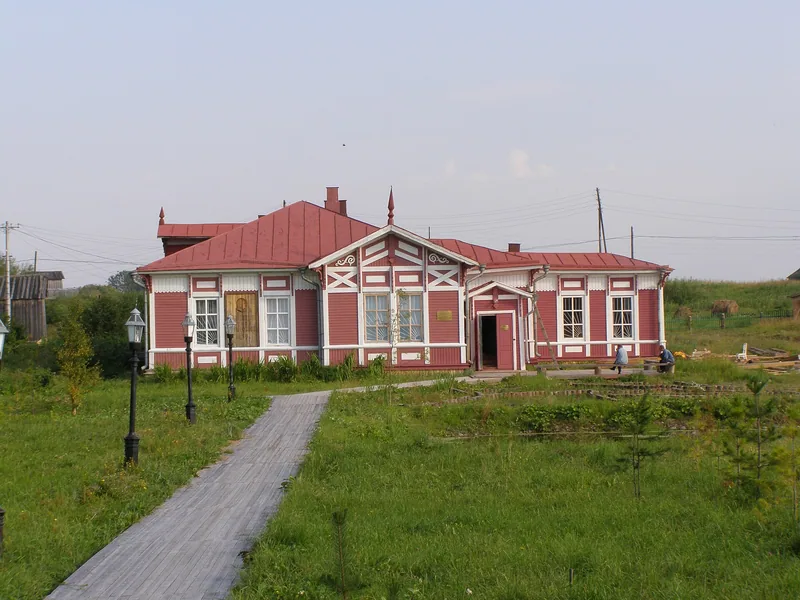

Kurostrov, an island in the middle of the Northern Dvina not far from Kholmogory, is where one of the most remarkable life stories in Russian science begins. Here, in the village of Mishaninskaya, Mikhail Lomonosov was born on 19 November 1711. Today the village bears his name, and just as three centuries ago the island is reached by water in summer and across the ice in winter. The Pomor country, with its sea trades, boats and long winters, shaped the character of a man who would combine chemistry, physics, poetry, mosaics and educational reform in a single life.
Lomonosov is often called a universal man, and that is no exaggeration. He wrote odes and textbooks, experimented with glass and metals, watched the sky and argued with academic officials. Yet the most striking thing about him is the path itself: from a peasant family at the edge of the country to the Academy of Sciences in St Petersburg and the founding of Moscow University. It is a story of curiosity, stubbornness and a belief that science should serve not a narrow circle of the chosen but the whole country.
A childhood by the White Sea
The future scientist's father, Vasily Dorofeyevich, was a prosperous Pomor fisherman who became a shipowner, carrying goods between Arkhangelsk and the northern lands. His mother, Elena Ivanovna Sivkova, was a deacon's daughter. A neighbour taught him to read, and later the village deacon gave him lessons. Next to today's museum on Kurostrov there is a pond that, according to tradition, was dug by the scientist's father, a small trace of the family homestead.
At about fourteen the boy got hold of books on grammar and arithmetic, real treasures for a village child in those days. He learned them almost by heart and realised he wanted to go on studying. There was no way to do that in a northern village: schools, libraries and learned people were hundreds or thousands of versts away. The wish to "study sciences" proved stronger than the familiar way of life, and the nineteen-year-old Pomor made a decision that changed everything.
On foot in search of learning
In 1730 Lomonosov set off for Moscow and, as the famous story goes, walked the whole way. To enter the Slavic Greek Latin Academy, which did not admit peasant children, he claimed to be the son of a nobleman. He gave up a familiar life and a well-off family home for the sake of learning, and his persistence paid off: the gifted student won a scholarship to study abroad.
From 1736 to 1739 Lomonosov studied at the University of Marburg, where his mentor was the philosopher Christian Wolff, and then took up mineralogy, mining and metallurgy in Freiberg. In Germany he married Elisabeth Christine Zilch. In the summer of 1741, after four years and eight months abroad, he returned to St Petersburg. He brought back not only knowledge but also a clear picture of how European university science worked.
The first chemical laboratory
In 1745 Lomonosov became a full member of the Academy and professor of chemistry, the first Russian to hold that chair at the Academy of Sciences. He spent years pressing for a laboratory of his own: Empress Elizabeth signed the decree for it in 1746, construction began in the summer of 1748, and on 12 October 1748 the scientist reported that the laboratory was ready. The Russian Academy of Sciences regards it as the starting point of chemistry as a science in Russia.
In his experiments Lomonosov repeated Robert Boyle's work on heating metals and concluded that, without access to outside air, the mass of the burnt metal stays the same. Together with Lavoisier he is considered one of the discoverers of the law of conservation of mass. In 1761, watching the transit of Venus across the Sun, he described an effect he interpreted as the planet's atmosphere. Much of his energy went into coloured glass: from its pieces he assembled mosaics, twenty-four of which survive.
A university open to all ranks
Lomonosov dreamed of a real university for Russia. In the summer of 1754 he proposed to his patron Ivan Shuvalov a structure of three faculties: law, medicine and philosophy. Shuvalov saw the project through to approval, and on 12 January 1755, St Tatiana's Day, Empress Elizabeth signed the decree founding Moscow University. Its first building stood in central Moscow by the Resurrection Gates, and two gymnasiums were opened alongside it, one for nobles and one for commoners.
Lectures were given in Latin and Russian, and before long the university had its own printing press and bookshop. In the same years Lomonosov prepared his Russian Grammar and works on rhetoric and versification, laying foundations for the literary language. He died in St Petersburg on 4 (15) April 1765. In 1940 Moscow University was named after him, and in the same year a memorial museum opened on Kurostrov; it occupies a school building from 1892.
Sources & context
- Lomonosov Historical and Memorial Museum (Lomonosovo)
- Russian Academy of Sciences — Lomonosov and Russia's first chemical laboratory
- MSU Faculty of Journalism — Lomonosov and the founding of Moscow University
- Presidential Library — Moscow University is founded
- Culture.RF — Lomonosov Historical and Memorial Museum
A russia.direct editorial selection based on open sources. Checked 30 September 2026. Practical suggestions are a decision guide, not a promise of outcomes.
Editorial principles