Nizhny Novgorod: beyond the kremlin walls
The Chkalov Stairs, the Upper Volga Embankment, Rozhdestvenskaya Street and the Strelka: a walk through Nizhny from the kremlin hill to the meeting of the Oka and the Volga.
Cultural feature · checked 5 October 2026 · 5 min read
Published 5 October 2026

Nizhny Novgorod was founded in 1221 by Prince Yuri Vsevolodovich of Vladimir as a fortress on the south-eastern edge of Rus, on a high bank where the Oka flows into the Volga. The kremlin still stands on that hill and is the first thing a traveller sees. But the city outgrew its walls long ago: step out of the gates and a different Nizhny begins, with long staircases, merchant mansions, trading streets below and wide views over two rivers.
This walk needs no complicated route. From Minin and Pozharsky Square you can descend the Chkalov Stairs to the Volga, then climb back up and follow the edge of the Upper Volga Embankment. Another path leads down into the old trading quarter, where Rozhdestvenskaya Street runs, and from there the Strelka is close at hand. Each of these places explains in its own way how the river made Nizhny one of Russia's great merchant cities.
A figure of eight with 560 steps
The Chkalov Stairs link Minin and Pozharsky Square and the Upper Volga Embankment with the Lower Volga Embankment. They were built between 1943 and 1949 to a design by Lev Rudnev, Vladimir Munts and Alexander Yakovlev, who supervised the work on site. In plan the staircase resembles a figure of eight: counting both sides there are 560 steps, and 442 from bottom to top along one side. Two viewing platforms sit where the flights cross, and from each the Volga opens out wider.
Officially the structure was called the Volga Stairs, but the popular name proved stronger: by the 1980s it had been replaced by "Chkalov Stairs", after the monument to the pilot Valery Chkalov unveiled at the top in 1940. Chkalov went down in history as the pilot who made the first non-stop flight from the USSR to the United States over the North Pole. Down by the river the boat Geroy (Hero) has stood since 1985, and newlyweds have long favoured the spot for wedding photographs.
An embankment on the brow of the hill
The Upper Volga Embankment runs along the high right bank from Minin and Pozharsky Square to Sennaya Square. It was once called Georgievskaya and looked rather shabby. In 1834 Emperor Nicholas I saw it from the river and was displeased, after which, from 1836, the embankment was rebuilt: it was paved, fenced, and the Alexander Garden was laid out on the slope, with two old descents, the Georgievsky and the Kazansky.
The buildings along the embankment read like an architecture textbook: classical mansions and merchant houses stand beside Soviet neoclassicism, constructivism and buildings from recent decades. The grandest house is the Rukavishnikov Estate, built in 1877 for the merchant Sergei Rukavishnikov in the spirit of academic eclecticism. Its upper floor holds a Russian-style dining room, drawing rooms in Baroque and Rococo taste and a double-height ballroom. Today it belongs to the Nizhny Novgorod Museum-Reserve.
Rozhdestvenskaya Street: an open-air museum
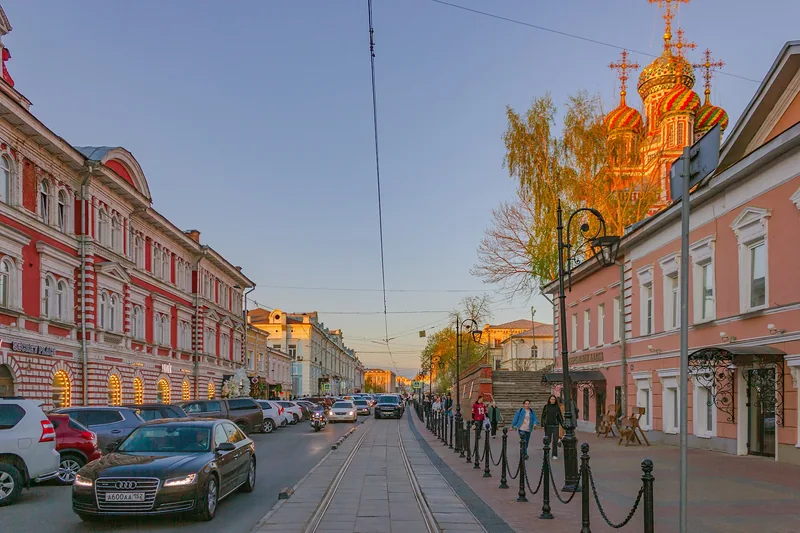
Down by the Volga runs Rozhdestvenskaya Street, once known as Zaryadye, a narrow lane by the market rows that grew into a formal city street. It takes its name from the stone Church of the Nativity built in 1653 by the merchant Semyon Zadorin. Its best-known landmark is the Stroganov Church, raised in 1719 by Grigory Stroganov. Altogether the street has 35 buildings officially recognised as architectural monuments.
In the early nineteenth century only stone construction was allowed here, to protect the street from fires. The nearby fair drew wealthy merchants, and along Rozhdestvenskaya rose hotels, apartment houses and banks with elaborate facades. For the All-Russian Industrial and Art Exhibition of 1896 the street received electric lighting, paved pavements and a tram. Since its 2012 reconstruction it is pleasant to walk slowly here, studying the plasterwork and the signboards.
The Strelka: where the rivers meet
The Strelka is the cape at the confluence of the Oka and the Volga and one of the city's main natural landmarks. Its fate was decided by the fair: a market that had grown up in the sixteenth century near the Makaryev Monastery was moved to Nizhny after a fire in 1816. Hotels and trading pavilions were built here, and the fair became one of the largest in the country, bringing Siberian furs, Swedish weapons, Indian pearls and Chinese porcelain.
For years the city's largest river port worked on the Strelka; ahead of the 2018 FIFA World Cup the cargo port was moved away and the cape began turning into a public space with a stadium and a park. Above it all rises the Alexander Nevsky Cathedral, built in the second half of the 19th century for the merchants of the fair. The Strelka is best seen from above, from the kremlin hill: from here you can watch the Oka give its waters to the Volga right at the foot of the city.
Sources & context
- Culture.RF — Nizhny Novgorod: 800 years of history
- Nizhny Novgorod Museum-Reserve — Rukavishnikov Estate
- Wikipedia — Chkalov Stairs (Russian)
- Wikipedia — Upper Volga Embankment (Russian)
- Wikipedia — Rozhdestvenskaya Street, Nizhny Novgorod (Russian)
A russia.direct editorial selection based on open sources. Checked 5 October 2026. Practical suggestions are a decision guide, not a promise of outcomes.
Editorial principles