The fountains of Peterhof: three hundred years without a single pump
How water from the Ropsha heights travels through canals, ponds and pipes to rise on its own in the jets of the Grand Cascade and Samson.
Cultural feature · checked 5 October 2026 · 5 min read
Published 5 October 2026
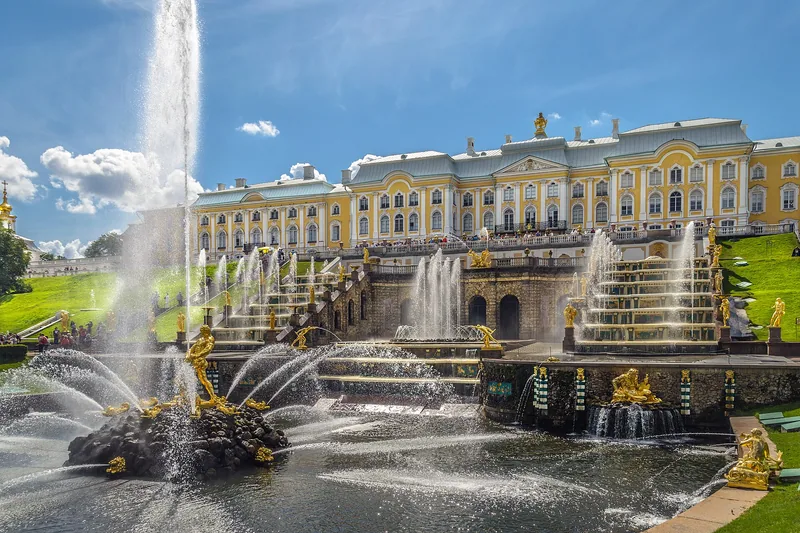

In the morning the Lower Park at Peterhof is quiet, but once the valves are opened the Grand Cascade comes alive: water runs down the steps, flashes on the gilded statues, and a tall jet rises from the lion's jaws at Samson's feet. It seems as if powerful machinery must lie behind the spectacle. In fact there is not a single pump at Peterhof: the fountains are fed by water that flows down by itself from high ground tens of kilometres from the shore of the Gulf of Finland.
The principle was laid down under Peter the Great, and it has barely changed since 1721. Water gathers in springs and streams near Ropsha, travels along canals, settles in ponds and then descends through pipes into the park, where the difference in height forces it upward into the air. The Peterhof fountains are at once a work of art and a large hydraulic system that visitors to the palaces and parks rarely stop to think about.
Water from the Ropsha heights
According to the Peterhof State Museum Reserve, the idea of the water conduit came from Peter the Great himself. The tsar was looking for a source that could supply fountains without machines and found it on the Ropsha heights, at the edge of the Izhora Upland. According to the museum, the difference in height between them and Peterhof exceeds 100 metres. The works were entrusted to the engineer Vasily Tuvolkov, who laid out the route so that as little digging as possible was needed.
As the museum describes it, the builders dug about 22 kilometres of canal, roughly 6 metres wide and more than 2 metres deep. On 8 August 1721 by the Old Style calendar (19 August by the New Style), Peter and Catherine set the system running by letting water into the canal near Ropsha. The museum dates the history of the fountain conduit from that day and marked its tercentenary in 2021: in all that time the system has never been given pumps.
Ponds, canals and pipes
The fountains work on the principle of communicating vessels: water stored higher up seeks to level out and rises in jets further down the slope. According to the museum, the system today includes 18 ponds, 12 canals and 10 large streams, and the main supply canals total about 56 kilometres in length; the page of the Museum of Fountain Craft gives other figures, 96 kilometres of canals and 135 hydraulic structures.
The last storage ponds before the Lower Park are in the Upper Garden. Its ponds held a reserve of water for the fountains, and fish were bred in them too. From there the water goes underground: about 14 kilometres of pipes run beneath the Lower Park. The Museum of Fountain Craft keeps fragments of eighteenth-century wooden and cast-iron pipes. According to the museum, the whole system uses about 1,100–1,200 litres of water per second.
The Grand Cascade
Peterhof's principal fountain structure was built between 1714 and 1724. The architects who worked on it were J. Braunstein, J.-B. Le Blond, N. Michetti and M. G. Zemtsov, while the hydraulic work was led by P. Sualem, V. Tuvolkov and the Barattini brothers. The cascade's fountains were ceremonially set running in August 1723. The cascade lies at the foot of the Great Palace and, together with it, forms the centre of the whole ensemble.
The composition consists of two seven-step staircases, between which a central three-step cascade descends beneath the arches of the Grand Grotto. The water falls into a semicircular basin from which the Sea Channel leads to the gulf. The decoration includes some 225 sculptures in bronze, lead and marble, among them 37 gilded bronze statues, 16 vases and 29 bas-reliefs. The cascade is one of the fountain works created in Peter's own time, along with the Bowls, the Sheaf, Adam and the Pyramid.
Samson and the fountain masters
In the centre of the basin stands the Samson Fountain, which appeared in 1735 under Empress Anna Ioannovna; the first sculpture was made by B. K. Rastrelli. The figure of the strongman tearing open a lion's jaws sends up a jet about 20 metres high, the tallest at Peterhof. In 1802 the statue was replaced by a work of M. I. Kozlovsky. The sculpture was lost during the war, and in 1947 V. L. Simonov and N. V. Mikhailov recreated it from old photographs and images.
Fountain masters have looked after the system since Peter's time; the first of them were the Italians Giovanni and Giuliano Barattini. According to the museum, the restoration of the entire fountain complex after the war continued until 2000. In 1990 Peterhof became part of the UNESCO World Heritage Site "Historic Centre of Saint Petersburg and Related Groups of Monuments" as one of the imperial suburban residences.
Sources & context
- Peterhof State Museum Reserve — Fountains 300
- Peterhof State Museum Reserve — Museum of Fountain Craft
- Peterhof State Museum Reserve — The Grand Cascade
- Peterhof State Museum Reserve — The Samson Fountain
- UNESCO — Historic Centre of Saint Petersburg and Related Groups of Monuments
A russia.direct editorial selection based on open sources. Checked 5 October 2026. Practical suggestions are a decision guide, not a promise of outcomes.
Editorial principles