Pulkovo: how astronomers measure the sky
Star catalogues, glass photographic plates and public tours introduce the observatory as a place of sustained scientific observation.
Science and culture guide · checked 24 September 2026 · 3 min read
Published 24 September 2026
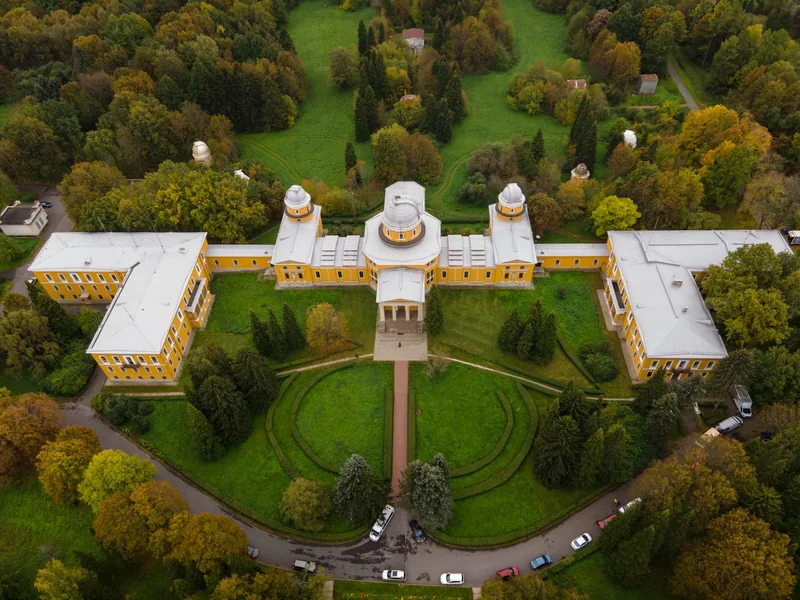

Where exactly is a star, and how does its position change? Answering requires precision, repeated observations and reliable records. The history of astronomy therefore includes catalogues, notebooks and images that can be compared years later alongside the story of large telescopes.
Pulkovo Observatory offers a way to explore this relationship between observation and memory. Its history, instruments and online photographic-plate database provide several starting points, from examining the architecture to discovering how a scientific archive is organised.
An observatory and its star catalogues
The observatory opened on 7 August in the Julian calendar, or 19 August in the Gregorian calendar, in 1839. Alexander Bryullov designed the architecture, and Wilhelm Struve became its first director. Pulkovo’s official history gives particular attention to its precise star catalogues.
Think of a catalogue as a system of coordinated records. To compare observations, we need to know what was measured, when and within which reference system. Even without doing calculations, this makes a useful museum question: how do many separate observations become a shared tool for other researchers?
Photography as a measuring instrument
The astrometry laboratory’s history explains how photography helped determine celestial positions, proper motions and parallaxes. A normal astrograph, an instrument for photographing the sky, was installed at Pulkovo in 1893. Sergei Kostinsky’s systematic observations formed the foundation of its glass-plate collection.
A recorded observation can be revisited. Comparing images from different dates makes changes available for study, while the characteristics of the instrument and image must be considered. Visitors can separate three questions: what appears in a picture, which quantity can be measured from it, and how the accuracy of the result is checked.
A first look at the plate archive
The public Pulkovo Photographic Plate Database interface provides searches by plate number, instrument, sky area, object and year range. Its instruments include the normal astrograph and the 26-inch refractor. This is a catalogue of observations; the existence of a record does not establish that every plate is available as a digitised image.
Begin with the field names. They reveal what makes an archive usable: an image needs a date, an identified subject and a connection to its instrument. If you find a record of interest, save its identifier and your search parameters so that you can return to the same material.
Preparing for a visit
The official visitor website offers museum and themed programmes. Some include observations, whose feasibility depends on clear skies and the objects available at the time. Choose by content: learning about historic instruments and hoping to observe a particular planet involve different expectations.
Before booking, confirm the schedule, age guidance, route accessibility and tour language. International visitors should arrange a suitable language format in advance. Bring one question that really interests you, such as how an old plate can be compared with a new observation. A conversation like that connects the domes with the everyday work of researchers.
Sources & context
- Pulkovo Observatory — official history
- Pulkovo Observatory — the normal astrograph
- Pulkovo astrometry laboratory — photographic observation history
- Pulkovo Photographic Plate Database — catalogue search
- Pulkovo Observatory — visitor programmes and observation conditions
A russia.direct editorial selection based on open sources. Checked 24 September 2026. Practical suggestions are a decision guide, not a promise of outcomes.
Editorial principles