RATAN-600: a ring of 895 mirrors listening to the sky
How hundreds of movable panels in the Bolshoi Zelenchuk valley work as one giant antenna, and what it hears, from the Sun to distant quasars.
Cultural feature · checked 5 October 2026 · 5 min read
Published 5 October 2026
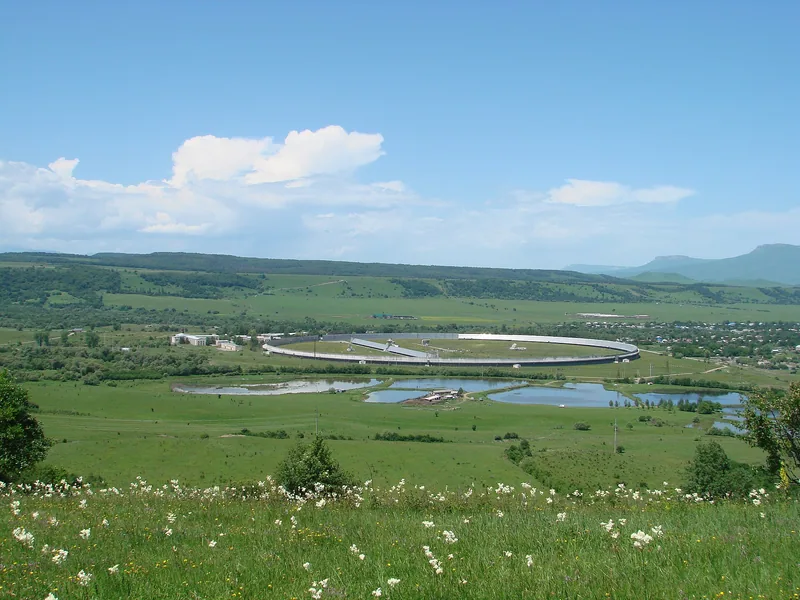

Seen from above, RATAN-600 looks like a giant compass mark on the plain near the village of Zelenchukskaya: a perfect ring 576 metres across, made of 895 tall metal panels. Inside the ring, small cabins travel on rails, and nearby stretches the long flat wall of another reflector. There is no dome and no tube. This is a radio telescope, and its main mirror is the ring itself, which can change its shape for every observation.
The telescope belongs to the Special Astrophysical Observatory of the Russian Academy of Sciences, founded in 1966. Its other famous instrument, the BTA optical telescope with a six-metre mirror, stands in the mountains about twenty kilometres away, at around 2,070 metres. RATAN-600 lies lower, at roughly 970 metres, in the valley of the Bolshoi Zelenchuk river. While the BTA gathers the visible light of stars, the ring in the valley catches radio waves, invisible to the eye but just as rich in information.
A variable-profile antenna
The idea of a variable-profile antenna for radio astronomy was put forward by Semyon Khaikin and Naum Kaidanovsky. Instead of building one huge fixed mirror, it is assembled from many separate elements, each of which can be precisely tilted and shifted. The same panels can then be used to "sculpt" the reflecting surface needed for a particular patch of sky each time. This flexibility made it possible to build an enormous instrument without a single giant dish that would have to be turned as a whole.
The project was developed by the Main Astronomical Observatory of the USSR Academy of Sciences at Pulkovo and approved on 18 August 1965. Construction began in the summer of 1968, the first sector of the ring was finished in 1973, and on 12 July 1974 the telescope received its first signal, from the radio source PKS 0521-36 at a wavelength of 3.9 centimetres. Regular observations began in 1975, and construction of the whole complex was completed in December 1976.
How a ring becomes one antenna
Each of the 895 elements is an elongated panel, about 2 by 11.5 metres according to the observatory, that can move with three degrees of freedom. Before an observation the panels are set so that together they reflect the radio waves from a source to a single point. There they meet a secondary mirror mounted in a feed cabin. The cabins run on rail tracks that spread from the centre in twelve directions, 30 degrees apart, and this is how the azimuth of an observation is chosen.
The ring is divided into four sectors, north, south, west and east, and each can work on its own, so independent observations of different parts of the sky can run at the same time. The total area of the reflector is about 12,000 square metres. Since 1985 a cabin with a conical mirror has collected radiation from the whole ring at once when observing near the zenith. And in "periscope" mode the flat reflector directs radio waves onto the southern sector of the ring.
A sky that drifts past
RATAN-600 works mainly as a transit instrument: the antenna is set to the required height above the horizon, and the source passes through its beam by itself as the Earth rotates. This avoids having to move the huge structure, and observations can be made in different bands: according to the observatory, from roughly 1 to 31 centimetres. The telescope's resolution in one direction is very high, which makes it well suited to studying the fine structure of bright sources.
Its research topics include the Sun and planets, distant radio galaxies and quasars, and the cosmic microwave background. The Guinness Book of Records lists RATAN-600 as the world's largest radio telescope with a reflecting mirror. It has also taken part in the search for artificial signals from space: in 2015 a signal at 2.7 centimetres from the direction of the star HD 164595 drew attention, but it was later judged most likely to be terrestrial interference.
A daily portrait of the Sun
One of its longest-running fields of work is radio observation of the Sun. Since May 1997 the observatory has published the results of daily observations: they take place at around 9:00 Universal Time and cover wavelengths from roughly 1.67 to 32 centimetres. The signal is recorded in two circular polarisations at once, which helps scientists study magnetic fields in the solar atmosphere, especially above active regions where flares are born.
So every day the ring in a quiet mountain valley takes a kind of radio portrait of our star, and at other hours it turns to distant galaxies. If you are in Karachay-Cherkessia, it is worth remembering that RATAN-600 and the BTA are two very different ways of looking at the same sky, both gathered in one observatory. It is best to check visiting arrangements in advance on the official website of the Special Astrophysical Observatory.
Sources & context
- SAO RAS — Antenna RATAN-600 and techniques of observations
- SAO RAS — RATAN-600 Solar Receiver Complex
- Wikipedia (RU) — RATAN-600
- Wikipedia — RATAN-600
- Wikipedia — Special Astrophysical Observatory of the Russian Academy of Science
A russia.direct editorial selection based on open sources. Checked 5 October 2026. Practical suggestions are a decision guide, not a promise of outcomes.
Editorial principles