Sagaalgan: Buryatia's White Month and its white food
How Buryatia welcomes the lunar New Year: a purification rite, a night of waiting for the guardian goddess, dairy dishes and prayers in the datsans.
Cultural feature · checked 5 October 2026 · 5 min read
Published 5 October 2026
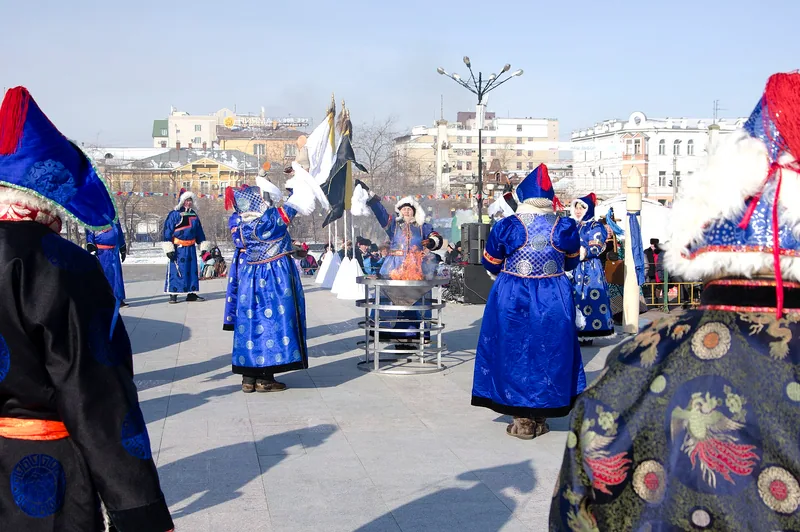

At the end of winter, while real spring in Transbaikalia is still a long way off, Buryatia celebrates Sagaalgan, the New Year of the lunar calendar. The name means 'White Month', and white is the key colour: it stands for purity of intention, renewal and a good beginning. The festival falls on the first day of the first lunar month, so its date shifts every year with the lunar calendar and has to be set anew.
Sagaalgan is not celebrated by Buryats alone: among Mongols the same festival is called Tsagaan Sar, and the White Month is also marked in Tuva. In Buryatia it is one of the most loved and honoured holidays, bringing together Buddhist rites and older folk customs. People welcome it at home and in the datsans, at city venues and in museums, and, as Vokrug Sveta magazine observes, it is now celebrated by people of Transbaikalia of many ethnic backgrounds and faiths.
From an autumn feast to the White Month
Mongols and Buryats once greeted the new year in autumn, in September, during the seasonal migrations. Around the thirteenth century the festival moved to the end of winter and came to be marked by the lunar calendar. Different explanations have been offered: the orientalist Dorji Banzarov linked the change to the spread of Buddhism, while another version holds that Khubilai Khan introduced the lunar calendar to bring order to timekeeping across his vast realm.
Marco Polo wrote about the festival too: according to him, the Mongol new year began in February and was called the White Feast. Ever since, Sagaalgan has been tied to the lunar calendar and its twelve-year cycle, in which each year corresponds to an animal and an element. The Year of the White Metal Mouse in 2020, for example, opened a new twelve-year cycle. The festival is not limited to a single day: the whole first lunar month is called the White Month.
Purification before the new year
The new year is meant to be met clean, both the home and the person. Beforehand, families clean the house thoroughly, discard old things and try to put both body and mind in order. On the 29th lunar day comes the Dugzhuuba rite: people rub themselves with pieces of dough, mould figures from it and take them to a ritual pyramid called the sor. Lamas chant prayers to drums, cymbals and horns, and then the sor is burned along with the misfortunes of the past year.
The last day of the old year is called Bituun, the 'closed' or 'empty' day. It is spent at home, with family and in prayer; on this day people avoid setting off on journeys, quarrelling and drinking alcohol. In the evening the old year is seen out with dairy food and buuzy. There is also a custom of staying awake through the night: it is believed that before dawn the guardian goddess Palden Lhamo rides across the world counting the living, and might mistake a sleeper for the dead.
White food
The festival's main fare is white food, known in Mongolian tradition as tsagaan idee. The term covers dairy products that symbolise purity of intention: sour cream, curd cheese, cheese, dried milk skins and fermented milk drinks. White food is believed to purify and to bring well-being in the coming year, and ideally the festive table should hold nine kinds of it. Traditional dishes also include salamat, a thick milk dish, and sweet milk foam.
The first day of the White Month belongs to the family. In the morning the young greet their elders, and only then does everyone sit at the festive table. Next to the white food stand buuzy, the meat dumplings also known as pozy, boiled meat, bukhlyor broth and noodle soup. Guests are greeted with special respect: a khadak, a silk scarf, is offered on open palms, with wishes of peace and well-being. In Mongolia people greet each other by asking 'Amar baina uu?', meaning 'Are you living in peace?'
Datsans, flags and official status
During Sagaalgan, prayer services are held in Buryatia's datsans, and believers visit the temples on particular days linked to their year of birth in the lunar calendar. According to descriptions, fresh ice is left by the door of the house at dawn: if it has diminished, Palden Lhamo's horse has quenched its thirst and the goddess has visited. Khii morin 'wind horse' flags, representing a person's guardian spirit, are raised on high ground and at datsans, their colour chosen by year of birth.
Sagaalgan is an official holiday in Buryatia. The republic's law 'On Holidays and Memorable Dates in the Republic of Buryatia', adopted in 2017, makes the first day of the White Month a non-working day every year. Because the date depends on the lunar calendar, it is fixed each year by a decree of the head of the republic. The first day is followed by a whole month of family visits, trips and prayer services, a time of purification and renewal that people in Buryatia try to greet with good thoughts.
Sources & context
- Government of the Republic of Buryatia — 18 February 2026 declared a non-working day for Sagaalgan
- Government of the Republic of Buryatia — Sagaalgan celebrated in the Kremlin
- Vokrug Sveta — The White Month festival: how the New Year is celebrated in Transbaikalia
- Vokrug Sveta — Hanging flags and checking the ice: how Buryatia celebrates the New Year
- Wikipedia — Tsagaan Sar
A russia.direct editorial selection based on open sources. Checked 5 October 2026. Practical suggestions are a decision guide, not a promise of outcomes.
Editorial principles