Samara: a city facing the Volga
A five-kilometre embankment, wooden houses and Art Nouveau mansions in the old centre, and the Zhiguli Mountains across the water: how Samara lives by its river.
Cultural feature · checked 5 October 2026 · 5 min read
Published 5 October 2026
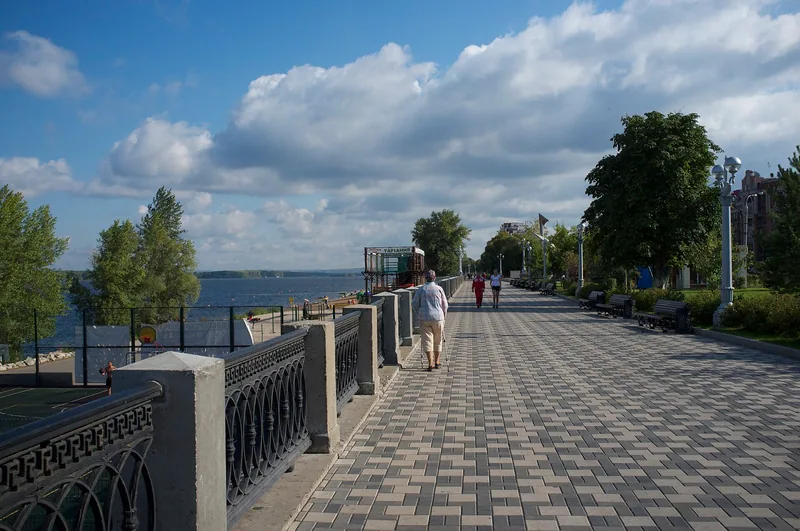

Samara grew out of a fortress built in 1586, by decree of Tsar Fyodor Ioannovich, where the Samara River flows into the Volga. The fortress guarded the state's south-eastern frontier and at the same time watched over an important trade route along the great river. The city still stands on the left bank, turned towards the water, while opposite, on the right bank, rise the Zhiguli Mountains.
The main reason to come here is the Volga itself and the way the city faces it. People walk and cycle along the embankment, watch the water from summer cafes and, in the warm season, go down to the city beaches. A few blocks from the shore the old centre begins, with its wooden houses and merchant mansions. And across the river the ridge of the Zhiguli fills the horizon all day.
Five kilometres along the river
The Samara embankment runs along the left bank of the Volga for about five kilometres, from Lesnaya Street to the river port. It was built in stages to a design by the architect Mikhail Trufanov. Work on the first stage, about 1,350 metres long, began in 1940; it stopped during the war and was completed in 1954. The second stage, about 1,400 metres, followed in 1958–1961 and was given reinforced concrete retaining walls.
The third stage carried the embankment on to the river station and was reconstructed in 2012, while the fourth, the Oktyabrskaya embankment, steps down to the water in terraces. The embankment was faced with Ural granite, and summer cafes with river views line its edge. During the 2011 reconstruction new street lights and cycle paths were added. The first city beach on this shore was laid out as early as 1939.
The Ladya and the voivode
One of Samara's most recognisable symbols is the Ladya (Boat) monument, unveiled in 1986 when the city celebrated its 400th anniversary. The monument's very name is a reminder that the city lived by the river and river trade from the very start. People tend to linger beside it: the spot is ideal for taking in the full width of the Volga and looking at the mountains on the opposite bank.
Another monument on the embankment looks back to the very beginning of the city's story. In 2014 a monument to the voivode Grigory Zasekin was unveiled here, a figure from the days when Samara was a frontier fortress. So a single walk brings several eras together: the fortress past, the anniversary 1980s and the present day with its cyclists, cafes and beaches. The embankment remains the city's main public stage, for residents and visitors alike.
A merchant city: timber and Art Nouveau
In the nineteenth century Samara grew rich quickly: in 1851 it became a provincial capital, and its favourable position on the river made it a major centre of the grain trade. Merchants built houses and mansions, and the old town still keeps wooden buildings with rich carved decoration. According to open sources the city has more than two thousand heritage sites, although some old quarters have been lost in recent decades.
Samara is especially proud of its Art Nouveau. The first building here in this style is thought to be the mansion of Alexander and Alexandra Kurlin, well-known patrons. Its facade has blue glazed tiles and green ceramic inserts, wrought-iron railings with butterflies and dragonflies, and an elegant woman's head portraying the lady of the house. It now houses the Museum of Art Nouveau, a branch of the Alabin Regional Museum, which calls it Russia's only museum devoted to the aesthetics of the turn of the twentieth century.
The Zhiguli across the river
The mountains you see from the embankment are the Zhiguli. They lie on the right bank of the Volga, inside the Samara Bend, a huge loop of the river. The range stretches for about 60 kilometres and is up to 32 kilometres wide, and its highest point, Mount Nablyudatel, rises to 381.2 metres. The northern slopes drop steeply to the Volga, while in the south the mountains descend gently into a plateau cut by narrow valleys.
The summits are made of limestone and dolomite laid down 230–350 million years ago, in the Carboniferous and Permian periods. What makes the Zhiguli special is that they are the only tectonically active mountains in European Russia: their uplift began around 7 million years ago. For Samara's residents they are a familiar horizon, and for visitors a reason not only to walk the embankment but also to cross to the other bank and the slopes themselves.
Sources & context
- Alabin Samara Regional Museum of History and Local Lore
- Tonkosti — Kurlina Mansion
- Wikipedia — Samara
- Wikipedia — Samara embankment
- Wikipedia — Zhiguli Mountains
A russia.direct editorial selection based on open sources. Checked 5 October 2026. Practical suggestions are a decision guide, not a promise of outcomes.
Editorial principles