Shchi: the cabbage soup that fed all of Russia
How fresh and sour, day-long and green shchi remained the main hot dish of the Russian table for more than a thousand years, from peasant huts to wealthy houses.
Cultural feature · checked 30 September 2026 · 5 min read
Published 30 September 2026
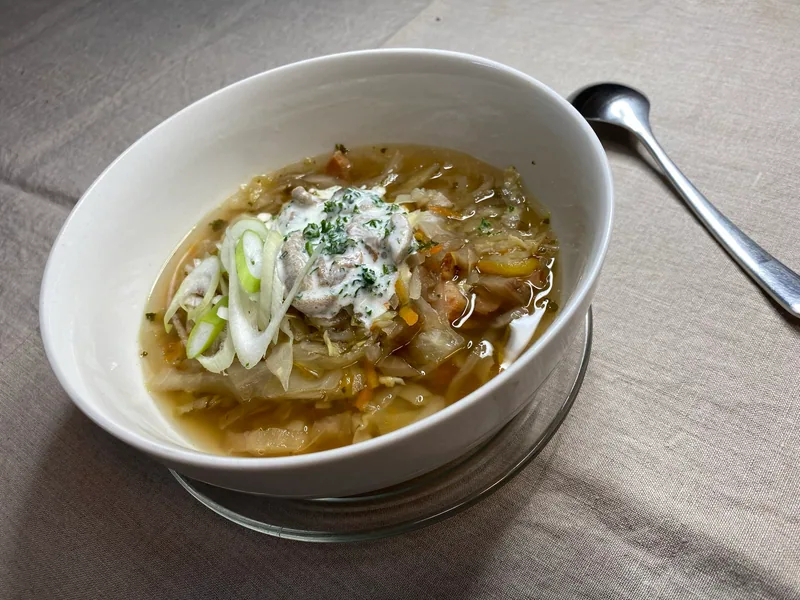

Some dishes are for feast days; others carry everyday life. Shchi belongs to the second kind. The culinary historian William Pokhlebkin called it the main hot liquid dish of the Russian table for more than a thousand years, and the saying "Shchi da kasha — pishcha nasha" ("shchi and porridge are our food") has long been almost a formula for Russian eating. People of every class ate shchi daily; the difference lay only in what went into the pot. Well-off homes cooked rich shchi with meat and mushrooms, poor ones an "empty" version of cabbage and onion.
The hallmark of shchi is its sourness. It came from sauerkraut or cabbage brine, sorrel, stewed Antonovka apples, salted mushrooms or, in fresh-cabbage shchi, sour cream, and sometimes several sour elements were combined. By Pokhlebkin's count there are 24 kinds of shchi, from entirely meatless to rich. They are served with dark rye bread and sour cream, and in that simple pairing you can sense a whole peasant cuisine grown out of the kitchen garden, the cellar and the stove.
A filling word
The word shchi has no universally accepted etymology. According to Max Vasmer's dictionary it goes back to Old Russian sŭto, "food, sustenance", so it literally means something filling. Other scholars link it to sŭchi, "juices, liquid", and see a kinship with the Russian words for juice and sorrel. The sixteenth-century household manual Domostroy spells the dish "shti", and originally the name seems to have meant any hearty dish with greens rather than cabbage soup alone.
Cabbage itself reached Rus from Byzantium, and cabbage soups have been known there since the ninth century, when peasants began to grow it. The vegetable thrived and kept well in the harsh climate, so it quickly became the basis of the everyday table. Early shchi contained cabbage, meat, mushrooms, flour, onion and garlic. Black pepper and bay leaf, which began to be imported around the fifteenth century, as well as carrot and parsley, were added later.
Fresh and sour
Shchi was made from both fresh cabbage and sauerkraut, and these are two soups of different character. Sour shchi made with sauerkraut was a dish of the long winter: cabbage put up in autumn provided both the base and the essential tang. Rich shchi with veal and cabbage, fresh or fermented, was cooked from autumn to early winter. On fast days meat was replaced with fish or mushrooms, or left out altogether. In Russia beef was the most common meat for shchi.
Pokhlebkin identified six components of a complete shchi: cabbage or the greens that replace it; meat (sometimes fish or mushrooms); roots such as carrot and parsley; aromatic additions such as onion, garlic, dill, pepper and bay leaf; a sour element; and the liquid base. This scheme explains why shchi adapted so easily to the season, to fasting and to a family's means: the contents changed, but the recognisable taste and sourness remained.
Day-long shchi and the Russian stove
Traditionally shchi was not so much boiled as slowly braised: a clay, later cast-iron, pot went into the Russian masonry stove, where even, gentle heat lasted for hours. The pot was put in early in the morning; by the time it came out the meat had fallen off the bone on its own, and the housewife had been free for other work. Long, slow cooking made everything tender and the flavour whole. After cooking, shchi was left to stand under a lid, which was thought only to improve it.
Hence sutochnye, or day-long, shchi: made with sauerkraut and prepared in advance, 12 to 24 hours before serving. Pokhlebkin noted that in that time they infuse and become noticeably tastier. Shchi could also be frozen: in winter it was taken on journeys as a solid block, and as much as needed was chopped off. In the nineteenth century, according to the magazine Vokrug Sveta, frozen stewed vegetables were carried along and combined with hot broth at taverns.
Green shchi and changing times
In spring, when winter stores of cabbage ran out, green shchi came to the table. It was cooked from the second half of April with nettle, sorrel, ground elder, spinach and other young greens, with sorrel providing the sourness. Nettle shchi with egg, beef and lard is already described in Sergei Drukovtsov's cookbook of 1779, and in P. Aleksandrova-Ignatieva's manual, published in 1909, nettle was combined with sorrel and the soup was served with hard-boiled egg and sour cream.
Everyday shchi changed too. In the nineteenth century, under the influence of French cooks, the old flour thickening began to be dropped and the broth made clearer. In the late nineteenth century potatoes and tomatoes appeared in shchi, and potatoes gradually replaced the flour thickening. Among the variants there is also "lazy" shchi, with coarsely cut cabbage and sour cream. Yet the essentials stayed the same: cabbage or greens, sourness, sour cream and a slice of rye bread beside the bowl.
Sources & context
- Wikipedia (Russian) — Shchi
- Wikipedia — Shchi
- William Pokhlebkin, National Cuisines of Our Peoples — Shchi
- Vokrug Sveta — A hearty dish with greens: the history of shchi
- Vokrug Sveta — Green shchi: historical recipes
A russia.direct editorial selection based on open sources. Checked 30 September 2026. Practical suggestions are a decision guide, not a promise of outcomes.
Editorial principles