Peak Terskol Observatory: a telescope on the slopes of Elbrus
How an observatory with the two-metre Zeiss-2000 telescope came to stand at about 3,100 metres in the Elbrus area, and what it studies today.
Cultural feature · checked 5 October 2026 · 5 min read
Published 5 October 2026
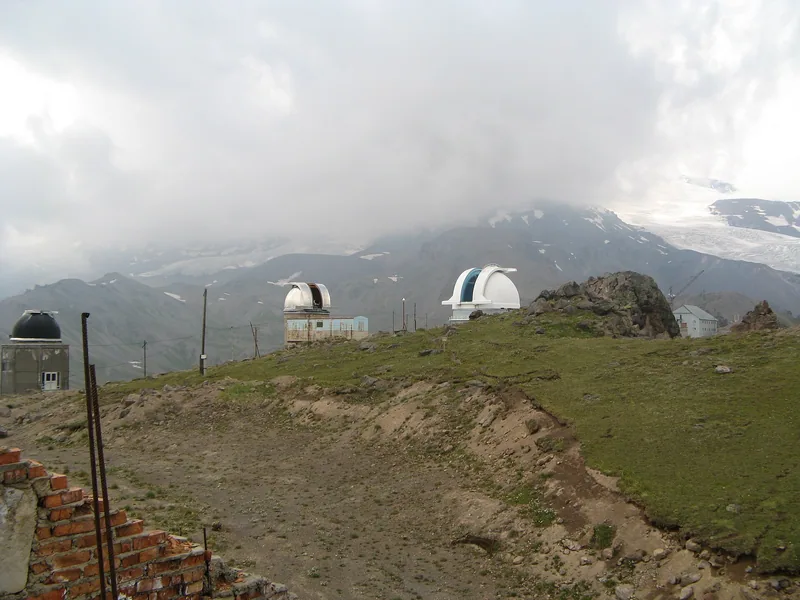

In the Elbrus area, on Peak Terskol, at about 3,100 metres above sea level, stand the domes of an observatory. The Baksan valley and its villages lie below, and the slopes of Elbrus rise close by. The higher a telescope stands, the less dense, moist air there is above it to blur and dim the light of the stars. That is why astronomers have long headed for the mountains, and the Terskol site was chosen precisely for the clear, steady sky above the slopes of Elbrus.
The observatory's main instrument is the Zeiss-2000 telescope with a two-metre mirror, made by Carl Zeiss Jena. Over the decades a whole research programme has grown up around it, from stellar spectra and the flashes of distant gamma-ray bursts to small fragments in geostationary orbit. The observatory's history is far from simple: it was built, completed and passed between different scientific organisations, and the road from the first expeditions to regular observations stretched over several decades.
Finding a place in the mountains
According to an account of the observatory's history published in 2001, a site for a high-altitude station was sought during expeditions in the 1950s and 1960s, and Peak Terskol proved one of the best options. The observatory was built by the Main Astronomical Observatory of the Academy of Sciences of the Ukrainian SSR in Kyiv: according to the Main Astronomical Observatory itself, work went on from 1970 to 1991, and Terskol was conceived as its high-altitude observing station.
Construction took place in difficult mountain conditions, and small instruments appeared on the summit first. According to the same account, five small telescopes were already working there before the main telescope arrived, used for astrophysical observations and for studying the astroclimate, that is, how clear, steady and transparent the sky above the site is. Such measurements are needed to judge whether a site justifies installing a large and costly instrument.
The long road of the two-metre telescope
The dome for the large telescope was assembled in 1986–1988, and in 1988 the instrument itself was delivered to Peak Terskol via the seaport of Novorossiysk. In 1990, however, installation came to a halt. According to the Main Astronomical Observatory of the National Academy of Sciences of Ukraine, from 1992 the observatory became part of the International Centre for Astronomical, Medical and Ecological Research, set up by the National Academy of Sciences of Ukraine, the Russian Academy of Sciences and the Government of Kabardino-Balkaria.
Installation resumed in 1994 and was completed in 1995, and from 1996, according to the 2001 account, intensive observations began on the two-metre telescope. According to the Main Astronomical Observatory, the instrument is a Ritchey–Chrétien design with a coudé focus. In its list of the observatory's instruments, the Main Astronomical Observatory also names a 60-centimetre reflector and solar telescopes, including the ATsU-26 horizontal telescope. In this way a small fleet of telescopes for different tasks grew up around the main instrument.
What the Zeiss-2000 sees
Today, according to the Institute of Astronomy of the Russian Academy of Sciences, the observatory operates as its Terskol Branch. The institute's website says that the Zeiss-2000, with fast, precise drives and sensitive radiation detectors, can record objects fainter than magnitude 23 with a positional error of no more than half an arcsecond. Staff of the branch have discovered new small bodies of the Solar System and monitor variable stars and gamma-ray bursts.
The research topics are very varied: high and ultra-high resolution stellar spectroscopy, the interstellar medium, stellar variability and asteroseismology, galactic nuclei and star formation, exoplanetary systems, solar physics and the asteroid and comet hazard. According to the institute, the international programme "Astronomy in the Elbrus Region, 2010–2014" comprised 42 projects and involved 38 scientific organisations from Russia and other countries. The high mountain site has proved useful for a wide range of tasks.
Watching the geostationary orbit
One applied line of work is observing space debris. According to a presentation by Institute of Astronomy researchers, regular CCD observations of small objects in geostationary orbit began at Terskol and Zvenigorod in 2006. In 2009 the Zeiss-2000 received a new camera, and between June and October of that year alone about 13,000 positions of 80 small objects were measured, 17 of which turned out to be previously unknown.
The observatory continues to be upgraded. In 2025 the journal Astrophysical Bulletin described tests on the Zeiss-2000 of a laser guide star system, a step towards adaptive optics that corrects distortions caused by atmospheric turbulence; the authors estimate that such a system could improve image quality by roughly an order of magnitude. So a telescope whose installation stretched over years keeps taking up new ways of observing the sky above Elbrus.
Sources & context
- Main Astronomical Observatory of NASU — Instruments (Peak Terskol)
- Institute of Astronomy RAS — Terskol Branch
- Dzerkalo Tyzhnia — "Only the stars are higher" (2001)
- INASAN presentation — space debris observations at Terskol (PDF)
- Astrophysical Bulletin (SAO RAS), 2025, vol. 80, no. 2 — laser guide star on the Zeiss-2000
A russia.direct editorial selection based on open sources. Checked 5 October 2026. Practical suggestions are a decision guide, not a promise of outcomes.
Editorial principles