Tula printed gingerbread: the board, the filling and three centuries
How a carved board turns dough into a picture, what fills a Tula gingerbread, and what the Tula Gingerbread Museum keeps.
Cultural feature · checked 30 September 2026 · 4 min read
Published 30 September 2026
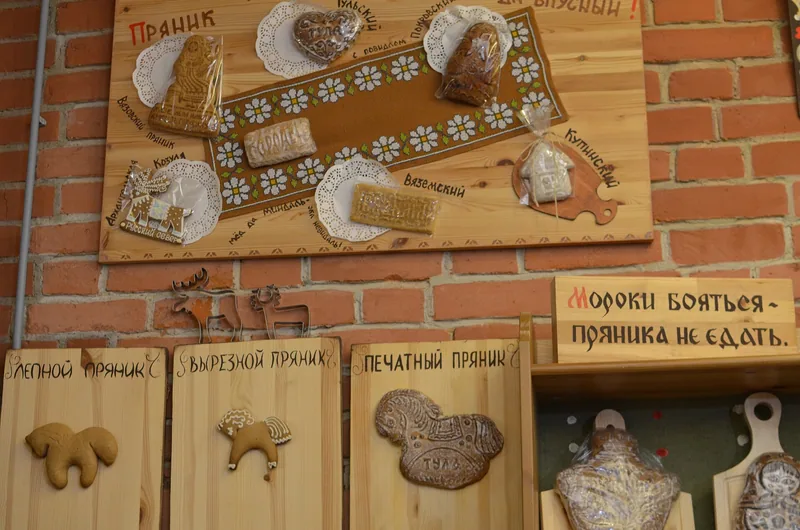

A Tula gingerbread is easy to recognise: a dense rectangular slab or flat figure, a glazed surface and a raised inscription or pattern on top. Behind that simple shape lie several centuries of craft and a special tool, the carved gingerbread board, without which there is no printed gingerbread at all. The board sets the shape, the design and the lettering at once, so the imprint could tell a baker whose carving it was and a buyer where the gingerbread came from.
Gingerbread has been known in Tula since the seventeenth century, and researchers found the first written mention of Tula gingerbread in a cadastral book of 1685. Since then it has become one of the city's best-known symbols, alongside the samovar, and has earned a museum of its own. The museum treats gingerbread not only as a treat but as a historical object through which the country's history can be read.
A picture in mirror image
Printed gingerbread takes its look from a wooden mould. Boards were made from hard woods such as birch, lime, walnut, maple and pear. The carver transferred the design onto the board in mirror image, so that once pressed, the lettering and patterns on the gingerbread would read the right way round. The work demanded precision: any mistake in the mirror carving would show on every gingerbread pressed from that mould.
The dough was pressed firmly against the carved surface and the relief passed onto the cake. Old boards show birds, fish, flowers, and geometric and plant ornament. Gingerbreads with elaborate relief were often cut into slices and shared among guests, which is how people remembered them at festive tables. The carving on such boards was fine and recessed, and old moulds are valued today as works of folk art.
What is inside the slab
A classic Tula gingerbread has a filling. Over the years it has been made with cherry, blackcurrant, raspberry or plum jam, while fruit butter and condensed milk are common today. According to a mid-twentieth-century description of the method, the dough was made with top-grade flour, butter and natural honey. The choice of filling largely sets the character of a gingerbread, and most buyers soon find a favourite.
The top is coated with glaze, which protects the gingerbread and sharpens the design. Sizes vary widely, from small slabs to have with tea to gift gingerbreads weighing about a kilogram, large enough to carry whole scenes and greetings. Such gingerbread travels well and makes an easy gift, which is why it is so often bought as a keepsake of Tula.
A craft reborn
In the twentieth century gingerbread making in Tula went through a break. Its revival came in the mid-1950s: according to accounts of the craft's history, bakers tracked down old recipes and restored equipment, and wooden moulds of lime wood were made at the Tula arms factory before trial production began. The story shows how much of a craft rests on the memory of people who know how to make things with their hands.
The first batches did not succeed straight away, but in time the gingerbread again became Tula's signature gift. Today several producers bake it, and since 2016 the city has held a Gingerbread Day festival that turns an old craft into a shared celebration. The festival brings together residents and visitors, and for those days gingerbread becomes a reason to talk about the city and its craftspeople.
The Tula Gingerbread Museum
The Tula Gingerbread Museum opened on 10 October 1996 and describes itself as Russia's first gingerbread museum. It occupies a wing of a house that once belonged to the Lyalin brothers, samovar makers and gunsmiths, on Oktyabrskaya Street. Its collection of almost 2,000 items includes gingerbread boards from the late nineteenth and early twentieth centuries, documents, photographs and personal belongings of Tula bakers. Over the years the museum has welcomed more than 750,000 visitors, and its old boards can be studied up close and compared across different carvers.
Besides the exhibition, the museum runs gingerbread-painting workshops and tea with fresh gingerbread; according to the museum, visits are arranged by advance booking. It is best to check opening hours and programmes on the museum's official website before you travel. Guests can also take part in gingerbread-themed quizzes and games, a good option when travelling with children.
Sources & context
- Tula Gingerbread Museum — about the museum
- Tula Gingerbread Museum — home page
- Wikipedia (RU) — Tula gingerbread
- Artefact (Culture.RF) — Gingerbread boards
- Virtual Russian Museum — Gingerbread board
A russia.direct editorial selection based on open sources. Checked 30 September 2026. Practical suggestions are a decision guide, not a promise of outcomes.
Editorial principles