Yakutia: the science beneath your feet
What permafrost means, and why studying it matters for homes, roads and everyday life.
Landscapes, history and everyday life · 3 min read
Published 24 September 2026
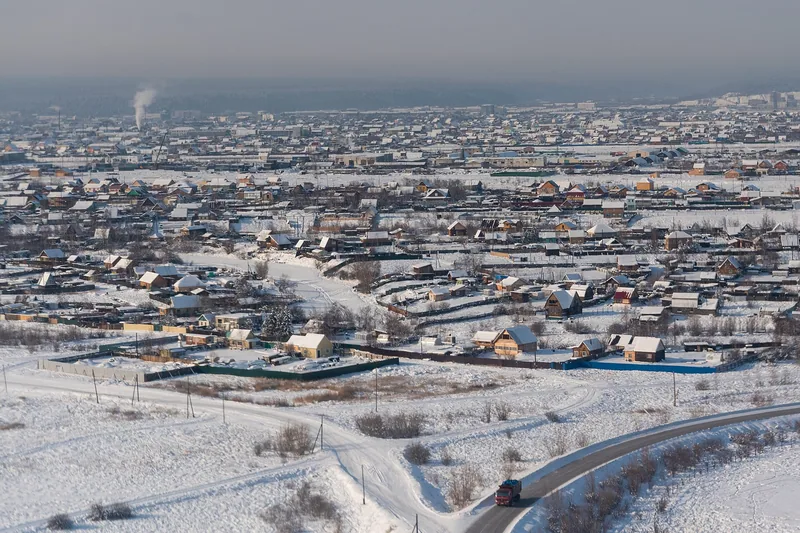

A winter view of Yakutsk draws attention to light, snow and intense cold. Yet one of the region’s most important subjects lies below the surface. Permafrost science provides a way to understand the relationship between the natural environment and life in a city.
It is also a clear example of fundamental research meeting practical problems. Ground temperature and material properties matter beyond a scientific paper: they connect with construction, the operation of infrastructure and observation of environmental change.
What permafrost actually means
NSIDC defines permafrost as ground or rock that remains at or below 0°C for at least two years. The definition concerns temperature; it does not mean that the entire layer is made of pure ice.
Seasonal freezing near the surface and permafrost are different phenomena. A photograph of a snowy street therefore cannot tell us the condition of the ground beneath a particular building. That requires measurements and local information, not simply an impression of severe winter weather.
Research based in Yakutsk
The Melnikov Permafrost Institute of the Siberian Branch of the Russian Academy of Sciences studies changes in the permafrost environment and interactions between structures and frozen ground. Its institutional description includes an underground laboratory for long experiments at natural sub-zero temperatures.
Such a laboratory makes cold an experimental condition. It is useful to distinguish observations of the environment from tests of material properties: the questions are related, but different. One describes conditions; the other helps establish how a material behaves.
Where the science meets a city
The institute’s engineering geocryology laboratory studies thermal and mechanical interactions between ground and structures. Its published account emphasises monitoring as a way to detect unfavourable processes and inform measures intended to support the stability of infrastructure.
This suggests a useful way of reading news about northern construction. Ask which observations were made, the conditions in which a solution was tested, and how the completed structure will be monitored. Clear boundaries make a technical achievement easier to understand.
Continue the exploration
The institute’s Museum of the History of Permafrost Studies introduces visitors to this field. Check the official visitor page for current access to particular facilities and the arrangements for guided visits before making plans.
For reading at home, build a small vocabulary: ground, ice, temperature, observation and deformation. Then return to the photograph of Yakutsk. It shows more than an unusual climate: it introduces a city whose everyday life is connected with the work of researchers and engineers.
Sources & context
- NSIDC — understanding permafrost
- Melnikov Permafrost Institute — research areas
- Engineering Geocryology Laboratory — research
- Permafrost Institute — museum visitor information
A russia.direct editorial selection based on open sources. Checked 24 September 2026. Practical suggestions are a decision guide, not a promise of outcomes.
Editorial principles