The Bolshoi Theatre: two and a half centuries on Theatre Square
From the privilege of 1776 to the renewed Historic Stage: how the Bolshoi grew, and how to choose a performance.
Cultural feature · checked 30 September 2026 · 5 min read
Published 30 September 2026
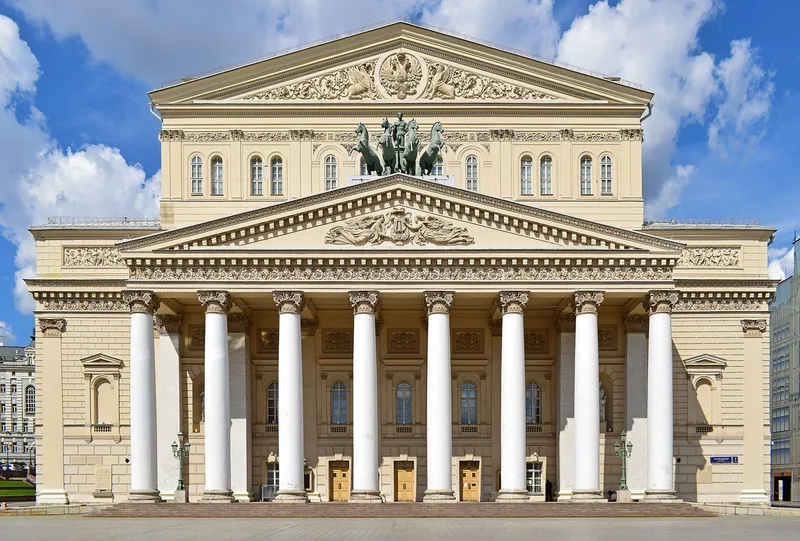

A columned portico crowned by Apollo's bronze quadriga, with the open expanse of Theatre Square in front. The Bolshoi Theatre is one of Moscow's most recognisable images and one of the world's great stages for opera and ballet. Behind its classical façade lies a history of fires, rebuildings and celebrated premieres. For many Muscovites and visitors to the capital, a first trip to the Bolshoi becomes an event remembered for a lifetime.
The theatre traces its history to 1776, which means it turns 250 in 2026. Over that time the buildings, architects and names on the posters have changed, but one thing has stayed the same: audiences come here for the special sense of occasion that an evening at the Bolshoi brings. To understand this history is to understand better both the theatre and the city that grew up around its walls.
The privilege of 1776
On 28 March 1776 Empress Catherine II signed a decree granting Prince Pyotr Urusov the privilege of being "the owner of all theatrical performances in Moscow". The prince's partner was Michael Maddox, an English engineer and theatrical entrepreneur. This day is regarded as the founding date of the Bolshoi Theatre. So Moscow gained a permanent theatre enterprise, from which the famous theatre grew over time.
Soon the Petrovsky Theatre opened: Moscow's first public theatre. Designed by Christian Rosberg, it held almost a thousand spectators and staged plays and operas. In 1805 the Petrovsky Theatre burned down, leaving the company without a home of its own for a time. Moscow was left for a long while without its main theatre venue, and the idea of a large new building became especially pressing.
The building on Theatre Square
The new building followed a competition design by Andrei Mikhailov, which the architect Joseph (Osip) Bové substantially reworked. The Bolshoi Petrovsky Theatre opened in state on 18 January 1825; according to reference works, the evening featured Fernando Sor's ballet Cendrillon. Thus a monumental theatre appeared on the square, the building whose outline we still recognise today. The premiere opened a new era in the life of the Moscow stage, and the theatre itself became the chief ornament of the renewed square.
On 11 March 1853 fire broke out in the theatre and raged for three days. Reconstruction was entrusted to the architect Alberto Cavos, and the work went quickly: the theatre reopened on 20 August 1856. Cavos replaced the former alabaster chariot of Apollo with the bronze quadriga that still crowns the portico today. Less than a year and a half after the ruins were cleared the theatre was welcoming audiences again — a remarkably short time for such a building.
The Historic and New Stages
On 29 November 2002 the New Stage went into service and took over part of the repertoire. In July 2005 the main building closed for a large-scale reconstruction, and on 28 October 2011 the Historic Stage reopened to audiences. Since the reconstruction its auditorium holds up to 1,740 people. The reconstruction lasted more than six years, and the return of the Historic Stage became one of Moscow's major cultural events.
Today the theatre has several venues: the Historic Stage, the New Stage, the Boris Pokrovsky Chamber Stage and the Beethoven Hall. These stages have seen many famous premieres — on 4 March 1877, for instance, Tchaikovsky's Swan Lake was first performed here, and the Bolshoi also premiered operas by Mussorgsky, Rachmaninoff, Rimsky-Korsakov and Shostakovich. Each venue has its own character, so an evening at the Bolshoi can turn out quite different depending on where you go.
Choosing a performance
If it is your first visit to the Bolshoi, you might start with the classics the theatre is famous for — a full-length ballet or a Russian opera on the Historic Stage, where the atmosphere of the old auditorium is felt most keenly. Those who enjoy chamber works and newer productions may want to look at the listings for the New and Chamber Stages and the Beethoven Hall. If you are in Moscow only briefly, it makes sense to check in advance what is on at the Historic Stage on your dates.
The playbill, programmes and ticketing rules are published on the theatre's official website, bolshoi.ru, and it is sensible to buy tickets only through official channels. Before the performance it helps to read the libretto and to allow time to look around the foyers and auditorium at leisure — that is part of the experience. And remember: even if tickets for the show you want are sold out, it is worth checking the official playbill from time to time.
Sources & context
A russia.direct editorial selection based on open sources. Checked 30 September 2026. Practical suggestions are a decision guide, not a promise of outcomes.
Editorial principles