Buses, trams and trolleybuses: getting around town
Route numbers, stops, validators and conductors, marshrutkas and map apps: what to know about surface transport in Russian cities.
Practical guide · checked 30 September 2026 · 5 min read
Published 30 September 2026
.jpg)
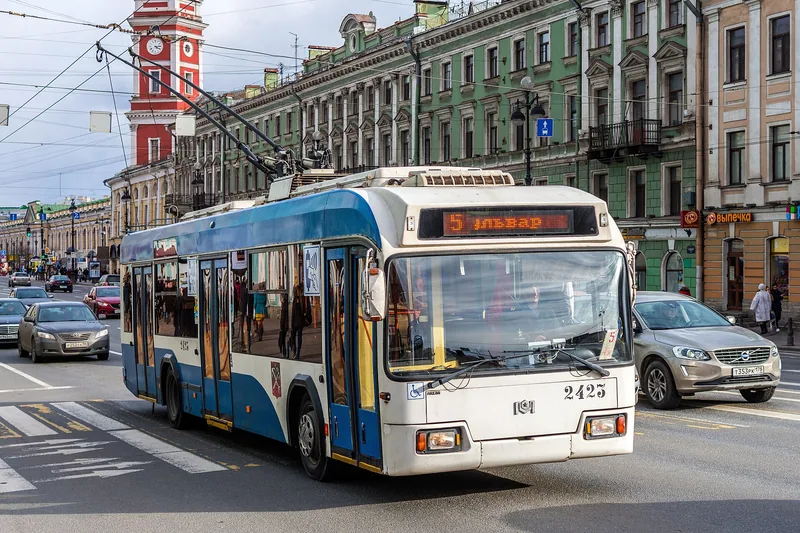
Only a handful of Russian cities have a metro, but buses, trams and trolleybuses run almost everywhere. For residents they are the main way to get to work, college or the market, and for a visitor they are a chance to see the city through a window rather than from underground. Surface transport is slower than the metro, but it stops closer to where you need to be and reaches districts the trains do not.
The general principles are similar from city to city, but the details vary: in some places you pay only at a validator, in others a conductor still walks through the vehicle, and some cities have plenty of minibus taxis on the streets. Payment methods and fares also change, so check them before your trip on the website of the local operator or city transport portal. Below are the basics that will help you get where you are going in an unfamiliar city.
What runs where
Each city has its own mix of transport. In Moscow the streets are served today by buses, electric buses and trams, while the trolleybus network, once one of the largest in the world, closed in August 2020, leaving only a museum line. In St Petersburg trolleybuses still run, and since Moscow's network closed, St Petersburg's has been the largest in Russia. Trams and trolleybuses also run in many other cities across the country.
Besides regular routes, large cities may have express routes that link outlying districts to the centre more quickly, as well as night routes. In Moscow, for example, night buses run through the small hours, and one route operates around the clock. Many cities also have marshrutkas, minibus taxis that follow a fixed route. According to Wikipedia they have largely been pushed out of Moscow and St Petersburg by regular buses, but in other cities they remain a familiar part of the transport mix.
Routes and stops
Every route has a number shown on a sign at the front and side of the vehicle, usually together with the terminal stops. In many cities buses, trams and trolleybuses are numbered separately, so the same number may mean different routes: look at the type of vehicle as well as the number. A stop usually has a sign listing the routes that call there, and sometimes a timetable.
Map apps help you plan a trip: they show which routes leave from a stop and, in a number of cities, where the vehicle you need is right now. In Moscow the Yandex Go app tracks buses, electric buses and trams in real time, and a route map is available on the Moscow Transport portal. The ITMO University guide recommends Yandex Maps for St Petersburg. Many cities have transport portals of their own, so look for them on the city administration's website.
Validators and conductors
In most large cities payment works like this: once on board, tap your transport card or bank card on the validator, a small terminal by the doors or on a handrail. In Moscow you can pay on all surface routes with a Troika card, a bank card or a smartphone. In St Petersburg, according to the ITMO guide, cash is no longer accepted on buses, trams and trolleybuses, and the validators take the Podorozhnik and bank cards.
Some vehicles have a conductor who walks through the cabin and collects fares, but many do not. In that case inspectors may board at any stop to check that passengers have paid, so tap your card as soon as you get on. Boarding practice varies between cities: in some you can enter through any door, in others only through the front one. If in doubt, watch what other passengers do or ask the driver.
Marshrutkas and good habits
Marshrutkas work a little differently from regular buses. As Wikipedia notes, the driver may not stop where nobody has asked to, so it is best to tell the driver clearly in advance where you want to get off. If the vehicle is full, it may pass waiting passengers by. How you pay depends on the city and the operator: in some places you pay the driver, in others at a validator, so check on the spot.
A few simple habits make the ride smoother. Have your card or phone ready while still at the stop so as not to hold up the queue at the door. Move down into the middle of the vehicle and do not stand in the aisle with a large backpack on. It is customary to give up your seat to older people, passengers with children and anyone who finds it hard to stand. Get ready to leave in good time, especially when the vehicle is crowded, and check the current rules and fares on the operator's website.
Sources & context
- mos.ru — How to use aboveground transport in Moscow
- ITMO University — A guide to public transport in St Petersburg
- Wikipedia — Transport in Moscow
- Wikipedia — Saint Petersburg trolleybus system
- Wikipedia — Marshrutka
A russia.direct editorial selection based on open sources. Checked 30 September 2026. Practical suggestions are a decision guide, not a promise of outcomes.
Editorial principles