Dmitri Mendeleev: a Tobolsk childhood and the periodic law
A Siberian boy from a large family, his mother's glassworks and a table that predicted elements no one had yet discovered.
Cultural feature · checked 30 September 2026 · 5 min read
Published 30 September 2026
.jpg)
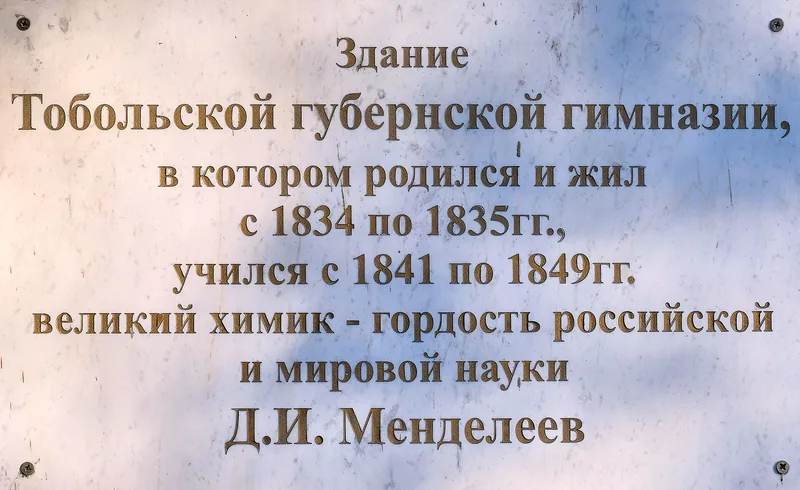
Tobolsk, the old capital of Siberia on the Irtysh, is proud of many of its natives, but one of them is known to practically every schoolchild. Dmitri Mendeleev was born here on 27 January (8 February) 1834, the man whose name stands behind the table of chemical elements that hangs in classrooms all over the world. He came into the world in a wing of the boys' gymnasium run by his father, and spent his childhood between the town and a village where the family kept a glassworks.
The path from a Siberian province to one of the great discoveries in the history of science seems almost unbelievable. The family was large and not wealthy, his father went blind early, and after his death everything rested on his mother's energy. Yet it was in the Tobolsk area that the boy first saw coloured glass born from sand and fire. This is a story of how childhood impressions, stubborn study and an enormous amount of work with facts came together as the periodic law.
A gymnasium wing and a glassworks
His father, Ivan Pavlovich Mendeleev, a graduate of the Main Pedagogical Institute in St Petersburg, taught literature and was director of the Tobolsk gymnasium. Dmitri was one of the youngest in a very large family: sources call him the seventeenth child, although accounts of the number of children differ. When his father lost his sight, his mother, Maria Dmitrievna, effectively became head of the household. She managed a small glassworks in the village of Verkhnie Aremzyani, about thirty kilometres from Tobolsk.
The factory left vivid memories. His mother let the children add manganese and iron to the molten glass and watch it take on different colours. Mendeleev himself later recalled these almost magical transformations as something that shaped his path into science. Today Verkhnie Aremzyani has a street and a school named after him, a monument, and since 1995 the school has housed the museum "At the Birthplace of D. I. Mendeleev", which keeps coloured glassware from that time.
From Siberia to St Petersburg
The boy studied at the Tobolsk gymnasium, but misfortunes struck the family one after another: his father died and then the glassworks burned down. Yet his mother did not give up the idea of a good education for her youngest son. In 1849, when Dmitri was fifteen, the family left their home region, and in 1850 he entered the Main Pedagogical Institute in St Petersburg, the very institution his father had once graduated from.
He graduated in 1855, then taught chemistry in Simferopol and Odessa, and in 1859–1861 worked in Heidelberg. On his return Mendeleev became a professor at the St Petersburg Technological Institute and then at the university, where he headed the chair of inorganic chemistry from 1867. From 1866 to 1890 he lived with his family in a university flat in the Twelve Collegia building, which now houses St Petersburg University's Mendeleev Museum and Archive.
How the table appeared
While working on his textbook Principles of Chemistry, Mendeleev looked for a logic that would bind the elements known at the time into a single system. The answer was the idea that the properties of elements depend periodically on their atomic weight. In February 1869 he sketched the first versions of the table, which are now kept in the museum and archive, and in March of that year he sent out a sheet entitled "An Attempt at a System of Elements Based on Their Atomic Weight and Chemical Affinity".
On 6 (18) March 1869 the discovery was presented to the Russian Chemical Society. It was later said that the scientist saw the whole arrangement of the elements in a dream, but behind that legend lie years of painstaking work with data. Principles of Chemistry, completed in 1871, became one of the most popular textbooks of its time and went through thirteen Russian editions.
Predictions and a return home
The boldest part of the system was its empty cells. Mendeleev did not simply leave gaps; he described the properties of the elements that should fill them. The forecast was brilliantly confirmed: gallium was discovered in 1875, scandium in 1879 and germanium in 1886. After that the periodic law was fully accepted and the scientist's name became famous far beyond Russia. Later the 101st chemical element, mendelevium, was named after him.
Mendeleev worked on much else besides: the theory of solutions, oil and industry, and from 1893 until the end of his life he headed the Main Chamber of Weights and Measures. In 1899 he came back to Tobolsk and Aremzyani and photographed the town, and that same year the town council made him an honorary citizen of Tobolsk. He died in St Petersburg on 20 January (2 February) 1907, and in 1984 a monument to him was unveiled in his home town.
Sources & context
- Great Russian Encyclopedia — Dmitri Mendeleev
- St Petersburg University — Mendeleev Museum and Archive
- Tobolsk city administration — Year of Mendeleev
- St Petersburg TV — The seventeenth child: a journey to Mendeleev's home region
- Wikipedia — Dmitri Mendeleev
A russia.direct editorial selection based on open sources. Checked 30 September 2026. Practical suggestions are a decision guide, not a promise of outcomes.
Editorial principles