Gzhel in colour: from majolica to artists’ porcelain
Historic vessels, the revival of painting and individual makers reveal a ceramic tradition that extends beyond blue and white.
Evergreen guide · checked 24 September 2026 · 3 min read
Published 24 September 2026
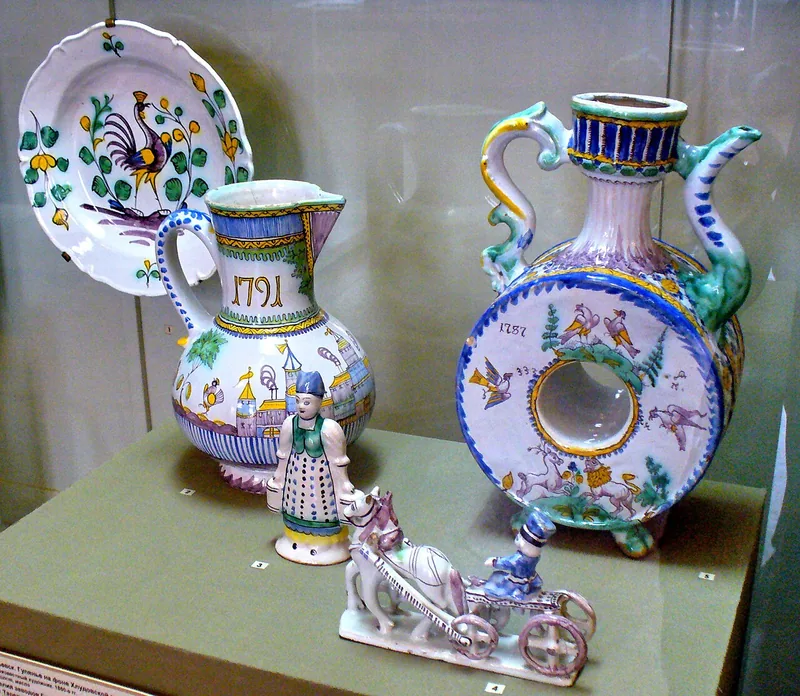

Gzhel is readily associated with blue painting on white. Yet the photograph of historic objects in Moscow’s State Historical Museum offers a different encounter: coloured figures, a jug and a vessel with an unusual silhouette. Placing different periods together helps reveal the craft’s range.
This is a story of materials, forms and artists. A museum collection, a manufacturer’s account and a workshop visit each offer a different point of entry. Museums enable comparison, while a working studio invites questions about how objects are made today.
Before the familiar blue
The Gzhel Porcelain Factory’s history describes eighteenth-century production encompassing tableware, toys, tiles and painted, multicoloured majolica. It connects today’s recognisable blue-and-white porcelain with the artistic revival of the 1940s and 1950s and the work of art historian Saltykov and artist Bessarabova.
Our photograph shows eighteenth-century objects, not the present factory range. Notice the relationship between figures and vessels: small characters stand alongside tableware. Together they invite us to consider ceramics as useful objects, sculpture and surfaces for drawing.
Majolica and the return of colour
Kuskovo Museum’s account of its Gzhel Sea exhibition explains that eighteenth-century Gzhel majolica featured multicoloured painting on unfired white enamel. In March and April 2025, the museum showed contemporary artists working with this tradition, including Anastasia Kovshareva and Antonina Nechaeva.
That exhibition has ended, but its description remains a useful way beyond one familiar image of Gzhel. When comparing objects, distinguish the date of the object from the date of its photograph, and the material from its colour. A blue pattern alone cannot establish either age or authorship.
The person behind the pattern
On its artists’ page, the Gzhel Porcelain Factory states that its artistic decoration is painted by hand. The page also introduces differing approaches. Irina Antropova looks to Chinese and Dutch porcelain painters, while Olga Zhukova describes moving from cobalt painting to work in several colours.
These examples offer a reason to ask for an artist’s name. When choosing an object, ask who designed the shape, who developed the decoration and how it was applied. Information about the artist and producer makes a purchase more meaningful and connects a particular workshop with the broader craft.
Making your own comparisons
Three objects are enough for a first exploration: a historic vessel, a blue-and-white piece and a contemporary work in several colours. Consider the proportions of handle and body, repeated elements and spaces between them. Recording the differences turns a collection of impressions into something more personal than a row of similar souvenirs.
Before travelling, confirm whether a museum or factory receives visitors, whether reservations are required and whether a demonstration is included. Arrange English-language support in advance. For a class, ask what the programme covers, whether firing is necessary and when the finished object will be available: workshops may have different arrangements.
Sources & context
- Gzhel Porcelain Factory — history of the craft
- Kuskovo — Gzhel Sea exhibition, 2025
- Gzhel Porcelain Factory — its artists
A russia.direct editorial selection based on open sources. Checked 24 September 2026. Practical suggestions are a decision guide, not a promise of outcomes.
Editorial principles