Irkutsk: wooden quarters, the Angara and the road to Baikal
Irkutsk's carved wooden houses, the 130th Quarter, the Angara riverbank and the city as a starting point for Baikal.
Cultural feature · checked 30 September 2026 · 4 min read
Published 30 September 2026
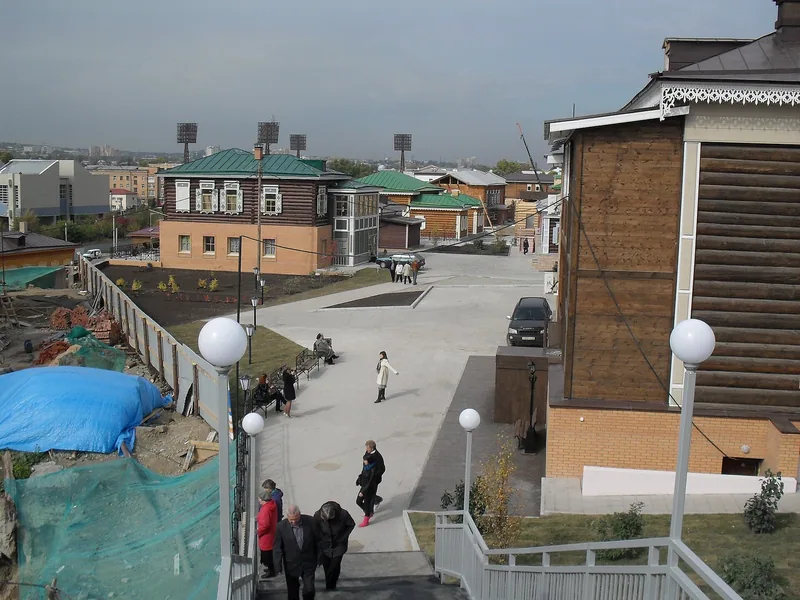

Irkutsk stands on the Angara, the river that flows out of Lake Baikal, and for many travellers it is the first stop on the way to the lake. Yet the city has a face of its own: old wooden houses with carved window frames that have survived for centuries and still shape the look of the historic centre. A walk through these streets helps you imagine what a Siberian city looked like before the age of apartment blocks.
A fort was built on the site of the future city in 1661, and Irkutsk received town status in 1686. In the nineteenth century wooden houses adorned with hand carving were built here, and it is this architecture that sets Irkutsk apart among Siberian cities today. The contrast between old log houses and later buildings makes a walk through the centre especially rewarding.
A city of wooden lace
Since 1998 the historic centre of Irkutsk has been on UNESCO's World Heritage Tentative List. The submission describes more than five hundred authentic wooden buildings forming whole urban ensembles, varied in style, type and date; of 553 sites, 216 were under state protection. In 1997 the World Monuments Fund named the historic centre of Irkutsk among its hundred priority sites.
The submission is also frank about the difficulties: many old houses lacked modern amenities, with stove heating and no running water or sewerage. So wooden Irkutsk is not only about beautiful facades but also about the ongoing work of preserving, restoring and carefully using old buildings. It is worth looking at the details, the carved window frames, cornices and gates that showed the owners' taste and the carpenters' skill.
The 130th Quarter
The best-known place to meet wooden Irkutsk is the 130th Quarter, also called the Irkutsk Sloboda. It was conceived for the city's 350th anniversary, celebrated in 2011, and opened in September that year. The triangular quarter lies in the southern part of the historic centre, not far from Krestovaya Hill. In 2010 the project won the international Zodchestvo architecture festival.
It holds about 65 buildings: some 32 original wooden houses of the eighteenth and nineteenth centuries were restored, 8 were moved from other streets, and 16 lost buildings were recreated from historical designs. The quarter has museums, workshops, a gallery, cafés and shops, and visitors are greeted by a sculpture of the babr, the heraldic beast of Irkutsk. The quarter works well as a first introduction, after which it is rewarding to seek out original wooden houses in neighbouring streets.
The Angara riverbank
A walk through Irkutsk is best continued by the Angara. The embankment in the historic centre is where locals come to stroll and look out over the broad river. Here, on the scenic bank, stands the monument to Alexander III, unveiled in 1908 and restored in 2003; it is linked to the history of the Trans-Siberian Railway. The sculptor Robert Bach portrayed the emperor not in state regalia but in a uniform associated with Siberia, and the monument is dedicated above all to the development of the region.
The Trans-Siberian still connects Irkutsk with other regions of Russia, so many visitors arrive by train. The embankment is lovely in any season, but in winter it can be especially windy and cold by the water, so dress warmly and check the forecast. In summer it is a pleasant place to watch the sunset, and in any season the embankment links the old centre with the river.
Gateway to Baikal
Irkutsk is about 70 kilometres from Baikal: sources give distances of 66 to 72 km to the source of the Angara. That makes the city a natural base for trips to the lake, and its surroundings combine steppe, forest-steppe and taiga landscapes. The nearness of Baikal is felt in the city itself: the Angara, on which it stands, begins at the lake.
It is easiest to combine the city and the lake: a day or two for the wooden quarters and the embankment, then a trip out to Baikal. Routes, transport timetables and the rules for visiting protected natural areas are best checked on official websites before you go. That way the trip stays unhurried, and the city becomes more than just a place to change transport.
Sources & context
- UNESCO World Heritage Centre — Historic Centre of Irkutsk (Tentative List)
- Living Heritage — 130th Quarter
- Wikipedia (RU) — 130th Quarter of Irkutsk
- Culture 38 — Monument to Alexander III
- Wikipedia — Irkutsk
A russia.direct editorial selection based on open sources. Checked 30 September 2026. Practical suggestions are a decision guide, not a promise of outcomes.
Editorial principles