Krasnoyarsk Hydroelectric Dam: a concrete wall across the Yenisei
How one of the world's most powerful hydroelectric stations was built, why it needs a ship lift that runs on rails and how its dam ended up on the ten-rouble note.
Cultural feature · checked 30 September 2026 · 5 min read
Published 30 September 2026
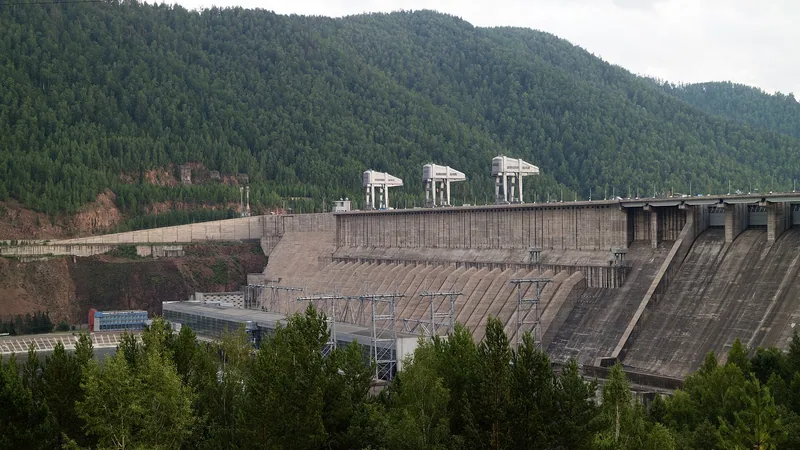

About 30 kilometres upstream of Krasnoyarsk, the Yenisei runs into a grey concrete wall 124 metres high and more than a kilometre long. This is the Krasnoyarsk Hydroelectric Station, a 6,000-megawatt plant that, when construction ended in the early 1970s, was the largest hydroelectric station in the world. The town of Divnogorsk grew up beside it, and upstream spread a reservoir that locals call the Krasnoyarsk Sea.
Two features make the dam recognisable far beyond Siberia. First, it is the only hydroelectric station in Russia whose complex includes a ship lift: vessels cross the dam in a giant water-filled tub that travels on rails. Second, almost everyone in the country knows its silhouette, because it is printed on the back of the 10-rouble banknote. The story of its construction is the story of how a great Siberian river was put to work.
The plan and the early years
The government decided to build a station on the Yenisei in July 1955, and by November the first two hundred workers from Ukraine had arrived at the site, a place called Stary Skit. Main works got under way in 1956. The project was prepared by the Lenhydroproject institute, while geological surveys in the area dated back to 1931–1932. From the winter of 1959 the construction was headed by Andrei Bochkin, later awarded the title Hero of Socialist Labour.
The original plan differed noticeably from what was eventually built. According to the Krasnoyarsk Regional Museum of Local History, the mid-1950s design envisaged 14 units of 286,000 kilowatts each and a vertical ship lift. The station was later redesigned with twelve 500-megawatt units, and for shipping the engineers came up with an entirely different and far more unusual structure. Alongside the dam grew Divnogorsk, a town created for the hydro builders.
Closing the Yenisei and the first current
The key day of the construction was 25 March 1963, when the Yenisei's channel was blocked and the river was diverted through prepared openings. That same year Yuri Gagarin visited the site; the museum and the local press recall how the first cosmonaut laid concrete in the body of the dam. According to Krasnoyarsk journalists, around a hundred thousand people in total took part in building the station and the town.
The first unit delivered industrial current on 3 November 1967, and the last two, units 11 and 12, started up in 1971. On 26 July 1972 a State Commission accepted the station into commercial operation. The gravity dam contains about 5.7 million cubic metres of concrete, and the station's average annual output is around 18.4 billion kilowatt-hours. In terms of capacity it still ranks among the largest hydroelectric plants in Russia and the world.
Ships on rails
Locks for a difference in water levels of more than a hundred metres would have been extremely complicated, so Lenhydroproject's engineers chose an inclined ship lift. A vessel sails into a water-filled chamber, and the chamber, ship and all, travels up or down the slope on rails, covering a height difference of about 104 metres at roughly one metre per second. The track gauge of this "railway" is 9 metres, the widest in the world. The chamber rests on 78 carriages and is driven by 156 electric motors along a toothed rack.
Halfway along, the chamber rolls onto a turntable 106 metres in diameter and turns through 140 degrees in order to descend to the water on the other side of the dam. It can take vessels up to 80 metres long and 17 metres wide. The lift was built in the 1970s, trial operation began at the end of the decade, and it was accepted into permanent service in 1982. The whole passage across the dam takes about an hour and a half, which by river-transport standards makes it quite an attraction.
A sea behind the dam, a dam on the banknote
Above the station lies the Krasnoyarsk Reservoir: it holds 73.3 cubic kilometres of water, covers about 2,000 square kilometres and stretches for some 388 kilometres, up to 15 kilometres wide. Creating this man-made sea changed life across the region: according to the local history museum, 136 settlements fell within the flood zone and their residents had to be resettled. Today the reservoir shores are a favourite place for Krasnoyarsk residents to relax, and Divnogorsk is one of the most picturesque towns on the Yenisei.
In 1997 the Bank of Russia issued a 10-rouble banknote dedicated to Krasnoyarsk. Its front shows a bridge over the Yenisei and a chapel, while the main image on the back is the dam of the Krasnoyarsk Hydroelectric Station. In everyday use the note has long since given way to a coin, but the image of the concrete wall across the Yenisei has stayed in the memory of several generations. For many, it was their first encounter with Siberian hydropower, straight out of their wallet.
Sources & context
- Krasnoyarsk Regional Museum of Local History — 6000 Megawatts: A History of the Krasnoyarsk HPP
- Bank of Russia — 10-rouble banknote, 1997 series
- CAWater-Info — Krasnoyarsk HPP (Russia)
- Newslab.ru — How the Krasnoyarsk HPP was built and modernised
- Wikipedia — Krasnoyarsk ship lift
A russia.direct editorial selection based on open sources. Checked 30 September 2026. Practical suggestions are a decision guide, not a promise of outcomes.
Editorial principles