Kubachi: the mountain village that learns silver from childhood
A Dagestani village of silversmiths: where the tradition came from, how the burin and niello work, and where to see Kubachi pieces.
Cultural feature · checked 30 September 2026 · 5 min read
Published 30 September 2026
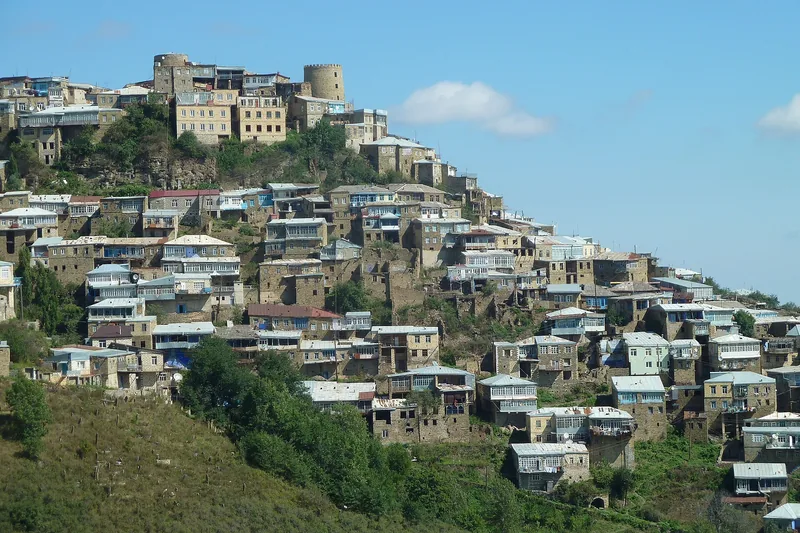

Kubachi is a village high in the mountains of Dagestan, in the Dakhadaevsky District, at an altitude of roughly 1,600–1,800 metres. It lies about 180 kilometres of mountain road from Makhachkala and a little over ninety from Derbent. From the outside it is a cluster of stone houses clinging to a slope; inside, it holds one of the best-known jewellery traditions of the Caucasus. Narrow lanes, staircases and flat roofs rise in terraces, so that an upper house sometimes stands almost on the roof of the one below.
Kubachi jugs, daggers, belts and ornaments long ago found their way into museums around the world. Yet the craft has not become a museum piece: masters still work in the village, and the skill of holding a burin and “reading” an ornament is passed down in families from one generation to the next. For the people of Kubachi this is not just a profession but part of family memory: tools, sketches and patterns pass from elders to the young along with stories of past masters.
A town of armourers
Medieval sources know the settlement as Zirehgeran, Persian for “armour-makers”. According to the State Museum of Oriental Art, the town flourished from the 6th to the 15th century and was famed for weapons, chain mail and chased metalware, later becoming known as Kubachi. Even then, skill in metalwork was the villagers’ main source of fame and prosperity, and the masters were known far beyond the mountains.
Metalwork is not the only witness to the village’s past. Kubachi is known for carved stone reliefs with ornaments, figures and narrative scenes, which the Oriental Art museum’s curators describe as a unique Caucasian tradition. A large collection of 15th–16th-century Persian ceramics was also found here in the 19th century; it came to be called “Kubachi ware”, although scholars believe the pottery was actually made in Iran. The story shows what a centre of trade and exchange the mountain village was: objects arrived from many lands, while local work spread across the region.
Burin, niello and filigree
A Kubachi master commands a whole range of techniques: engraving, niello, chasing, filigree, bone inlay and enamel. The most recognisable is fine engraving combined with niello: a dark alloy fills the incised lines of the design, and the silver ornament seems to rise from the surface. The work demands patience and a steady hand: the fine ornament is done by hand, and a single large piece can take a long time.
The ornament itself is a complex system; according to the Kubachi Art Factory, it has more than twenty-five basic elements. Local motifs have merged with patterns borrowed from the art of Russia, Turkey, Iran and other Caucasian peoples. Since the mid-20th century, coloured enamel, turquoise and other stones have joined the traditional gilding and niello. An experienced eye recognises Kubachi work by the density and rhythm of the pattern, where plant scrolls, stars and geometric figures merge into a single whole.
From artel to art factory
In 1924 the masters formed a jewellery artel, which in 1960 became the Kubachi Art Factory. According to the enterprise itself, some 800 people worked there in the 1970s, and its pieces won awards at international exhibitions. The factory was an important milestone: it helped preserve the craft in modern times, train young people and present Kubachi art at exhibitions.
The factory is recognised as an especially valuable object of the cultural heritage of the peoples of Russia. At the same time many masters work in their own workshops, and family transmission of skill remains the main reason the craft is still alive. Many homes have their own workshop, and children see from an early age how a pattern is born, sometimes picking up their first burin themselves.
Where to see Kubachi work
Kubachi silver is held by the State Hermitage, the State Historical Museum, the Louvre, the Metropolitan Museum of Art and the Victoria and Albert Museum. In Dagestan, visit the P. S. Gamzatova Dagestan Museum of Fine Arts in Makhachkala, which holds, for example, Kubachi brass jugs from around 1900, and the National Museum of the Republic of Dagestan, whose objects were shown at the “Kubachi — Zirehgeran” exhibition in Moscow in 2021. Museum displays let you look closely and compare work from different eras, from old weapons to 20th-century jewellery.
In the village itself you can see a medieval tower and the museum at the art factory. Travellers report that there is no public transport to Kubachi and that the mountain roads are partly unpaved. Opening hours and visiting conditions are best checked in advance on the museums’ official pages or with local guides. It is best to come with respect for local ways: Kubachi is a living village, not an open-air museum, and its hosts’ hospitality is valued as much as their craftsmanship.
Sources & context
- State Museum of Oriental Art — “Kubachi — Zirehgeran” exhibition
- Kubachi Art Factory — company history
- Culture.RF — Kubachi water jug and measure (Gamzatova Dagestan Museum of Fine Arts)
- Wikipedia — Kubachi silver; Kubachi ware
- Nasha Planeta — Kubachi village travel guide
A russia.direct editorial selection based on open sources. Checked 30 September 2026. Practical suggestions are a decision guide, not a promise of outcomes.
Editorial principles