Kvass: the bread drink made at home
How rye bread, malt, sugar and yeast become kvass, where the drink comes from and what okroshka has to do with it.
Cultural feature · checked 5 October 2026 · 5 min read
Published 5 October 2026
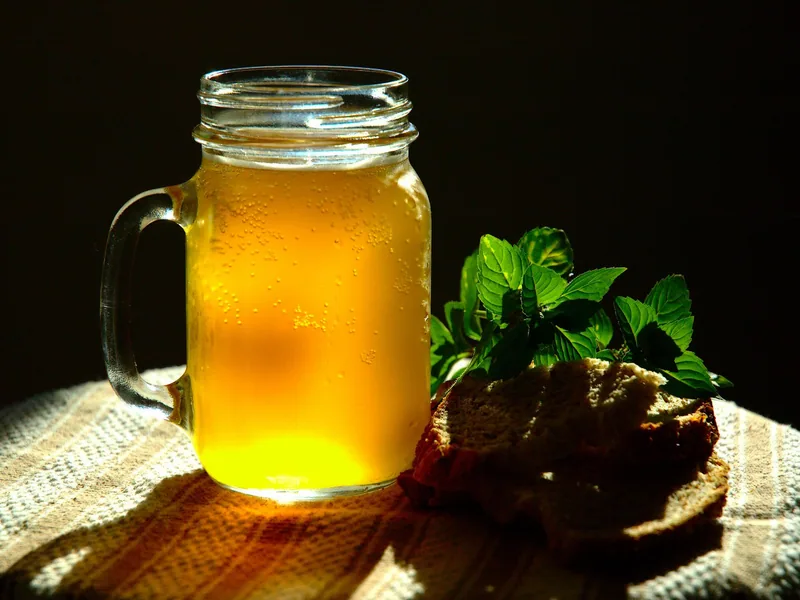

In a Russian summer kvass is everywhere: in bottles, in mugs poured from street barrels, in home-made jars covered with gauze. Cloudy, sweet and sour, smelling of rye crust, it seems a very simple drink, and indeed all it needs is bread, water, sugar and a little patience. Yet behind that simplicity lie more than a thousand years of history, monastery kvass houses, street kvass sellers and a whole family of cold soups without which a summer table is hard to imagine.
Encyclopedias define kvass as a traditional Russian drink made by fermenting a wort of grain, rye bread or malt, and sometimes of fruit and berry juices. The fermentation is left incomplete: yeast and lactic bacteria have time to make the drink lightly sparkling and tart, but not to make it strong. That is why kvass is officially classed as a non-alcoholic drink, even though a small amount of alcohol does form in it.
What kvass is by the rules
Today the make-up of kvass is described by the interstate standard GOST 31494-2012, in force since 1 July 2013. It defines kvass as a non-alcoholic drink obtained by incomplete alcoholic, or combined alcoholic and lactic, fermentation of a wort, with an ethanol content of no more than 1.2 per cent by volume. The wort may be made from grain, fruit and berry, vegetable or aromatic plant ingredients, and fermentation relies on yeast and lactic acid bacteria.
The standard allows sugar, honey, salt and drinking water to be added, but rules out artificial flavourings and synthetic colourings. Industrial kvass is usually made from kvass wort concentrate, which is dissolved in water, mixed with sugar syrup and fermented for several hours. English-language sources put ordinary kvass at around 0.5 to 1 per cent alcohol, and according to the Znanie encyclopedia its strength can in some cases exceed 2 per cent.
How kvass is made at home
The best-known home method starts with rye bread. Slices are dried into rusks, covered with hot water and left for about half a day to make a dark, fragrant infusion. This is strained, sugar and baker's yeast are added, and it is left to ferment again somewhere warm, at around 20 °C, for roughly another twelve hours. The finished kvass is strained again, poured into bottles or jars and put somewhere cold.
There is another route, through malt. In the old days grain, most often rye, was sprouted, dried and ground, then the malt was mixed with unmalted flour and water to make a wort. This took time and skill, but gave a rich flavour and colour. There is also a middle way: rye flour is mixed with malt and boiled with water, then sugar and yeast are added, and from there everything follows the familiar fermentation routine.
From the chronicle to the yellow barrel
Kvass already appears in the Primary Chronicle, which tells how, after the Christianisation of Rus, Prince Vladimir ordered food, mead and kvass to be handed out to those in need. The Great Russian Encyclopedia dates this mention to 988. Linguists trace the word itself to an ancient root meaning to sour or turn sour. For centuries afterwards kvass remained one of the most ordinary everyday drinks in Rus.
Monasteries are a chapter of their own. According to material from the Kirillo-Belozersky Museum-Reserve, the Stoglav Council of 1550 banned the brewing of intoxicating kvass in monasteries, while ordinary kvass stood on the table almost all year round except during Great Lent. Towns had their kvasniki, sellers who often specialised in a single kind. In the nineteenth and twentieth centuries kvass was sold on the streets from barrels, and after the war yellow kvass tanker barrels became a familiar sign of the Soviet summer.
Monastery kinds, berries and okroshka
Rye bread kvass is the main kind, but far from the only one. Monastery records mention barley and oat kvass, honeyed kvass and kvass made with sweetened malt, as well as kvass flavoured with mint, oregano, juniper or raisins. Encyclopedias also list fruit and berry kinds: cherry, apple, cranberry and lingonberry. Honey kvass in monasteries, according to old descriptions, was set to ferment either with hops and yeast or simply with a soft white kalach loaf.
Kvass is not only for quenching thirst. It is the base of okroshka, a cold dish of herbs, vegetables and chopped meat or fish covered with kvass. Botvinya combines kvass with boiled beetroot, onion and fish, while the very simple tyurya is bread crumbled into kvass or water. In this way kvass became the foundation of a whole summer cuisine that people in Central Russia still look forward to every year, along with the first fresh greens.
Sources & context
- Great Russian Encyclopedia — Kvass
- Znanie.Wiki (Russian Society Znanie) — Kvass
- Kirillo-Belozersky Museum-Reserve — I. A. Kuznetsova, Kvass making in monasteries
- GOST 31494-2012 Kvass. General specifications (text on Meganorm)
- Wikipedia — Kvass
A russia.direct editorial selection based on open sources. Checked 5 October 2026. Practical suggestions are a decision guide, not a promise of outcomes.
Editorial principles