Maslenitsa: a week of pancakes and a farewell to winter
How seven days of pancakes, sledging and family visits end with a bonfire in which a straw effigy of winter goes up in flames.
Cultural feature · checked 30 September 2026 · 5 min read
Published 30 September 2026

At the end of winter, Russian towns and villages suddenly smell of melted butter and hot batter. Maslenitsa has begun: the noisiest week of the folk calendar, when you are supposed to eat pancakes, slide down icy hills, visit friends and make merry as if a long fast lay ahead. And indeed it does. The festival sits on the border between winter and spring and falls in the last week before Great Lent, so its dates change every year: they depend on Easter and land in late February or early March.
Maslenitsa has two faces. Ethnographers see in it an ancient farming festival tied to fertility, the sun and the memory of ancestors. The Church calls the same week Cheesefare Week: meat is already off the table, but dairy, eggs and fish are still allowed. The two layers fused long ago. One festival holds rites for seeing off winter, family visits and Forgiveness Sunday, while its central figure remains a straw doll that is honoured all week and solemnly burned at the end.
Narrow and wide
The week was divided into two halves. From Monday to Wednesday ran the "narrow" Maslenitsa, when household chores could still be done; from Thursday the "wide" Maslenitsa began, work stopped and the time for festivities arrived. Each day had its own name. Monday was the "meeting": the Maslenitsa effigy was welcomed with songs and round dances, the first pancakes were baked, and by custom the very first ones went to poor neighbours in memory of the dead.
Tuesday was for "flirting": young people strolled, got acquainted and looked for a match, since weddings were not allowed during Lent. Wednesday was the "treat day", when tables groaned with food and a son-in-law went to his mother-in-law's for pancakes while she watched closely how he behaved at the table. Thursday was known as "revelry", and Friday as "mother-in-law's evenings", when she paid a return visit. Saturday brought "sisters-in-law's gatherings": a young wife hosted her husband's sisters and gave them presents. Sunday closed the week with the farewell.
The pancake: sun and memory
The dish of the week is the blin, a thin pancake, and its meaning runs deeper than it seems. Round, golden and hot, it is considered an ancient symbol of the sun, which gathers strength after the long winter. But it also had a quieter role: researchers note that the blin was a food of remembrance. Hence the saying "the first pancake is for the dead": the first one off the pan was placed on a windowsill or taken to the cemetery, in the hope that ancestors would help the living with the coming harvest.
Pancakes were not the whole story. According to the Russian Museum of Ethnography, the Maslenitsa table also held dairy and flour dishes, eggs, fish, pies and fermented drinks. The abundance made obvious sense: a strict fast lay ahead, and before it one was expected to eat one's fill and see one's relatives. The family visits laid out day by day turned the festival into a string of feasts in which pancakes were baked, given away and eaten from morning till night.
Hills, horses and snow fortresses
Maslenitsa is an open-air festival. Young people sledged down hills, and horses in festive harness drove through the streets. Couples married during the past year received special attention: they were shown off, driven around and honoured in front of the whole village, and it was believed that the vitality of young couples passed into the earth. In some places fist fights were held, and these too were linked to the coming harvest.
One of the liveliest games was the storming of a snow town. A fortress was built of snow, one team defended it and the other attacked, and the attackers' victory stood for the defeat of winter. The Kultura.RF website dates this game to the early 18th century. It shows how ritual and pure fun mix in Maslenitsa: 19th-century peasants still believed that the way the week was celebrated affected the harvest, yet they simply enjoyed the snow, the sun and each other's company.
Forgiveness Sunday and the bonfire
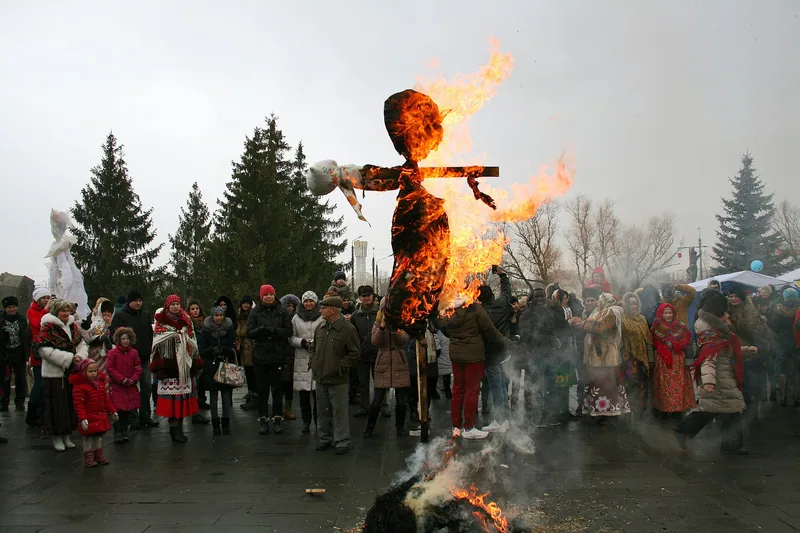
The last day of the week is Forgiveness Sunday. Relatives and friends ask one another for forgiveness, sometimes with small gifts, and churches hold a rite of forgiveness before Great Lent begins. By tradition people also visited their ancestors' graves on this day. In the evening comes the climax: the straw effigy of Maslenitsa, dressed in a peasant woman's clothes, is burned on a bonfire, often on a riverbank. The fire in this rite was understood as cleansing, and the ashes were believed to help the coming harvest.
In Soviet times the festival almost disappeared from public life, but from the late 1980s it began to return, and today it is one of the country's biggest popular celebrations. For a week city squares and parks turn into fairs with pancakes and tea, music, games and sledging, and at the end, as before, the effigy blazes. At home, meanwhile, people bake pancakes again. Many do not keep the fast, but they happily see off winter by the old rules.
Sources & context
- Russian Museum of Ethnography — Maslenitsa (Butter Week, Cheesefare Week): traditions
- Kultura.RF — What is the history of Maslenitsa?
- Foma magazine — Maslenitsa day by day
- Wikipedia — Maslenitsa
A russia.direct editorial selection based on open sources. Checked 30 September 2026. Practical suggestions are a decision guide, not a promise of outcomes.
Editorial principles