Moscow Metro: an urban space beneath the city
The first line, an architectural perspective and a practical way to understand the transport network.
Landscapes, history and everyday life · 3 min read
Published 24 September 2026
_(19343382734).jpg)
A metro journey can feel like the short interval between two appointments. Look a little more slowly and it becomes part of the city itself: architecture, engineering and the daily routes of many different people meet in the same space.
Moscow’s system can reward a first-time visitor and someone who has used one line for years. Begin with a familiar station as a place where people must find their way, keep moving and share space with other passengers.
How the network began
According to the metro’s official history, the first stage opened on 15 May 1935. It linked Sokolniki and Park Kultury, with a branch from Okhotny Ryad to Smolenskaya, and covered 11.2 kilometres in total.
Trial services preceded the opening. The organisation brought together responsibilities including train operations, traction, communications, track and structures. Even a short chronology shows that a line is more than a tunnel: it depends on several kinds of expertise working together.
Read a station as architecture
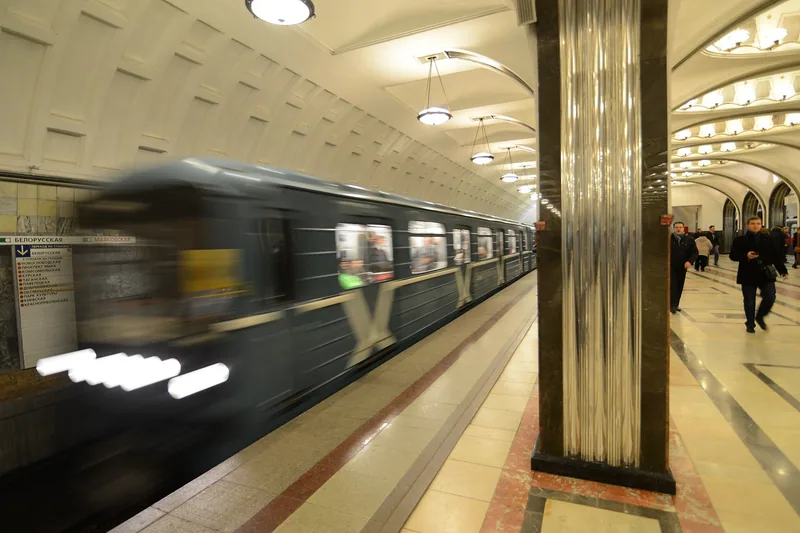
Our suggested exercise focuses on three things: light, the rhythm of structural supports and the arrangement of passages. Compare the impression at platform level with the entrance hall. What helps you understand where to go, and what draws your eye?
The archive photograph shows part of Mayakovskaya station with a moving train. It supports a discussion of the station’s space, but it does not replace a current map, signs or information about present-day restrictions. The photograph has its own date and viewpoint.
Make an unfamiliar journey easier
Before travelling, check the interchange, direction and most useful exit as well as the names of your starting and destination stations. Save the names in Cyrillic so that you can match them with signs when necessary.
Once the route is clear, there is more room to notice architecture. Choose a time when a closer look will not obstruct other passengers, keep passages clear and follow the operator’s current rules. Curiosity works best alongside the station’s everyday transport function.
Know which information needs updating
Use the Moscow Metro’s official resources for current maps, fares, accessibility and service changes. A historical feature explains development; it cannot be a permanent instruction for every journey. Check practical details at the time you need them.
For an exploration of your own, compare two stations using the same questions: lighting, material, scale and wayfinding. Then consider how those choices relate to the function of the place. A routine journey can become a small investigation of the urban environment.
Sources & context
A russia.direct editorial selection based on open sources. Checked 24 September 2026. Practical suggestions are a decision guide, not a promise of outcomes.
Editorial principles