Novosibirsk: the city that grew up by a bridge
How a settlement of Trans-Siberian Railway builders on the banks of the Ob became Siberia's largest city in just a few decades.
Cultural feature · checked 30 September 2026 · 5 min read
Published 30 September 2026

Novosibirsk has no ancient kremlin and no centuries-old chronicle. Its history spans little more than 130 years, and it begins with an engineering decision: where to carry the Trans-Siberian Railway across the Ob. The site chosen lay away from the old Siberian centres, and in spring 1893 the first workers arrived. A settlement quickly grew up around the construction site, and within a few decades it had become one of the largest cities in the country.
According to the 2021 census, Novosibirsk had 1,633,595 residents, making it Russia's third most populous city after Moscow and Saint Petersburg and the largest in Siberia. It has a metro with a bridge over the Ob, a huge opera and ballet theatre and the famous scientific town of Akademgorodok. Yet all these stories lead back, one way or another, to a single spot on the riverbank where the first piles of the railway bridge were once driven.
A decision that changed the map
In 1891 the survey party choosing a site for the railway bridge over the Ob was led by the engineer and writer Nikolai Garin-Mikhailovsky. It was he who rejected the option of building the crossing at Tomsk and proposed another site where the river was better suited to a bridge. That decision, in effect, determined that a new city would appear on the map of Siberia. Today the square in front of Novosibirsk's railway station bears Garin-Mikhailovsky's name.
Construction got under way in 1893, and the bridge was put into service on 28 March 1897. It served the railway for almost a century, until 1990. The builders' settlement went by various names at first: Gusevka, Novaya Derevnya, Krivoshchekovsky Vyselok, Alexandrovsky. In 1895 the name Novo-Nikolayevsk, in honour of Emperor Nicholas II, took hold. So a temporary workers' camp acquired a name, and with it a future.
Explosive growth
The growth figures are impressive even today. According to the Novosibirsk Tourist Information Centre, the settlement had 7,832 residents in 1897, 26,028 by 1905 and 107,129 by 1917. In 1903 Novo-Nikolayevsk was granted town status. In 1910–1912 a trading arcade and school buildings went up to designs by the architect Andrei Kryachkov, and in 1897 the foundation was laid for the stone Cathedral of Alexander Nevsky, one of the town's first permanent buildings.
In 1926 the city was renamed Novo-Sibirsk, later written as a single word. In 1937 it became the centre of a region, and by 1939, together with Berdsk, it had around 406,000 inhabitants. For a city not yet half a century old, it was a remarkable journey: from a camp beside a construction site to one of Siberia's main industrial and transport hubs, where the railway met the great river.
A theatre under a dome
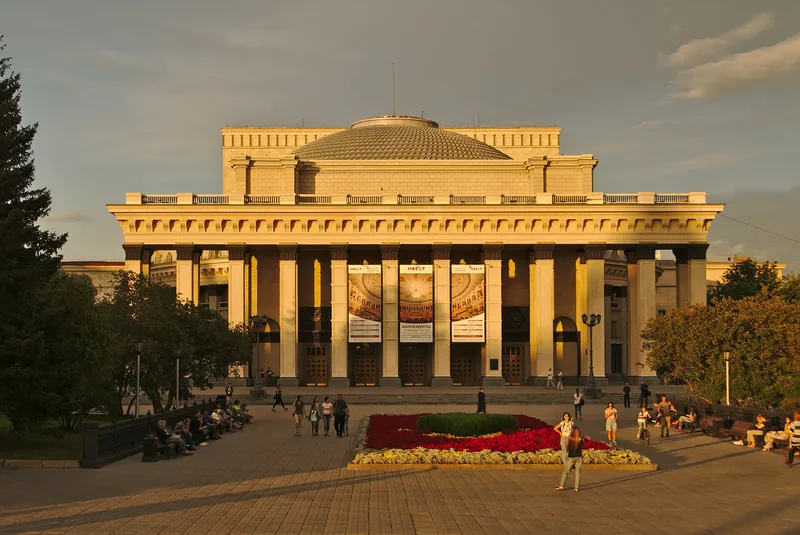
Novosibirsk's chief symbol is the opera and ballet theatre on the central square. Its foundation stone was laid on 22 May 1931; by 1941 the building was practically finished, and in 1942 the government ordered its urgent completion. During the war the future theatre sheltered treasures from the museums of Moscow and Leningrad. It opened on 12 May 1945 with Mikhail Glinka's opera Ivan Susanin.
The building is striking in its scale. A vast dome rises above the auditorium, and the stage has a working area of 1,044 square metres; according to the city's history portal it can hold up to a thousand people and is larger than the stage of the Bolshoi Theatre. The main hall seats 1,774. The theatre was granted "academic" status in 1963, and its stage remains one of the country's leading venues for opera and ballet.
A metro over the Ob and a city of science
Novosibirsk was the first city in Siberia to get a metro: the first line opened in 1985. Today the system has two lines and 14 stations, and its most unusual part is the covered metro bridge over the Ob, 2,145 metres long and regarded as the longest in the world. Trains cross the wide river inside an enclosed gallery, and the ride from one half of the city to the other is a reminder that Novosibirsk owes its existence to a river crossing.
Another chapter of the city's story began in 1957, when construction started on Akademgorodok, a research complex of the Siberian Branch of the Academy of Sciences about 30 kilometres south of the centre. russia.direct has already told its story separately. As for Novosibirsk itself, the city that began as a settlement by a bridge keeps growing along the river, binding the railway, factories, theatre and science into one great Siberian metropolis.
Sources & context
- Novosibirsk Tourist Information Centre — A short history of the city, part 1
- History of Novosibirsk — Opera and Ballet Theatre
- Wikipedia — Novosibirsk
- Wikipedia — Novosibirsk Metro
- Wikipedia — Nikolai Garin-Mikhailovsky
A russia.direct editorial selection based on open sources. Checked 30 September 2026. Practical suggestions are a decision guide, not a promise of outcomes.
Editorial principles