Ostankino Tower: concrete squeezed by steel
How engineer Nikolai Nikitin conceived a tower of prestressed concrete held together by tensioned steel cables and a heavy base.
Cultural feature · checked 30 September 2026 · 5 min read
Published 30 September 2026
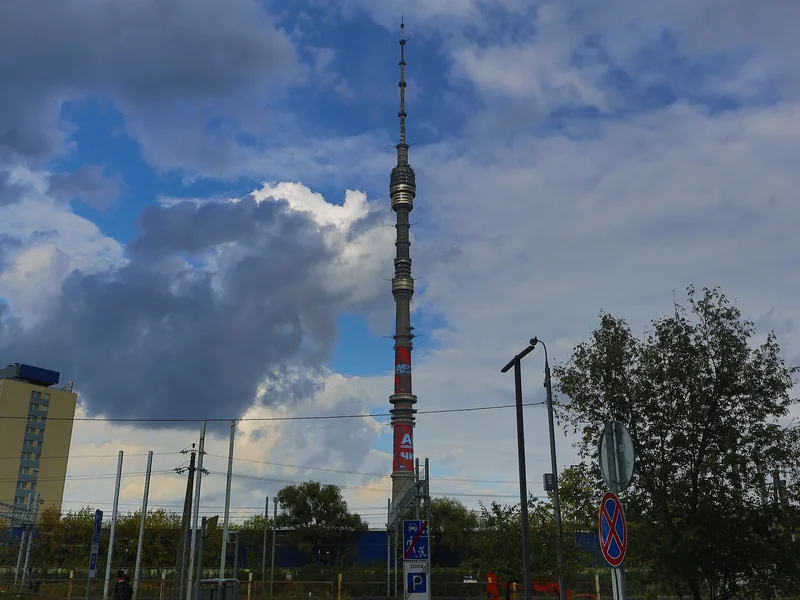

Ostankino Tower can be seen from almost anywhere in Moscow: a slender white needle 540 metres tall, assembled from concrete rings. Since 1967 it has been the main television transmitter for the capital region and the tallest free-standing structure in Europe. But its outward simplicity is deceptive. Tensioned steel cables run up the inside of the shaft, while the foundation goes less than five metres into the ground.
The author of this design was the engineer Nikolai Nikitin. He proposed abandoning the usual steel lattice and building the tower from prestressed reinforced concrete, in which steel compresses the concrete in advance and keeps it from cracking. The bold idea was at first met with doubt, and construction even stopped for a while, but the calculations proved right. The tower has stood for more than half a century, survived a severe fire and remains one of the symbols of the Soviet school of engineering.
A lily turned upside down
The first designs for Moscow's television tower envisaged a steel lattice structure. Nikitin disliked them and put forward his own version in reinforced concrete. The image behind the tower is said to be an upside-down lily, a flower with strong petals and a thick stem. According to the tower's official website, the engineer prepared his design in just three days, although a week had been set aside for the job. The chief architect was L. I. Batalov, and the design team also included D. I. Burdin, M. A. Shkud and L. N. Shchipakin.
On 27 September 1960 the first reinforced-concrete blocks were laid in the tower's base. Work then came to a halt: specialists doubted that such a shallow foundation could carry such a height, and construction resumed only in 1963. Nikitin's ideas echoed the work of Yuri Kondratyuk and the Italian engineer Pier Luigi Nervi, and the project became one of the boldest in the world of high-rise construction at the time.
Steel that squeezes concrete
Concrete withstands compression very well but copes poorly with tension: when the wind bends a tall tower, the concrete on one side begins to stretch and may crack. Nikitin solved this with prestressing. Steel cables run inside the shaft, between 145 and 149 of them depending on the source, stretching from the conical base up to around the 385-metre mark. According to the tower's website, each cable is tensioned with a force of about 70 tonnes.
The tensioned cables constantly squeeze the ring-shaped sections of the shaft, so even in a strong wind the concrete stays compressed and does not open up in cracks. This made the tower look light while being very strong. The calculated deflection of its top at maximum wind speed is about 12 metres; for a structure of this height that is simply a flexible design doing its job, not a cause for alarm. The tower's website also states that it is designed to withstand an earthquake of magnitude 8.
As steady as a roly-poly toy
The most surprising part of the design is hidden underground. The foundation goes no deeper than 4.6 metres, less than that of many residential buildings. The tower stays upright not because of depth but because of how its mass is distributed: the base is very heavy and the centre of gravity sits low, like that of a roly-poly toy. Together with its foundation the tower weighs about 55,000 tonnes, most of it concentrated in the lower part of the structure.
The tower's lower cone stands on supports, or "legs", between which you can walk. At first four were planned, but on the advice of the German engineer Fritz Leonhardt, creator of the world's first concrete television tower in Stuttgart, their number was increased to ten. These supports give the base of the tower its recognisable silhouette of an upturned flower. In this way the Soviet and European engineering schools met in one of Moscow's best-known structures.
A record, a fire and a second life
On 5 November 1967 a State Commission signed the act accepting the first stage of the tower. At 540 metres it became the tallest free-standing structure in the world and held that title until the CN Tower in Toronto appeared in 1976. In Europe, Ostankino is still the tallest. The glazed observation deck is at 337 metres and the open one at about 340, while just below them the revolving Seventh Heaven restaurant used to turn.
On 27 August 2000 a severe fire broke out at a height of about 461 metres, destroying several floors and damaging most of the prestressing cables. The tower nevertheless stood firm, the best proof of the safety margin Nikitin had built in. After restoration the observation decks reopened in 2008 and the restaurant in 2016. Today the tower is operated by the Russian Television and Radio Broadcasting Network (RTRS) and remains the main broadcasting centre for the Moscow region.
Sources & context
- Official Ostankino Tower website — History
- Wikipedia — Ostankino Tower (Russian)
- Wikipedia — Ostankino Tower
A russia.direct editorial selection based on open sources. Checked 30 September 2026. Practical suggestions are a decision guide, not a promise of outcomes.
Editorial principles