Palekh: from the icon to the lacquer box
How icon painters from a village in the Ivanovo Region created lacquer miniature on papier-mâché, now famous worldwide.
Cultural feature · checked 30 September 2026 · 5 min read
Published 30 September 2026
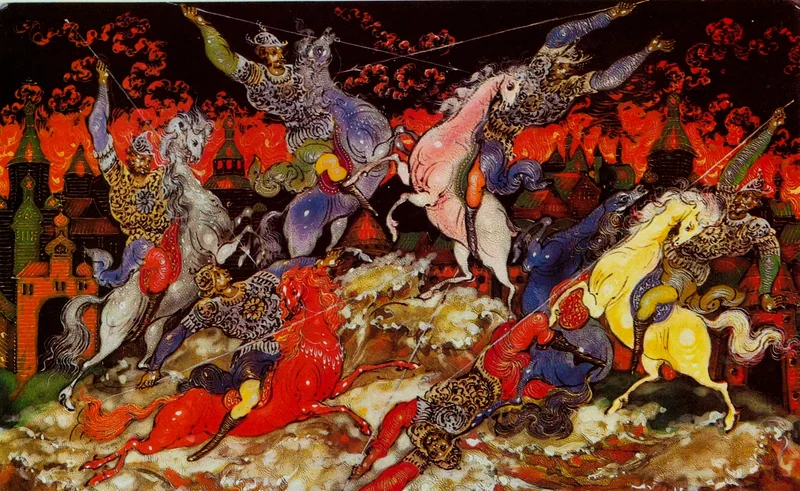

A black lacquered box lid, and on it a tiny world: a Firebird in golden plumage, slender-legged horses, fairy-tale towers and figures elongated as on old icons. This is Palekh miniature, and it is hard to mistake for anything else. The home of this art is the small town of Palekh in the Ivanovo Region. You can study such a piece for a long time: every detail is painted so finely that you want to lean in closer.
Behind each such piece lie centuries of icon-painting training and the story of how artists, in hard times, found a new life for their skill. In 2024 Palekh marked the centenary of its lacquer miniature, and the story continues in the town's workshops, art school and museum. It is the story of people who managed to preserve their forebears' craft by changing only the surface they painted on.
An icon-painting village
As early as the 16th and 17th centuries Palekh was a centre of the old icon-painting craft of Vladimir-Suzdal Rus. Legend has it that icon painters from Vladimir and Suzdal once took refuge in the forests along the little Paleshka river. Palekh icons were known for especially fine brushwork, soft flowing lines, a restrained palette and generous use of gold. Skill was handed down here from generation to generation for centuries, and icon painting was the business of the whole village.
In the early 20th century the craft declined, and after 1917 the icon painters were left without work altogether. They needed a new use for their art without abandoning a manner refined over generations. The answer came from a material already familiar to Russian lacquer workshops: papier-mâché. So in the early 1920s began a search that led to the birth of a new art.
The Artel of Ancient Painting
In 1923 Ivan Golikov began experimenting with painting on papier-mâché in a Moscow workshop, and that same year Palekh works received a first-class diploma at the All-Russian Agricultural Exhibition. On 5 December 1924 the Artel of Ancient Painting was founded in Palekh by seven artists: Ivan Golikov, Ivan Bakanov, Alexander and Ivan Zubkov, Alexander and Vladimir Kotukhin, and Ivan Markichev. The artel's name stressed continuity: the artists had no intention of abandoning the old manner; they simply carried it over to new objects.
The art historian Anatoly Bakushinsky supported the artists. Success came quickly: in 1925 Palekh miniatures were acclaimed at the International Exhibition in Paris. By 1927 the artel had 25 members, and by June 1932 more than a hundred. In 1928 a vocational school opened, which later became the Gorky Palekh Art School. As early as 1924 Palekh works were shown in Venice to great acclaim, and in 1932 the exhibition "The Art of Palekh" opened in Moscow, accompanied by a book by Bakushinsky.
Tempera, gold and lacquer
The base of a miniature is a light papier-mâché blank coated with black lacquer. It is painted with egg-yolk tempera, and, as the Kultura.RF portal explains, the paints are thinned with table vinegar or kvass. The palette holds the icon painters' "ancient" pigments: ochre, azure and red lakes. Patterns and highlights are laid in gold and silver leaf. The work is unhurried: the tiniest details are painted with the finest of brushes, with a jeweller's precision.
By tradition the gold is burnished with an animal's tooth so that it gleams against the dark ground. The finished painting is then varnished. Subjects most often come from Russian fairy tales, epics and literature: the Firebird and Ivan Tsarevich, Vasilisa the Beautiful, the Snow Maiden. The elongated figures and delicate drawing betray the art's icon-painting past. Each box is a small painting with its own story, composition and mood.
The Museum of Palekh Art
The best place to see Palekh in full is the State Museum of Palekh Art, founded, according to Kultura.RF, in 1934. Its collection numbers more than 15,000 items, including over two thousand lacquer miniatures by Palekh artists and early Russian icons of the 15th and 16th centuries. The collection also includes lacquers from other centres — Fedoskino, Mstyora and Kholuy, as well as Japan and China — making it possible to compare Palekh with neighbouring schools.
The museum spans several venues: the Museum of Lacquer Miniature on Bakanov Street, the "Museum of the Icon" exhibition centre, the house-museum of Ivan Golikov, the studio-museum of Nikolai Dydykin and the house-museum of Pavel Korin. Before travelling, it is worth checking the museum's official pages to see which displays are open and when. An unhurried walk through Palekh, from the museum halls to the artists' memorial houses, helps you feel that miniature here is not a souvenir but a life's work.
Sources & context
- State Museum of Palekh Art — 100 years of Palekh lacquer miniature
- Rodina — Palekh art workshops opened 100 years ago
- Kultura.RF — From icon to lacquer box
- Kultura.RF (Artefact) — State Museum of Palekh Art
- Wikipedia — Palekh miniature
A russia.direct editorial selection based on open sources. Checked 30 September 2026. Practical suggestions are a decision guide, not a promise of outcomes.
Editorial principles