Pskov: learning to read a city through its churches
White walls, belfries and the Mirozhsky frescoes offer an introduction to Pskov’s architectural tradition.
Architectural heritage · checked 24 September 2026 · 3 min read
Published 24 September 2026
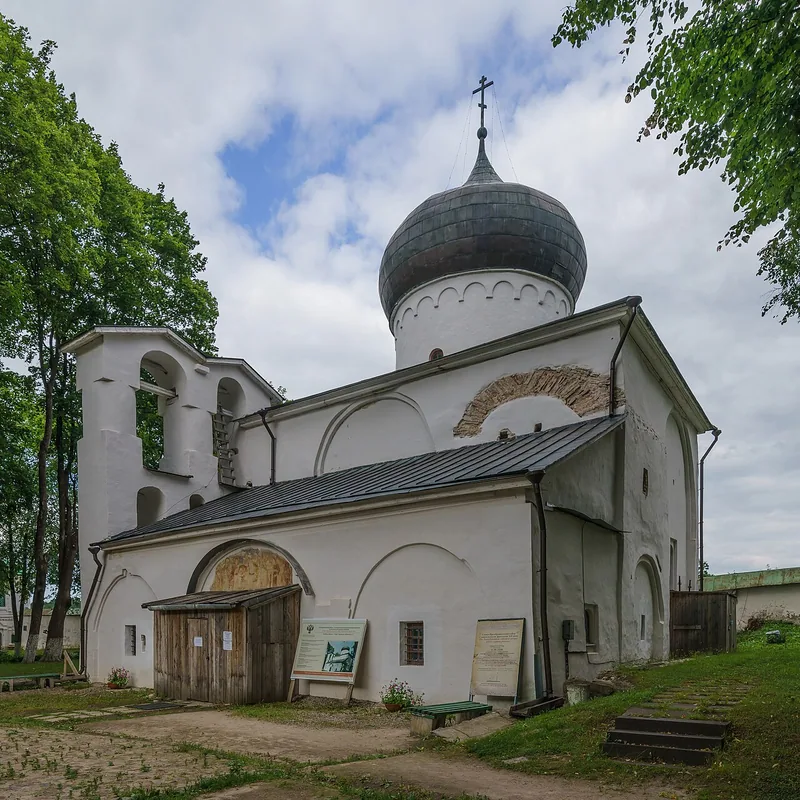

Explore Pskov one building at a time. Choose a church, look at it from several accessible viewpoints, then compare it with another. Asking what repeats can be more rewarding than trying to memorise every name and date in a single walk.
In 2019, UNESCO inscribed ten selected monuments of Pskov’s ecclesiastical architecture on the World Heritage List. This is a serial property made up of individual components, rather than a designation turning the entire city into one museum object. Everyday life continues between them.
Volume, porch and belfry
UNESCO identifies cubic forms, domes, porches and belfries among the school’s characteristics. Its development drew on Byzantine and Novgorodian traditions, with a particularly important period in the fifteenth and sixteenth centuries. These few reference points are enough to begin comparing buildings.
Separate a building mentally into its main volumes. Where is the entrance, how far does it project, and what does an adjoining part conceal? Then consider the open space around it. A simple sketch or photographs from two sides can explain the arrangement better than a single frontal view.
Mirozhsky: stone outside, colour within
The monastery’s Transfiguration Cathedral was built in the second quarter of the twelfth century for Nifont, Archbishop of Novgorod. The museum identifies local limestone and plinth bricks among its materials, and Greek painters as the makers of its interior frescoes.
Ask different questions outside and inside. In the grounds, compare the weight of the walls with the building’s height. Before the frescoes, consider how scenes relate to one another and where gestures and gazes lead. You do not need to recognise every subject: choose one image and look for its explanation in the museum’s resources.
A large history in a small fragment
An archive report dated 22 January 2021 describes the discovery of 561 fresco fragments near the cathedral’s altar end. Researchers suggested that they might have been removed when a window was enlarged in the eighteenth century. The pieces were carefully collected, dried and labelled for study.
This is a useful example of why conservation takes patience. A painted fragment becomes evidence through its recorded location and subsequent examination. When looking at a monument, distinguish surviving material, restoration and explanations that researchers still present as possibilities.
Planning an unhurried visit
Our suggestion is to begin with one architectural ensemble and allow time to return to details. Entry to Mirozhsky Cathedral depends on the weather: the museum specifies opening without precipitation. Check the museum page for visiting conditions before travelling.
If entry is unavailable, continue examining the exterior and use the museum’s digital resources. In working churches, respect services and local photography rules. Save both Мирожский монастырь and Mirozhsky Monastery so that you can connect maps, signs and museum descriptions. A short route with time to look can be more memorable than collecting names.
Sources & context
- UNESCO — Churches of the Pskov School of Architecture
- Pskov Museum — Mirozhsky Cathedral and visiting conditions
- Pskov Museum — fresco fragments, 22 January 2021
A russia.direct editorial selection based on open sources. Checked 24 September 2026. Practical suggestions are a decision guide, not a promise of outcomes.
Editorial principles