The Pushkin Museum of Fine Arts: from a cast gallery to a world collection
How a university museum of plaster copies, dreamed up by Ivan Tsvetaev, grew into one of Moscow's great collections of world art.
Cultural feature · checked 30 September 2026 · 5 min read
Published 30 September 2026
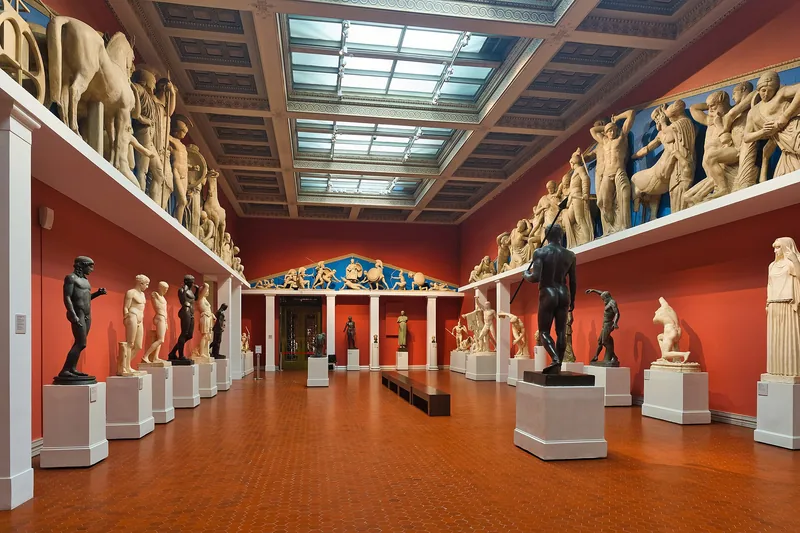

On Volkhonka Street, opposite the Cathedral of Christ the Saviour, stands a building in classical forms, as if in homage to the antiquity where it all began. Today the Pushkin State Museum of Fine Arts holds around 700,000 works here and in its other buildings: paintings, sculpture, drawings and prints, decorative art, archaeology, coins and photographs. Yet the museum was conceived quite differently, as a teaching collection of plaster casts from which students could study the world's sculpture without travelling abroad.
The museum's story is one of a single stubborn idea gathering collections nobody had planned in advance. Egyptian antiquities, Western European painting, Impressionists from Moscow private collections and personal collections of the 20th century all arrived later, layer by layer. The casts never went away: a plaster David by Michelangelo still stands in the Italian Courtyard, a reminder of how it all began.
Professor Tsvetaev's dream
Ivan Vladimirovich Tsvetaev, a professor at Moscow University and an expert in classical art, campaigned from 1893 for an art museum in Moscow. He saw it above all as a university teaching centre that would also be open to the wider public. Casts were central to this vision: plaster copies made it possible to show the whole history of sculpture, from the ancient Near East and Greece to the Renaissance, under one roof. Incidentally, the founder's daughter was the poet Marina Tsvetaeva.
Tsvetaev approached the task with rare thoroughness. He travelled abroad at his own expense to see the originals before ordering copies, sometimes chose lesser-known monuments that mattered to him, and insisted on fresh moulds rather than old, worn ones. That is how the collection acquired, for example, a cast of the stele of Hammurabi's laws after the Louvre original (1904), the doors of Hildesheim Cathedral (1908) and the winged bulls from the palace of Sargon II (1910).
A patron, an architect and a building
In 1896 a competition was announced for the design of the Museum of Fine Arts named after Emperor Alexander III, and in 1898 the architect Roman Klein was chosen; the foundation stone was laid on 17 (29) August that year. The state allocated 200,000 roubles, but the main donor was the industrialist Yury Stepanovich Nechaev-Maltsov, who gave around two million roubles for marble, sculpture and Egyptian objects. The building's engineering structures were designed by Vladimir Shukhov.
The museum opened on 31 May (13 June) 1912 in the presence of Nicholas II and the Dowager Empress Maria Feodorovna. At the opening more than a thousand casts and copies of wall paintings and mosaics were on show in 22 galleries. That same year a cast of Michelangelo's David was ordered in Florence for the Italian Courtyard. Tsvetaev, director since 1911, lived to see his creation finished but did not survive long after the opening; he died in 1913.
Egypt, painting and a new name
The first major collection of originals was the Egyptian antiquities assembled by the orientalist Vladimir Golenishchev, more than six thousand objects. The state bought them in 1909 and handed them to the museum in 1911. After the revolution the institution changed: in 1923 it was taken out of the university's control and became an independent art museum. On 10 November 1924 a picture gallery opened, built around Western European paintings from the Rumyantsev Museum.
In the 1920s and 1930s the collection grew with nationalised private collections and with works from the Hermitage and other Leningrad museums that considered them outside their own scope. In 1932 the museum became the State Museum of Fine Arts, and in 1937 it was named after Pushkin. During the war, in 1941–1944, the main collections were evacuated to Novosibirsk and Solikamsk.
Impressionists and the December Evenings
In 1948 the museum received about 300 paintings and more than 80 sculptures from the closed State Museum of Modern Western Art. Most were French Impressionist and Post-Impressionist works from the collections of the Moscow collectors Sergei Shchukin and Ivan Morozov. Today the museum's holdings include Botticelli and Cranach, Cézanne, Gauguin, Degas, Picasso and Van Gogh's The Red Vineyard.
The museum has long lived by more than exhibitions. Since 1981 it has hosted the December Evenings, begun by the pianist Sviatoslav Richter: concerts held among the paintings, with the festival later named after him. On 24 January 1994 the Department of Private Collections opened, and on 30 May 1997 the Tsvetaev Educational Art Museum, whose very name recalls the founder's original vision. Exhibitions and opening times are best checked at pushkinmuseum.art.
Sources & context
- Pushkin State Museum of Fine Arts — History of the museum
- Pushkin State Museum of Fine Arts — History of the collections
- Pushkin State Museum of Fine Arts — The Tsvetaev collection
- Wikipedia (Russian) — Pushkin State Museum of Fine Arts
- Wikipedia — Pushkin Museum
A russia.direct editorial selection based on open sources. Checked 30 September 2026. Practical suggestions are a decision guide, not a promise of outcomes.
Editorial principles