Rostov finift: painting born in fire
How Rostov Veliky's artists paint miniatures in enamel, and where to see the finest old and new finift.
Cultural feature · checked 30 September 2026 · 5 min read
Published 30 September 2026
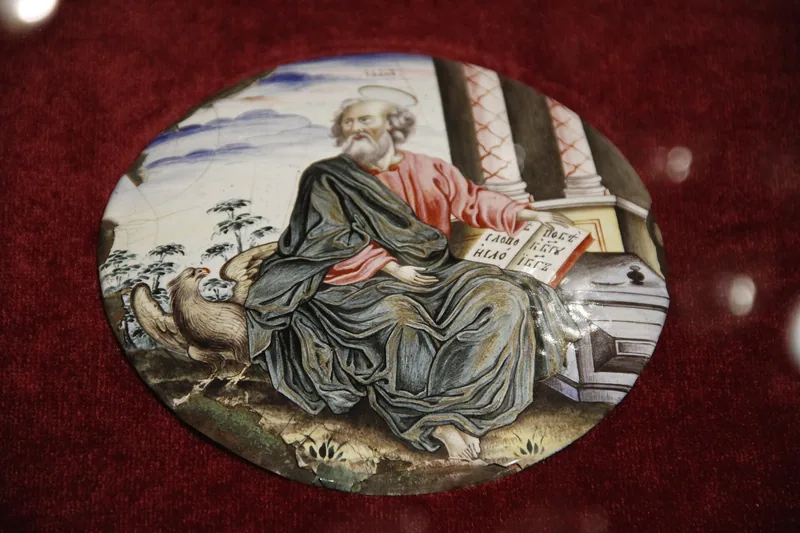

A small copper plate coated in white enamel, and on it a portrait, a bouquet or a view of a white-stone kremlin, painted with a jeweller's precision. The colours of finift do not fade with time: they are fused into a glassy base by the heat of the kiln. For almost three centuries such miniatures have been tied to one town — Rostov Veliky. Their sparkle recalls precious stones, although at heart they are nothing more than copper and glass.
In old Russia the word finift meant artistic enamel. Today Rostov finift means both antique icons in museum cases and modern jewellery made at the local factory. To understand where its special glow comes from, it is worth looking into both its history and the workshop. Both are possible in Rostov itself, home to the kremlin museum and to the factory that still makes finift.
Origins of the craft
Painting in enamel colours appeared in Europe in the 16th century; in Russia the art of enamel emerged in the late 17th century in Solvychegodsk and Moscow. In the early 18th century such painting began in Rostov too, within monastic circles. From the 18th century onwards the town became one of the main centres of Russian enamel. These dates show that Rostov finift grew out of an interest in enamel painting shared by Europe and Russia, yet quickly found a character of its own.
According to some sources, Metropolitan Arseny Matseevich stood at the origins of Rostov's miniature painting on enamel. The first pieces served the church: enamel images decorated mitres, chalices, Gospel covers and altar crosses. Over time portraits, landscapes and secular jewellery joined the icon subjects. Such objects demanded special care: a miniature had to remain clear and expressive even when only a few centimetres across.
Workshop and factory
In the 20th century the craft was kept alive by devoted masters. In 1918 an artel was organised that later became the Rostov Finift factory. The craft flourished in the 1930s, and in the 1960s the range expanded as finift began to be combined with filigree — openwork patterns of fine twisted wire. The combination of enamel and filigree made the pieces even more festive and recognisable.
Rostov enamels depict many subjects: portrait miniatures, landscapes on boxes and scenes from epics, folk songs and fairy tales. The factory still carries on the traditions of old Russian enamels, and its pieces have become one of the recognisable symbols of Rostov. Every piece is made by hand, so no two miniatures are ever the same.
How a miniature is made
The desired shape is cut from thin copper sheet and gently domed with a hammer. The plate is then coated on both sides with ground transparent and white enamel and fired in a muffle kiln at about 800 °C, producing a smooth white ground for painting. Enamel itself is a glassy mass coloured by metal oxides. Precision is needed from this very first stage: how the colours will lie depends on an even white ground.
Painting proceeds in several stages, each of which, as the factory describes it, ends with a firing at about 850 °C: first the malevka with the main colours, then the procherk with fine details, and finally the podtenok. The paints are mixed with lavender oil or turpentine and change colour in the fire, so the artist largely paints "from imagination". Repeated layering gives finift its depth and glow. For the mounts, hot cloisonné enamel is also used to emphasise the design, while the filigree elements are twisted by hand and soldered with silver solder.
The Enamel Museum in the Rostov Kremlin
The whole history of the craft can be traced in the Rostov Kremlin, an ensemble built mainly under Metropolitan Jonah Sysoevich in the second half of the 17th century. The museum within its walls dates back to October 1883, when the Museum of Church Antiquities opened in the White Chamber. The Enamel Museum became a separate department on 3 July 1995. The kremlin itself, with its walls, towers and churches, deserves a walk of several hours.
Its display occupies the building of the Sudny Prikaz, the former court office: in summer 2000 a suite of three halls opened, followed a little later by a technology hall showing enamellers' tools and equipment. Here you can follow the path from 18th- and 19th-century icon painting on enamel through the Soviet period to the work of 21st-century masters. Opening hours and tours are best checked on the museum-reserve's website. After the museum, it is rewarding to seek out the work of today's Rostov enamellers — a good way to see how an old art lives on.
Sources & context
- Rostov Kremlin — The Enamel Museum in the Rostov Kremlin
- Rostov Finift factory — History
- Rostov Finift factory — How it is made
- Association of Folk Art Crafts of Russia — Rostov finift
- Wikipedia — Rostov Kremlin
A russia.direct editorial selection based on open sources. Checked 30 September 2026. Practical suggestions are a decision guide, not a promise of outcomes.
Editorial principles