The Russian Museum: how to read the halls of the Mikhailovsky Palace
St Petersburg's state museum of Russian art, from a 12th-century icon to the avant-garde, and how not to get lost along the way.
Cultural feature · checked 30 September 2026 · 5 min read
Published 30 September 2026
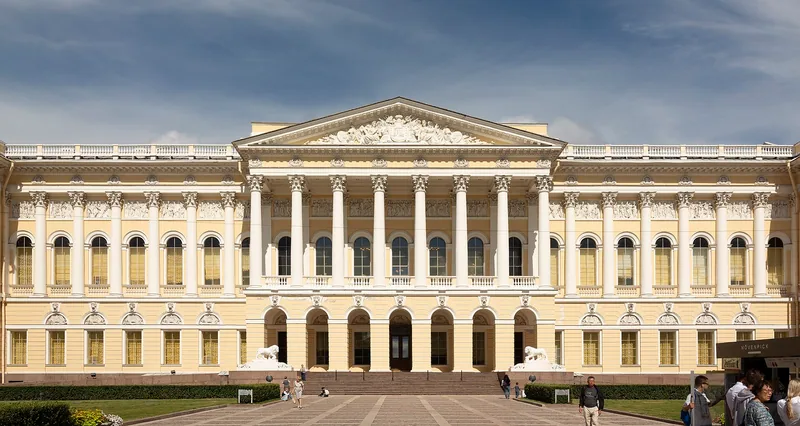

In the very centre of St Petersburg, on Arts Square, stands the Mikhailovsky Palace. Since the late 19th century it has housed what the museum calls the world's largest collection of Russian art: according to the museum itself, more than 450,000 objects made between the 10th and the 21st centuries. Icons and ceremonial portraits, huge history paintings and avant-garde canvases are arranged so that a walk through the halls becomes a short course in the history of Russian art.
The State Russian Museum has long outgrown a single building: its architectural ensemble includes the Mikhailovsky Palace, the Benois Wing, the Marble and Stroganov palaces, the Mikhailovsky Castle, the Summer Palace of Peter I and the Summer and Mikhailovsky gardens. Yet the main route still starts in the Mikhailovsky Palace. To keep it from turning into an endless procession of frames, it helps to know how the display is organised and where the collection came from in the first place.
The Museum of Emperor Alexander III
The idea of a museum of national art is linked to Alexander III, and the decree founding it was signed by Nicholas II on 13 (25) April 1895. The new institution was named the Russian Museum of Emperor Alexander III and was given the Mikhailovsky Palace. It formally opened to visitors on 7 (19) March 1898. The capital thus gained a state museum devoted entirely to Russian fine art rather than to the European masterpieces for which the Hermitage was famous.
The first collection was modest by today's standards: at the opening it listed 445 paintings, 111 sculptures and 981 works on paper. Pieces came from the Academy of Arts (122 paintings), the Hermitage (80) and the Winter, Gatchina and Alexander palaces (95 paintings between them), together with private collections. The holdings grew for decades after that, and after 1917 they absorbed many nationalised private collections.
Rossi's palace and the Benois Wing
The Mikhailovsky Palace was built by Carlo Rossi in 1819–1825 for Grand Duke Mikhail Pavlovich, the youngest son of Paul I. It is a classic example of St Petersburg Neoclassicism and one of the architect's best-known buildings in the city. In 1895–1898 the architect V. F. Svinyin adapted the palace for museum use, which is why some rooms still keep traces of their earlier life, such as the Small Study or the former state bedroom.
The collection soon outgrew the space, and in 1914–1920 a new building designed by L. N. Benois and S. O. Ovsyannikov was added to the palace; today it is simply called the Benois Wing. Where the palace offers the state enfilades of a former grand-ducal residence, the Benois Wing was conceived from the start as a museum building. This is where art from the turn of the 20th century through to the 21st is shown, and the chronological route from the palace carries on naturally inside it.
A route through the Mikhailovsky Palace
The chronological display begins on the second floor. The first rooms hold early Russian painting, including the museum's oldest object, the 12th-century icon of the Archangel Gabriel known as the Angel with the Golden Hair. The next rooms show works by Andrei Rublev and Dionisy; according to encyclopaedic sources the museum holds about five thousand icons in all. Then the 18th century begins: portraits by Vishnyakov and Rokotov and Rastrelli's sculpture Empress Anna Ioannovna with a Little Blackamoor.
The climax of the state enfilade is the hall of academic art. Here hang Karl Bryullov's The Last Day of Pompeii (1833) and Ivan Aivazovsky's The Ninth Wave (1850); the seascape's title refers to the old belief that the ninth wave in a storm is the most dangerous. Going down to the first floor, visitors enter the second half of the 19th century. Among the works here is Ilya Repin's Barge Haulers on the Volga, which joined the collection in 1918; the museum also owns his famous Zaporozhian Cossacks.
The Benois Wing and the avant-garde
In the Benois Wing the chronology continues: Symbolism, Fauvism, Suprematism, abstraction. On the second floor you can trace how Russian artists of the early 20th century broke the familiar rules one after another. Mikhail Vrubel, Wassily Kandinsky, Kazimir Malevich and Pavel Filonov are all represented, along with decorative art such as Vrubel's ceramics and Soviet porcelain. For many visitors, this wing is the real discovery after the classical halls of the palace.
In the late 1980s the museum set up a department of contemporary trends, and since then the collection has kept growing with art of recent decades. The museum's popularity shows in the numbers: according to the museum, 5.1 million people visited in 2025, and The Great Karl, an exhibition devoted to Bryullov, drew 477,000 visitors. Current opening times and routes are best checked on the official website, rusmuseum.ru.
Sources & context
- State Russian Museum — About the museum
- Kultura.RF — Guide to the Mikhailovsky Palace and the Benois Wing
- Wikipedia (Russian) — State Russian Museum
- Wikipedia — State Russian Museum
A russia.direct editorial selection based on open sources. Checked 30 September 2026. Practical suggestions are a decision guide, not a promise of outcomes.
Editorial principles