Sabantuy: a festival of the plough, wrestling and horse races
How an ancient farming rite of the Tatars and Bashkirs became a summer festival of towel wrestling, horse races and cheerful contests.
Cultural feature · checked 30 September 2026 · 5 min read
Published 30 September 2026
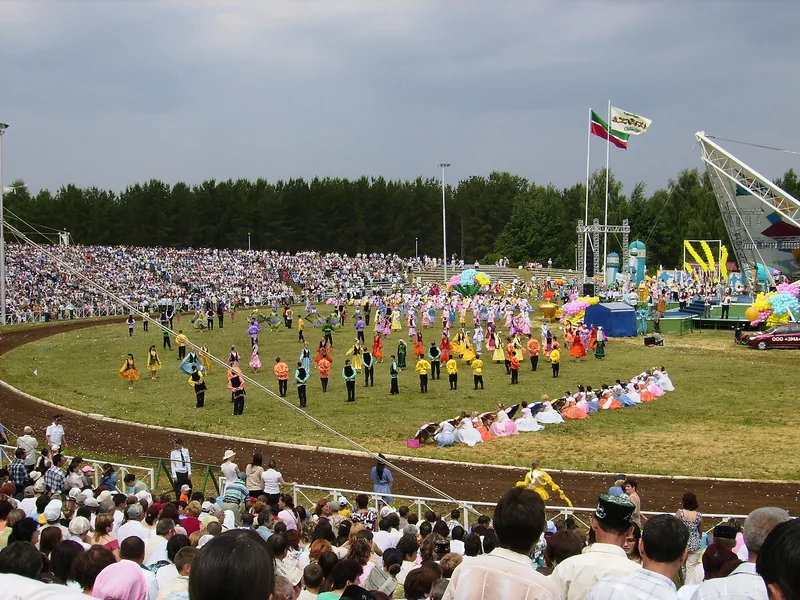

In summer, thousands of people gather at forest edges and meadows across Tatarstan and Bashkortostan. In the middle is a ring where two wrestlers, gripping each other with towels, try to lift their opponent off the ground. Nearby someone is climbing a tall smooth pole, children are racing in sacks, and further off horses are being readied for the races. This is Sabantuy, a festival whose name is translated from the Turkic languages as "festival of the plough": saban means plough, and tuy means feast or celebration.
Sabantuy's roots reach deep into the past, to farming rites through which people tried to appease the spirits of fertility and secure a good harvest. It was once held in spring, before or after field work, but today it is celebrated in summer, mostly in June. The Bashkirs call it Habantuy, and in Tatarstan itself it has become one of the main festivals of the year. The word has taken root so firmly that in Russian "sabantuy" is used jokingly for any noisy get-together.
From rite to national festival
The first detailed written accounts of Sabantuy were left by 18th-century travellers: the Russian scholar Ivan Lepekhin and the German ethnographer Johann Georgi. Among the Bashkirs they saw a festival with prayers for a rich harvest, a feast and horse races. The old rites were full of farming magic: in some places ploughmen and fields were doused with water, and children were cooked a special ritual porridge that the Tatars call qarğa botqası, "crow's porridge".
Over time the village rite grew into a festival of the whole people. By the early 20th century Sabantuy was already seen as the national festival of the Tatars, with rules shared across many places. In Soviet times it was not banned but moved to the period after sowing. Today it is held in every district of Tatarstan and then in Kazan; in the republic it is a state holiday that draws hundreds of thousands of people every year.
Gathering the gifts
Preparations began long before the day itself. Young women embroidered kerchiefs and towels in advance: these went to the winners of the contests, and the finest embroidery was a matter of pride. Children went from house to house collecting grain, butter and eggs for a communal porridge, while older youths toured the village gathering dyed eggs and gifts for the festival. Entering a house, they wished that their "step might be light", and such a visit was believed to bring the household prosperity.
These rounds were more than prize collecting. Every household contributed something to the common celebration, so Sabantuy was felt to be the whole village's affair rather than the work of a few organisers. Traditionally the elders, the aqsaqals, set the date. The contests took place on the maydan, a festival ground usually chosen at the edge of a forest. On the appointed day everyone gathered there with food, songs and the gifts they had collected.
Köräş: wrestling by the sash
The main event of Sabantuy is the national wrestling köräş. Wrestlers hold each other by a sash or towel thrown across the opponent's back and try to bring him down. The bouts are fought only standing. In Bashkir köräş, as described by Bashkortostan's expert council on intangible heritage, leg sweeps and leg hooks are forbidden, and a clean win is scored when the opponent is lifted off the mat and thrown onto his back so that both shoulder blades touch it.
Bouts proceed by age, from young boys to grown men, and the strongest meet in the final. The overall winner earns the honoured title of batyr. The traditional prize is a live ram, a symbol of plenty, and it is still ceremonially presented to the champion. In the past a batyr also received embroidered towels; today the ram often comes with cash prizes and even a car. Historians link köräş to martial exercises that once prepared young men for mounted combat.
Races, the pole and the pots
Horse races draw just as much attention, and they appear in the very earliest descriptions of the festival. Spectators line the course and cheer the riders loudly. Besides the races, the maydan hosts foot races, tug-of-war and climbing a tall smooth pole with a prize waiting at the top. Some have the strength and skill to reach the top, while others slide back down to the crowd's laughter without ever touching the reward.
The merriest contests are the comic ones. Contestants race in sacks, run with an egg on a spoon, trying not to drop it, and try to smash a clay pot with a stick while blindfolded. Another game is a pillow fight with hay-stuffed sacks while sitting astride a log: whoever stays on wins. In the evening young people came to the festival with songs and dances. Today Sabantuy is held in Moscow and other regions, and since 2014 it has also been celebrated in European cities.
Sources & context
- Kultura.RF — Sabantuy: history, traditions and customs
- Intangible Cultural Heritage of Bashkortostan — Köräş, the Bashkir national wrestling
- Living Heritage — Sabantuy, the plough festival
- Wikipedia — Sabantuy (Russian)
- Wikipedia — Sabantuy
A russia.direct editorial selection based on open sources. Checked 30 September 2026. Practical suggestions are a decision guide, not a promise of outcomes.
Editorial principles