Shukhov Tower: the openwork geometry of Vladimir Shukhov
How straight steel rods formed a curving tower at Shabolovka, and where Shukhov’s hyperboloids began — from Polibino to Moscow.
Cultural feature · checked 30 September 2026 · 5 min read
Published 30 September 2026
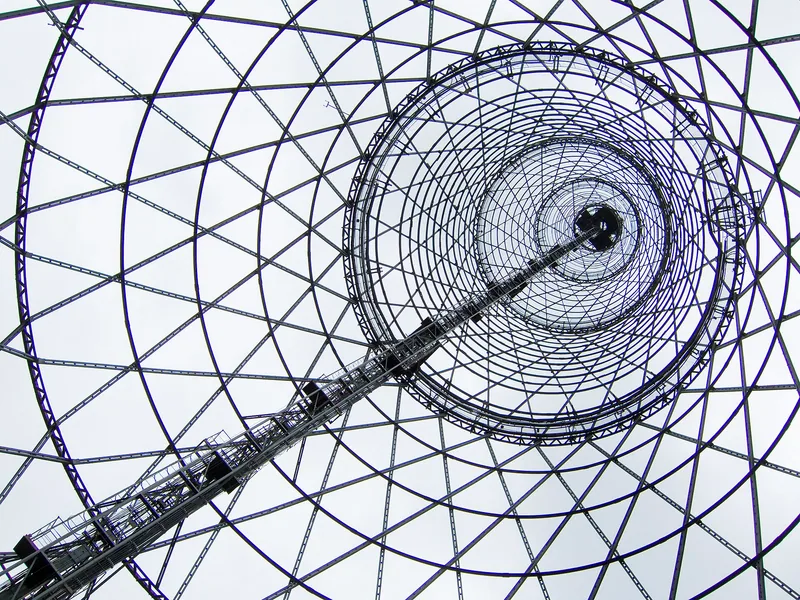

Above Moscow’s Shabolovka district rises a lattice tower that looks now like a woven basket, now like a stack of light lampshades. Muscovites know its silhouette well, and engineers around the world know it as one of the peaks of early-20th-century structural thinking. It is especially striking against the sky: clouds show through the mesh of steel rods, and the structure seems to weigh almost nothing.
Its author was Vladimir Grigoryevich Shukhov (1853–1939), an engineer often compared to Edison for the number and range of his inventions. His central idea was at once simple and bold: to build a curved, strong and light structure entirely out of straight members. His legacy is vast, from oil pipelines and storage tanks to the roofs of the Upper Trading Rows and Kievsky Station, but it was the towers that made his name known far beyond his profession.
A curve made of straight lines
A hyperboloid of one sheet is a surface that can be formed entirely from straight lines. Set straight rods in a circle at an angle and tie them together with rings, and you get a lattice shell with a “waist”. Shukhov developed both the structures themselves and the mathematical method for calculating them. Look up at such a structure from below and you see straight lines crossing and merging into a smooth curve; geometry here becomes almost graphic art.
In such a lattice the load is shared among many rods, so the tower is strong and wind-resistant yet remarkably light. The design saves metal, a quality that proved decisive in hard times. For Shukhov beauty and calculation did not conflict: a form found for reasons of economy and strength turned out to be exceptionally elegant as well.
The first tower: Nizhny Novgorod and Polibino
The first hyperboloid tower appeared in 1896 at the All-Russia Industrial and Art Exhibition in Nizhny Novgorod, for which Shukhov designed several pavilions. About 37 metres tall, it is regarded as the world’s first lattice hyperboloid structure. The exhibition was a showcase of the technical achievements of its day, and the lattice tower immediately drew attention as a new word in construction.
After the exhibition the industrialist and patron Yury Nechaev-Maltsov bought the tower and moved it to his estate at Polibino, now in the Dankovsky District of the Lipetsk Region. It still stands there, and the estate is under state protection at the federal level. Shukhov and his followers later built, by various estimates, some two hundred hyperboloid towers. The small tower at Polibino is a rare chance to see the very beginning of a great engineering story in almost its original state.
Shabolovka: 1920–1922
The Shabolovka radio tower was built in 1920–1922, during the Civil War; the last section was installed on 14 February 1922. The original design called for a height of 350 metres, but a shortage of metal forced the plan to be scaled down. The finished tower consists of six hyperboloid sections stacked on top of one another and stands about 150–160 metres tall; sources differ slightly on the figure. Even in its reduced form the tower became a dominant feature of the district and one of its main landmarks.
The whole structure weighs only about 240 tonnes. It was built without cranes or scaffolding: the sections were hoisted into place with wooden winches. The tower served radio and then television; the Ostankino Tower replaced it as the country’s main television hub, and broadcasting from Shabolovka ended in 2002. The method was dictated by circumstance, but it went down in history as an example of ingenuity, with engineering thought making up for a lack of machinery and materials.
The tower today
The tower’s condition has long been a concern, as its metal has suffered decades of corrosion. In 2014 its future became the subject of wide public debate, and that same year the tower was granted status as a cultural heritage site of regional significance. The debate showed how dear the tower is to many people, not only engineers and architects but also those who simply grew up with its silhouette.
In April 2026 a reconstruction project received a positive expert review. It envisages dismantling the tower in stages from the top down, restoring its elements and reassembling it on the same spot while keeping its historical parameters; some specialists, however, have voiced concerns about replacing the original metal. As the work is only beginning, it is best to follow news of the tower through official announcements. Whatever the outcome, the story of the Shukhov Tower is a reminder of how important it is to care for monuments of engineering as much as for palaces and churches.
Sources & context
- Archi.ru — Shukhov Tower reconstruction receives positive expert review
- Living Heritage — Shukhov Tower
- Wikipedia — Shukhov Tower
- Wikipedia — Shukhov Tower in Polibino
- Wikipedia — Vladimir Shukhov
A russia.direct editorial selection based on open sources. Checked 30 September 2026. Practical suggestions are a decision guide, not a promise of outcomes.
Editorial principles