Krasnoyarsk Stolby: stone giants above the Yenisei and the people who climb them
How rock pillars above Krasnoyarsk grew out of ancient magma, and why a tradition of free climbing called stolbism has lived around them for a century and a half.
Cultural feature · checked 5 October 2026 · 5 min read
Published 5 October 2026
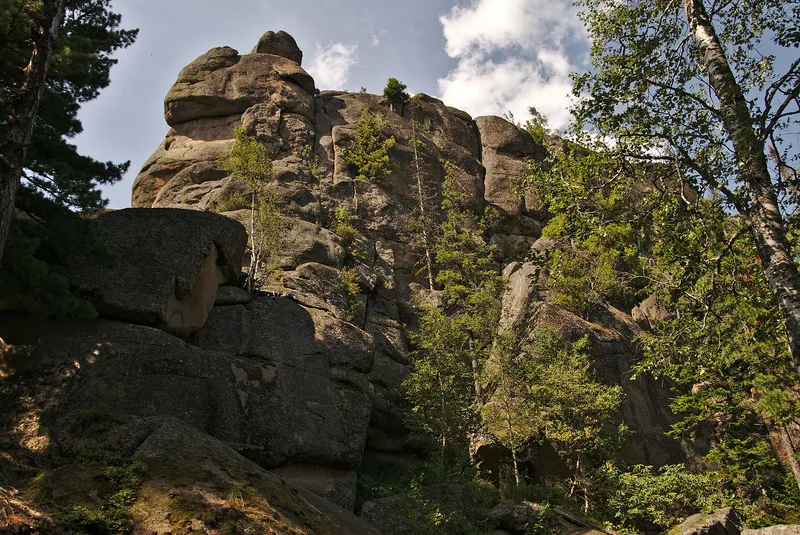

On the right bank of the Yenisei, almost touching Krasnoyarsk, solitary rocks rise out of the dark taiga: grey, rounded, as if stacked from giant stone cushions. Locals simply call them the Stolby, the Pillars. Many have names of their own: the First and Second Pillars, Grandfather, the Feathers, the Lion Gates, Takmak. For people in Krasnoyarsk this is not distant wilderness but a place they have visited at weekends since childhood, where they meet friends and learn to hold on to stone.
The Stolby are famous not only for how they look but for their people. For more than a century and a half the rocks have been home to stolbism, a culture of climbing without ropes, with its own huts, customs and vocabulary. It was the stolbists who got the rocks protected: a nature reserve was created here in 1925, and in 2019 it became Krasnoyarsk Stolby National Park. In 2025 the Stolby marked a hundred years as a protected area.
Frozen magma
According to the national park, the highest and toughest landforms here are made of granites and quartz syenites. The syenites date from the Middle Devonian: they were once magma that pushed into older layers of basalt, limestone, schist and sandstone and cooled deep underground. The surrounding rocks proved softer, and over millions of years the wearing down of the mountains gradually exposed the hard intrusive bodies. That is how stone formed underground came to stand on the surface.
A new uplift of the area began, according to the park's geologists, some 30–35 million years ago, and rivers once again started cutting into the land. Then frost, water and wind took over: weathering worked unevenly, along cracks, leaving separate rock remnants standing out from the massifs. Their rounded blocks and slabs resemble people or animals, hence the names. The park's central ridge rises 600–700 metres above sea level, and its highest point, on the Kaidyn Ridge, reaches 832 metres.
Taiga on the city's doorstep
The park lies on the north-western spurs of the Eastern Sayan, on the watershed of the Yenisei's right-bank tributaries, the Bazaikha, the Mana and the Bolshaya Slizneva. It is a transition zone between forest steppe and mountain taiga. About 80 per cent of the territory belongs to the upper belt of dark coniferous taiga, with spruce, fir and Siberian pine, while pine, larch, birch and aspen grow lower down. According to reference sources, the national park covers about 48,000 hectares.
Yet only a small part of the park is open for recreation: the tourist and excursion area takes up, by available figures, less than 4 per cent of its area. The rest of the taiga stays away from the trails. The pressure on this small part is heavy: in recent years the park has recorded around a million visits a year. That is why visiting rules here are strict and access is sometimes restricted, for example because of bear activity; the park's official website publishes current information.
The birth of stolbism
The first geographical description of the Stolby appeared in 1837, and in 1845 a detailed book about them by P. A. Chikhachev was published in Paris. The national park dates the history of rock climbing here to 1851, when the first sporting ascent of the First Pillar took place on the feast of Ivan Kupala. By the end of the nineteenth century climbing had become a familiar pastime for townspeople, and wooden huts began to appear beneath the rocks, where groups spent the night and gathered together.
Stolbists climbed without ropes, relying on natural holds and the skill of reading the rock, and cleared lichen and debris from the faces as they went. The community rested on unwritten rules of friendship, hospitality and mutual help. On the eastern wall of the Second Pillar a large inscription reading Svoboda, Freedom, painted by three daring men in 1899, can still be seen; over time it became one of the symbols of the Stolby and is still kept up today.
From reserve to national park
In 1913 there was an attempt to quarry stone near the Second Pillar, and townspeople took it as a warning. In 1919 the Krasnoyarsk Geographical Society asked for the rocks to be protected, and on 30 June 1925 the Yenisei provincial executive committee established the Stolby reserve, covering 3,966 hectares. Its first head was A. L. Yavorsky, himself devoted to the rocks. Later the reserve grew considerably and took in the taiga around the rocks.
Stolbism has not always had an easy time: in 1938 free climbing was banned and the huts were pulled down. But after the war the tradition returned: in 1946 the Berkuty society was formed, and in 1960, when the reserve faced closure, its defenders gathered around 50,000 signatures. The Stolby produced well-known mountaineers, among them the Abalakov brothers. In 2019 the reserve was turned into a national park, and in December that year it welcomed its millionth visitor of the year.
Sources & context
- Krasnoyarsk Stolby National Park — History
- Krasnoyarsk Stolby National Park — Geology
- Krasnoyarsk Stolby National Park — The territory
- Znanie encyclopedia — Krasnoyarsk Stolby (national park)
- Lenta.ru — Stolbism: history and traditions
A russia.direct editorial selection based on open sources. Checked 5 October 2026. Practical suggestions are a decision guide, not a promise of outcomes.
Editorial principles