Suzdal: white stone, a kremlin and wooden architecture
Suzdal's UNESCO-listed white-stone monuments, the kremlin on the Kamenka and the Museum of Wooden Architecture, seen on foot.
Cultural feature · checked 30 September 2026 · 4 min read
Published 30 September 2026
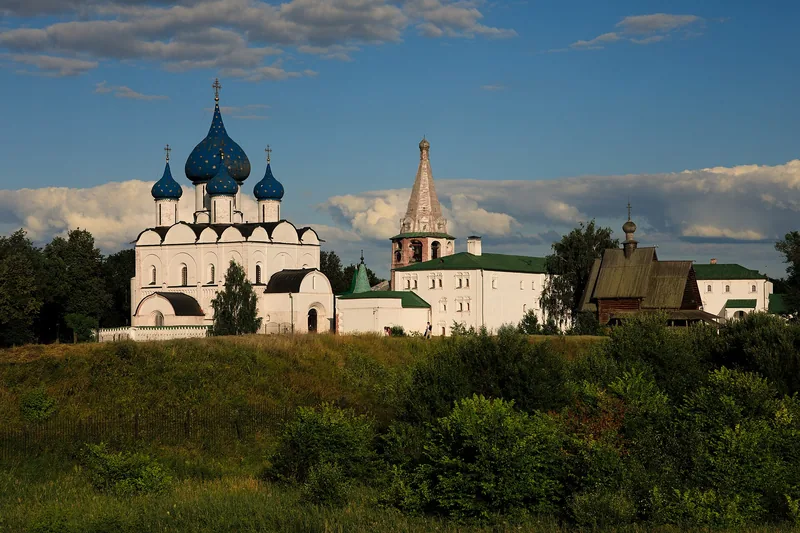

Suzdal is a small town where architecture waits at almost every turn: cathedrals, monasteries, bell towers and wooden churches set among meadows and the bends of the Kamenka River. Its central theme is white stone, the material used eight centuries ago to build the churches of the Vladimir-Suzdal land. Even a short walk here becomes a history lesson that needs no preparation: it is enough to look around.
In 1992 the white-stone monuments of Vladimir and Suzdal, together with the church at Kideksha, were inscribed on the UNESCO World Heritage List. Suzdal lets you see this tradition up close and without hurry, since the town is easy to explore on foot. Below are a few stops that make a good start to getting to know the town.
A UNESCO heritage
The White Monuments of Vladimir and Suzdal were inscribed on the World Heritage List in 1992 under criteria (i), (ii) and (iv). In Vladimir the property includes the Cathedral of the Assumption, the Golden Gate and the Cathedral of St Demetrius, with the Church of the Intercession on the Nerl nearby; in Suzdal it covers the Cathedral of the Nativity, the Saviour Monastery of St Euthymius, founded in 1352, and the Convent of the Deposition of the Robe. Together these buildings show how the architecture of north-eastern Rus developed over several centuries.
UNESCO highlights the regular blocks of white limestone, refined proportions, fine stone carving and apparent lightness of these buildings. The Church of Sts Boris and Gleb at Kideksha, near Suzdal, is described as the first church in Russia built of white limestone. Hence the recognisable look of the churches of this land: they seem not heavy but almost to float above the surrounding landscape.
A kremlin in the bend of the Kamenka
The Suzdal Kremlin stands in a bend of the Kamenka River in the southern part of town. It is ringed by earthen ramparts about 1,400 metres long, raised at the turn of the eleventh and twelfth centuries. Inside is an ensemble that took shape over several centuries: the cathedral, the bell tower and the Archbishops' Chambers. The ramparts are still easy to make out today, and walking along them offers views of the river and surrounding meadows.
The Cathedral of the Nativity was built of white stone in 1222–1225. In 1528 its walls were taken down to the arcade band with female masks and rebuilt in brick, and the cathedral gained five domes in place of three. The old section still bears lion figures, masks and intricate ornament. So one building joins two eras: thirteenth-century white stone below and sixteenth-century brick above.
The Golden Doors and the bell tower
The cathedral keeps its Golden Doors, an outstanding work of thirteenth-century applied art. The western doors date from the 1220s, while the southern, main doors were probably made a little later, in the 1230s or 1240s. They are worth a pause to study the details. The doors are one of the reasons lovers of early Russian art travel to Suzdal on purpose.
Opposite the cathedral's southern facade a bell tower was built in 1635, crowned with a tall octagonal tent roof. The Archbishops' Chambers, which grew from the fifteenth to the eighteenth century as the residence of Suzdal's bishops, now house a museum with displays on local history. The bell tower is one of the kremlin's landmarks, its tent roof clearly visible from nearby streets and the riverbank.
Wooden Suzdal and a walk
Across the Kamenka, on Pushkarskaya Street, is the Museum of Wooden Architecture and Peasant Life. It was created in the 1960s and 1970s, when wooden buildings were moved here to preserve them. Today its 3.5 hectares hold 18 monuments of the eighteenth and nineteenth centuries, among them the Transfiguration Church of 1756 from the village of Kozlyatyevo, more than 21 metres tall, and the Resurrection Church of 1776 from the village of Patakino. The Transfiguration Church, with its tiers narrowing as they rise, is one of the museum's most striking buildings.
The museum recreates a small village of the old Vladimir province, and its log houses show peasant interiors and everyday objects. The kremlin and the museum combine easily into one walk along the river. Opening hours and tickets are best checked on the website of the Vladimir-Suzdal Museum-Reserve. Comfortable shoes and a little spare time are the main things you will need to get to know Suzdal.
Sources & context
- UNESCO World Heritage Centre — White Monuments of Vladimir and Suzdal
- Vladimir-Suzdal Museum-Reserve — Museum of Wooden Architecture
- Wikipedia (RU) — Suzdal Kremlin
- Wikipedia (RU) — Cathedral of the Nativity (Suzdal)
A russia.direct editorial selection based on open sources. Checked 30 September 2026. Practical suggestions are a decision guide, not a promise of outcomes.
Editorial principles