The Trans-Siberian: building the country’s longest railway
From the first stone in Vladivostok in 1891 to the great bridges over Siberian rivers, and how to travel the line in stages.
Cultural feature · checked 30 September 2026 · 4 min read
Published 30 September 2026

The Trans-Siberian Railway is more than a railway. It links Moscow with the Pacific, crosses eight time zones and runs through dozens of cities, many of which grew and changed because of it. From Moscow to Vladivostok it measures 9,288.2 kilometres. On the map it looks like a long thread pulling together a vast country, and for many Siberian and Far Eastern cities it is still the main link with the rest of Russia.
For travellers the Trans-Siberian is an almost mythical route: a week on the move, landscapes shifting from forest to steppe, Lake Baikal outside the window. Behind the romance, though, lie a quarter-century of hard work by many thousands of people and engineering solutions that are still a source of pride. So a trip on the Trans-Siberian is a journey not only through space but through history, where every major bridge and station has its own chapter.
A beginning on the Pacific
In spring 1891 Emperor Alexander III signed the decree to build the Great Siberian Way. Tsesarevich Nicholas, the future emperor, chaired the construction committee and on 31 May (19 May Old Style) 1891 laid the railway’s first stone near Vladivostok. Fittingly, construction began not in the capital but at the opposite end of the country, on the shore of the Pacific.
Work went on from several ends at once. According to the Russian Historical Society, up to 85,000–90,000 people worked on the line, laying 500–600 kilometres of track a year. Regular train services began in 1901, and the line became fully continuous in 1916. The builders had to lay track through taiga, swamps and permafrost, in a harsh climate and far from any large city.
Bridges over great rivers
The hardest sections were the crossings of Siberia’s rivers: the Ob, the Yenisei and the Amur. The Yenisei bridge at Krasnoyarsk, designed by Professor Lavr Proskuryakov, was built between 1896 and 1899 and was about 907 metres long. At the 1900 World’s Fair in Paris the design won a gold medal. In the late 1990s new spans were built on the old piers and the historic trusses were dismantled. The bridge became a symbol of the engineering school of its time and long remained one of Krasnoyarsk’s great sources of pride.
The final link was the bridge over the Amur at Khabarovsk, also designed by Proskuryakov, which opened on 5 October 1916. It was about 2.6 kilometres long. The bridge was rebuilt in the 1990s and 2000s and now carries both rail and road traffic. Completing this bridge at last allowed trains to run from Moscow to Vladivostok without transfers, on a single overland line.
The Circum-Baikal line
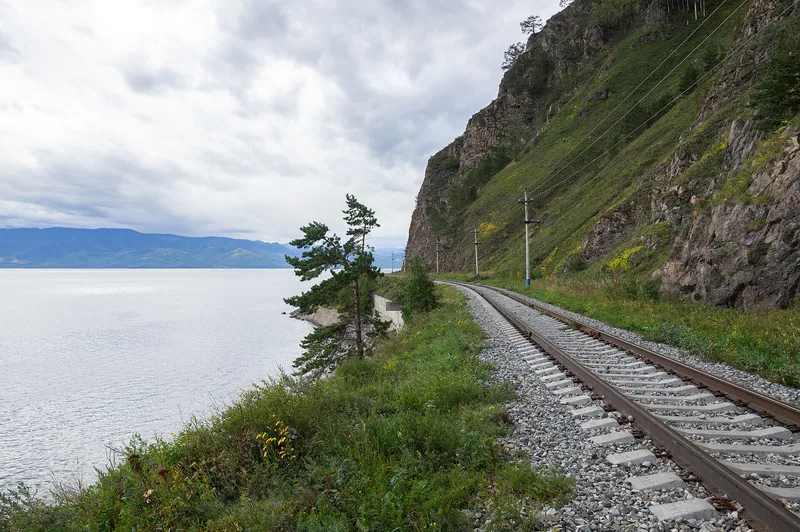
Baikal is a chapter of its own. Before a line ran round the lake, trains were carried across it on the icebreaking ferries Baikal and Angara. In 1904 the Circum-Baikal Railway was completed; it is often called the “golden buckle” of the Trans-Siberian. The ferry crossing over the huge lake was a bold solution, but it depended on weather and ice, which is why a continuous line along the shore was so badly needed.
The roughly 84-kilometre section along the shore includes more than thirty tunnels and many bridges and stone galleries. Today it is one of the most popular tourist routes, and since 2002 the entire main line has been electrified. Here trains run right by the water, between cliffs and the lake, and this section is considered one of the most scenic on the whole route.
Travelling the line in stages
Riding the whole line without stopping takes about six to seven days on the train. Many travellers prefer to split it into segments: for example Moscow to Yekaterinburg, where the border between Europe and Asia runs; then Novosibirsk and Krasnoyarsk; then Irkutsk, about 60 kilometres from Baikal; and finally Ulan-Ude, Chita, Khabarovsk and Vladivostok. Stops let you feel how cities, architecture, food and even the pace of life change as you travel east.
This approach leaves time to see the cities, not just the view from the window. These are only planning ideas: timetables, train routes and fares change, so check current information with the rail operator and on the regions’ official tourism portals shortly before you travel. Whatever you choose, the key to the Trans-Siberian is not to hurry: watch the window, talk to fellow travellers and let the vast country unfold before you gradually.
Sources & context
- Russian Historical Society — On 29 March 1891 Alexander III signed the Trans-Siberian decree
- RUSSPASS Magazine — The Trans-Siberian Railway
- Wikipedia — Trans-Siberian Railway
- Wikipedia — Krasnoyarsk Railway Bridge
- Wikipedia — Khabarovsk Bridge
A russia.direct editorial selection based on open sources. Checked 30 September 2026. Practical suggestions are a decision guide, not a promise of outcomes.
Editorial principles