Transport cards: how to pay for city travel
Troika in Moscow, Podorozhnik in St Petersburg, city cards elsewhere and paying by bank card: how cashless travel works.
Practical guide · checked 30 September 2026 · 5 min read
Published 30 September 2026
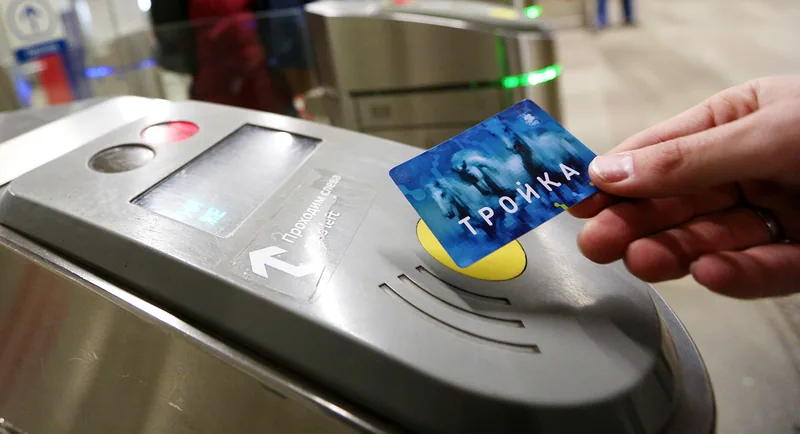

In Russia's large cities you almost always pay for a ride without cash: you simply tap a card on the metro turnstile or on the validator inside a bus or tram. Many cities have their own transport card for this, a plastic card with a chip that holds money or travel passes. In Moscow it is the Troika, in St Petersburg the Podorozhnik, and Kazan and many other cities have cards of their own.
A transport card is not the only option: in many cities you can also tap a bank card or a phone with contactless payment on the validators. But the rules, payment methods and fares differ from city to city and change from time to time. Before you travel, open the website of the local operator or city transport portal and check the current fare and the accepted ways to pay. Below are the general principles that will help you find your way on day one.
Troika in Moscow
Moscow's Troika card was introduced in 2013 and works on the metro, surface transport and suburban trains. You can load travel passes valid for a set number of days, or put money into the Wallet and pay for each trip separately. The card is sold at metro ticket offices and new ticket machines, at MCC and MCD ticket offices, at Mosgortrans machines and at suburban railway ticket offices. You pay a deposit for the card itself, which is refunded when you return it undamaged.
You can top up a Troika in the metro, at ticket offices and machines, or remotely: through the Moscow Transport portal, the Moscow Metro and Moscow Transport apps, by text message and through partner apps. In some cases money added remotely has to be written onto the card at a special terminal in the metro, so check the procedure on the official website. For your first trips it is useful to know that several Moscow stations have information desks staffed by people who speak Russian and English.
Podorozhnik in St Petersburg
In St Petersburg the main card is called the Podorozhnik. It works as an electronic wallet: you load money onto it, and the fare is deducted on every trip. The card is valid on the metro, buses, trams and trolleybuses. You can buy it at any metro station, at the St Petersburg Metro offices and at a kiosk in Pulkovo Airport. The balance is easy to top up at metro ticket offices, at station terminals that offer an English menu, or online.
Since 2017 the two capitals have issued a combined Troika–Podorozhnik card. Technically it is a single card with two wallets, one for Moscow and one for St Petersburg, with a design that depends on the city where it was issued. It suits people who travel often between the two cities, as there is no need for separate plastic on each trip. Check the operators' websites for where the combined card is available now and how to top up each of its wallets.
Cards in other cities
Many regional capitals have their own transport cards, and they work on a similar principle. In Kazan, for example, the transport card is valid on the metro, trams, trolleybuses and buses, as well as on suburban trains; it is sold at places including post offices and can be topped up at hundreds of points around the city and online. If you are staying in a city for a while, a card usually pays off in convenience.
Regional cards differ in their names, sales points and terms, and concession versions for students, schoolchildren and pensioners are issued separately and are usually meant for local residents. So when you arrive in a new city, start with the website of the local transport operator or metro: it normally has a section on paying fares that lists where to buy and top up a card. Look there for the current fare too, since fares are revised regularly.
Bank cards and phones
In many cities you can travel without a transport card at all, simply by tapping a bank card on the turnstile or validator. Moscow Metro turnstiles accept contactless bank cards, and on the city's surface routes you can pay with a bank card or a smartphone. In Kazan, validators on trams and trolleybuses accept bank cards from various payment systems and NFC-enabled phones. In St Petersburg, according to a guide from ITMO University, validators on surface transport also accept bank cards.
Bear in mind that paying by bank card does not always work on the same terms as a transport card. The ITMO guide, for instance, notes that in St Petersburg a trip paid by bank card costs more than one paid with a Podorozhnik, so regular travellers are better off getting the city card. Tap only one card at a time on the validator, so that the system does not charge the wrong account. Check the current rules and fares on the operator's website.
Sources & context
- mos.ru — How the Moscow Metro works: the Troika card and ways to pay
- mos.ru — Moscow and St Petersburg travel cards merged
- Wikipedia — Troika card
- ITMO University — A guide to public transport in St Petersburg
- Kazan Transport — The transport card
A russia.direct editorial selection based on open sources. Checked 30 September 2026. Practical suggestions are a decision guide, not a promise of outcomes.
Editorial principles