Ukha: fish broth from the river campfire to the fair
How an ancient word for any broth became the name of a fish soup, and why white, black and red ukha are cooked differently.
Cultural feature · checked 30 September 2026 · 5 min read
Published 30 September 2026
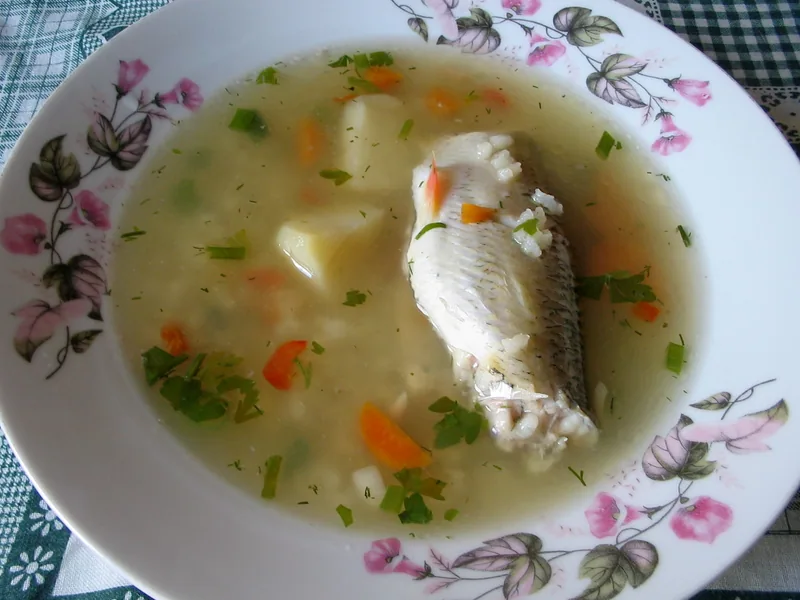

Today the Russian word ukha means only one thing: a hot soup cooked in a particular way from fresh fish. It was not always so. For centuries almost any broth was called ukha, and only gradually did the word pass to the fishermen. On the great rivers, where fish was always plentiful, ukha became both an everyday and a festive dish: it was cooked on the bank from the fresh catch and, on wealthy tables, from sterlet, prized according to where it was caught: the Oka, the Volga, the Dvina, the Sheksna or the Ob.
Pokhlebkin stressed that true ukha is not simply soup with fish in it. It is a clear, gently gelatinous and delicate broth with hardly any vegetables: a little potato and carrot, obligatory onion, parsley, dill, pepper and bay leaf. It is cooked in a pot that does not react with food, enamelled or earthenware, uncovered and over moderate heat. Ukha is served with dark bread or pies: fish kulebyaka, open-topped rasstegai, pies with rice and egg.
An ancient word
The word ukha is very old and has relatives across Europe. Max Vasmer lists Bulgarian yukha, Serbo-Croatian jūha, Czech jícha and Polish jucha, as well as Lithuanian jū́šė, "fish soup", and Old Prussian iuse, "soup with meat". Further back the chain leads to Latin iūs, "broth, soup", Sanskrit yū́ṣ and a Greek word meaning "broth". All of them, according to Vasmer, go back to an Indo-European root meaning "to stir, to mix".
In other words, ukha was originally just a "cooked mixture", any liquid broth. Dictionaries still record this obsolete sense: "any broth, pottage". Within Russian itself the word gradually narrowed, and along the way you can see how everyday cooking changed: from meat broth to chicken broth and then to fish broth, which in the end became the word's only meaning.
From meat to fish
According to Pokhlebkin, in the eleventh and twelfth centuries ukha meant meat broth. In the sixteenth and seventeenth centuries chicken broth was also given the name, hence "chicken ukha", which today sounds almost like a contradiction. From the fifteenth century fish increasingly became the basis of ukha, and by the late seventeenth and early eighteenth centuries the word was firmly attached to fish broths alone.
Over time ukha also acquired local faces. Pokhlebkin mentions sterlet ukha as a Volga dish and smelt ukha as a Pskov one, while English-language reference works most often link ukha with the Don and Cossack cooking. The rivers gave a varied catch, from perch and ruffe to sturgeon. That abundance allowed a refined system to take shape in which different fish gave different broths, and therefore different kinds of ukha.
White, black and red
Pokhlebkin divided ukha into three kinds. White ukha, the finest, is made from fish that give a clear, gelatinous and delicate broth: zander, perch, ruffe and whitefish. Black ukha uses ide, carp, chub and crucian carp. Red, or amber, ukha is made from sturgeon, beluga, stellate sturgeon, nelma and salmon. For a good ukha he advised combining two to four kinds of fish; only red ukha may be made from a single species. He considered roach and fish of the herring family unsuitable.
The order of work matters too. First a salted vegetable stock is made, and the fish goes in only briefly: river fish for 15–20 minutes, Siberian fish for 25–30, or it falls apart and the broth clouds. In the old way, small fish and bones were first cooked through and strained, and the large pieces were then cooked in that strong stock. This way ukha became rich yet stayed clear.
From campfire to fair
Fishermen's ukha on the riverbank has its own customs. Fishermen often add a shot of vodka at the end of cooking, and another well-known trick is to plunge a smouldering brand from the fire into the pot just before taking the ukha off the heat. Enthusiasts insist that ukha is best made from fresh rather than frozen fish, and they prefer small, young fish. Nineteenth-century travellers counted ukha among the finest dishes of Russian cuisine.
Sterlet ukha was a symbol of a generous table. In Dead Souls, Nikolai Gogol listed sterlet ukha with burbot and milt among the travelling pleasures of middling landowners. The angling expert Leonid Sabaneev joked in the 1870s that ukha made from sterlet alone was fit only for amusing young merchants at the Nizhny Novgorod Fair, and advised first making a strong broth from perch and small fish. In that advice the experience of the fishermen's campfire met the taste of the Volga fairs.
Sources & context
- William Pokhlebkin, National Cuisines of Our Peoples — Ukha
- Vasmer's Etymological Dictionary — ukha
- Wiktionary (Russian) — ukha
- Kultura newspaper — Sterlet ukha? Not bad at all!
- Wikipedia — Ukha
A russia.direct editorial selection based on open sources. Checked 30 September 2026. Practical suggestions are a decision guide, not a promise of outcomes.
Editorial principles