Vladivostok: a city worth seeing from different levels
Harbour views, streets and museum stories introduce the Far Eastern city through places and people.
Landscapes, history and everyday life · 3 min read
Published 24 September 2026
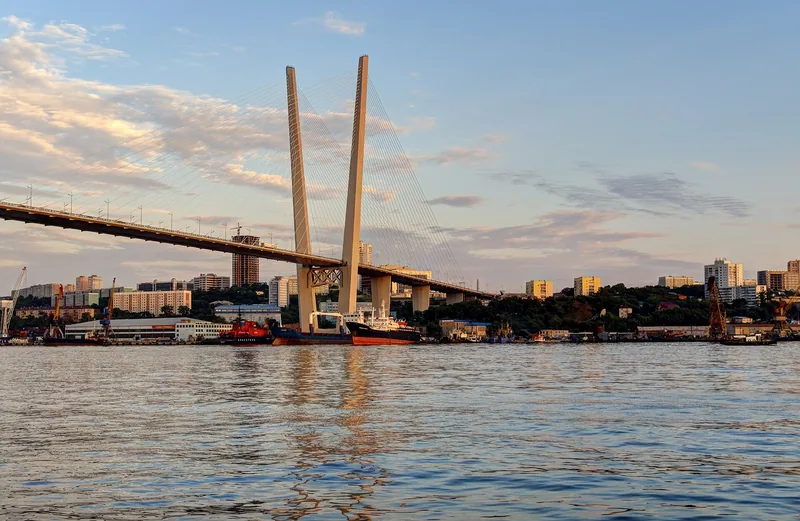

In a panoramic photograph of Vladivostok, the bridge and water tend to catch the eye first. The city becomes more legible when street names, individual buildings and people’s stories join that broad view. A rewarding introduction moves from the skyline to a small object.
Try combining three perspectives: geography, history and everyday life. None requires seeing everything in a single day. Choosing one connection and following it carefully can produce a more memorable understanding than a long checklist.
Begin with the harbour view
Our photograph shows Golden Horn Bay and the Golden Bridge. It offers a useful starting image: water and relief help explain why an overview and a street-level journey can give different impressions of distance.
Before planning a walk, compare the view with a map and actual pedestrian connections. A panorama shows how places relate to one another, but does not guarantee a direct or convenient walking route. Such details matter particularly when imagining everyday life in a city.
A museum shaped by local initiative
The Arsenyev Museum traces its history to the museum of the Society for the Study of the Amur Region, established in 1884. The institution’s account of its first building describes public donations and practical help from local residents.
This episode presents culture as a shared undertaking. Behind a museum’s name stand people who decided that knowledge of a region should be collected, preserved and made available. It is a useful way to connect an institution with the community around it.
Studying a region means asking different questions
The museum’s history mentions archaeological, ethnographic and botanical collections contributed by its founders. Vladimir Arsenyev became an active contributor, and the institution received the explorer’s name in 1945.
Turn those fields into questions: what can an object tell us about someone’s life, a plant about an environment, and a written record about an event? Different kinds of evidence complement one another when their distinct purposes are kept in view.
A visitor’s route and a resident’s perspective
For a cultural introduction, choose a museum story and one city place connected with it. If you are considering life in Vladivostok, add an ordinary journey: from a possible home to work, a shop or a place of study.
These are two useful scales for the same city. A view can inspire the first wish to visit; attention to daily conditions makes that interest more informed. The museum’s official resources and our atlas profile provide places to continue exploring at your own pace.
Sources & context
A russia.direct editorial selection based on open sources. Checked 24 September 2026. Practical suggestions are a decision guide, not a promise of outcomes.
Editorial principles