Vologda lace: the work within a delicate line
Bobbins, linen, patterns and their makers: look beyond the ornament to the person who created it.
Craft, museums and visual language · 3 min read
Published 24 September 2026

It is easy to treat lace as an attractive background: a pale pattern that can be appreciated at a glance. Looking longer raises different questions. How was the line designed? What holds its shape? Why does a dense section sit beside an almost empty space? These questions bring craftsmanship into view.
We suggest approaching Vologda lace as an object, a drawing and the outcome of skilled work. This is not a set of making instructions: hand movements are difficult to learn from a description. It is, however, a way to prepare useful questions for a craftsperson or museum specialist.
Begin with the tools
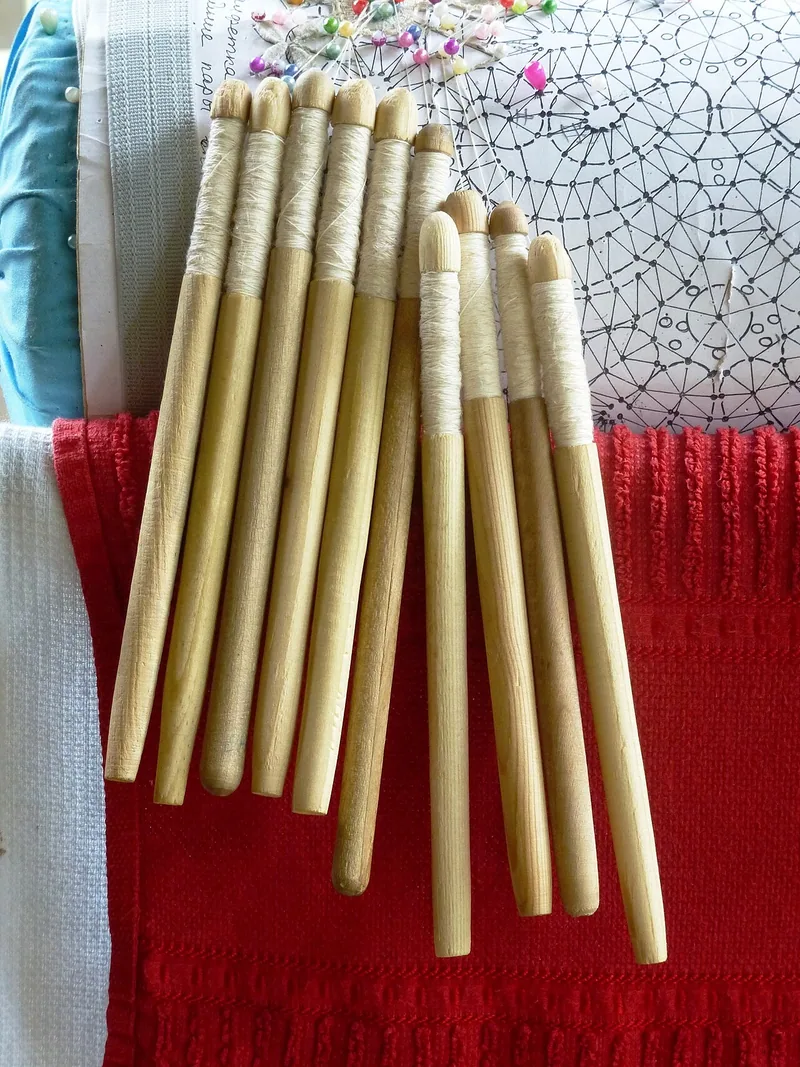
Our photograph shows wooden bobbins, threads, pins and a patterned working surface. It reveals the distance between a finished object and its making: the airy result begins with a very physical arrangement of tools. The source does not establish the location, so we do not present it as an interior of the Vologda museum.
Try following a single thread. Where is it held taut? Where does it change direction, and how does it relate to its neighbours? At a demonstration, asking what problem the maker is solving at that moment may be more revealing than asking how quickly a whole piece can be completed. A specific action makes complexity easier to understand.
Line, material and authorship
Vologda’s official tourism portal highlights flowing lines and repeated elements in the local lace tradition. It discusses linen and cotton, and names the Bryantseva lacemakers and artist Viktoria Elfina in its account of the craft. Such names matter: a regional tradition contains many individual people and artistic choices.
Start with the museum label: maker, date, material and purpose. Then compare two pieces through one feature, such as the treatment of an edge. A tablecloth, collar and wall panel each asks something different of its form. You can notice where a pattern serves the object’s function and where it becomes an image in its own right without knowing specialist terminology.
The museum on Kremlin Square
Vologda’s Lace Museum opened on 3 November 2010 in a historic building on Kremlin Square. The museum’s account on the Artefact platform describes a chronological display exploring stages in the development of the craft. That structure encourages comparison instead of treating tradition as a fixed set of patterns.
For a first visit, choose two questions: how does the purpose of lace change, and how does its design change? Take brief notes on a few objects, keeping their makers’ names. If photography is permitted, capture the label as well as the piece. An attractive image without its creator’s details soon becomes anonymous decoration.
Encountering a living craft
If you want to try lacemaking, look for a class that clearly describes the level and expected outcome. Ask whether tools are provided, how long the introductory work takes and whether prior experience is needed. These are questions for the organiser, not a promise that a particular programme runs every day.
Useful Russian words include кружево (lace), коклюшка (bobbin), лён (linen) and узор (pattern). The city tourism portal mentions foreign-language tours; confirm the current language and timing with the museum. When buying an artist’s work, ask about the maker, material and care instructions. A connection to a region becomes more personal when it includes the person behind an object.
Sources & context
- Vologda Museum Reserve on Artefact — the Lace Museum
- Official Vologda tourism portal — the museum and lacemaking
- Photograph of bobbins — the photographer’s description and licence
A russia.direct editorial selection based on open sources. Checked 24 September 2026. Practical suggestions are a decision guide, not a promise of outcomes.
Editorial principles