Yasnaya Polyana: Leo Tolstoy's house, forest and quiet grave
The museum-estate near Tula where Tolstoy was born, wrote his great novels and lies buried.
Cultural feature · checked 30 September 2026 · 5 min read
Published 30 September 2026
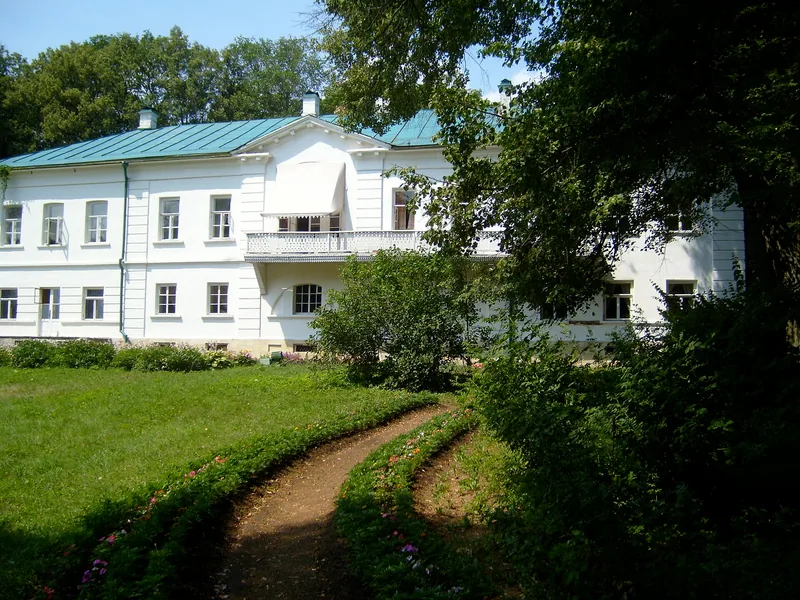

Twelve kilometres south-west of Tula, some two hundred kilometres from Moscow, lies an estate known to readers all over the world. Leo Tolstoy was born here on 9 September 1828; here he spent most of his life and wrote War and Peace and Anna Karenina. The writer himself called Yasnaya Polyana his "inaccessible literary stronghold". Here he spent his childhood, the years of his family life and his late reflections, which the whole world would go on to debate.
Today the estate is a museum-reserve that preserves the writer's house, old parks, ponds and forests. People come not only for the exhibits: many simply want to walk the same avenues Tolstoy walked and to stand by his simple grave in the woods. Yasnaya Polyana's great gift is that it lets you see the writer not on a pedestal but in his own home, among his books, belongings and familiar paths.
The writer's house
The estate's main house was built by Tolstoy's grandfather, but in 1854 the writer sold its central part, which was then dismantled. After returning from military service Tolstoy settled in the right wing, which grew over time with additions in 1871 and 1894. He lived in this house for more than fifty years. This story only adds a human dimension to the house: it changed along with the fortunes of its owner and his family. In 1862 Tolstoy's young wife, Sophia Andreyevna, came to live here.
Its interiors keep traces of the everyday life of a large family. In the study stands the leather sofa on which Tolstoy himself and his children were born; nearby are a modest bedroom and a library of some 22,000 volumes. The museum also holds personal belongings, photographs, writing implements and Tolstoy family portraits. Everything here was made not for show but for the work and life of a large family, and that is exactly what makes the house feel so alive.
The estate and its landscapes
Yasnaya Polyana is not just a house. On the grounds stand the Volkonsky House, the oldest stone building on the estate, and the Kuzminsky wing, where a school for peasant children opened in 1859. Parks and gardens cover more than 40 hectares, surrounded by ponds, fields and forests that keep the look of Tolstoy's time. The school for peasant children mattered greatly to Tolstoy, and its story is one of the most interesting chapters of estate life.
Walking routes lead through avenues and gardens to the stables and farm buildings. The landscape changes with every season: spring orchards, summer meadows, autumn avenues and snow-covered parks. No wonder many visitors return again and again at different times of year. The walk from the house to the forest and the writer's grave becomes part of getting to know Yasnaya Polyana in its own right.
The grave in the Stary Zakaz forest
Tolstoy asked to be buried at Yasnaya Polyana without rites, in a wooden coffin, in the Stary Zakaz forest opposite the ravine, "at the place of the green stick". In childhood his elder brother Nikolai told him a legend about a stick buried at the edge of the ravine: whoever found it would make people stop falling ill, fighting and dying, and they would become "ant brothers". The Tolstoy children played at this game, huddling under armchairs draped with shawls, and the writer carried the memory with him all his life.
The writer died on 20 November 1910 at Astapovo station and was buried where he had asked. His grave is a simple green mound with no headstone and no cross. In the museum's words, this simplicity reflects how Tolstoy understood life and death, and that is why the place makes such a strong impression on visitors. Many visitors walk to the grave in silence, and this path through the forest becomes the most memorable part of the trip.
The museum today
The estate became a museum in 1921, and 3,147 people visited it in its first year. Today the museum-reserve has nine branches, including a research and cultural centre in Tula and museums at neighbouring estates — Pirogovo, Nikolskoye-Vyazemskoye and Pokrovskoye. During the occupation of 1941 the exhibits were evacuated and saved. Preserving the writer's house and belongings has been the work of several generations of museum staff.
The museum offers guided tours, educational programmes for schoolchildren, horseback rides, exhibitions, creative workshops and literary gatherings. Event schedules, tickets and accessibility information are published on the official website ypmuseum.ru, which is worth checking before a trip. Such a rich programme gives many reasons to come to the estate: a tour, an exhibition, a festival or simply a long walk.
Sources & context
- Yasnaya Polyana Museum-Estate — official website
- Yasnaya Polyana Museum-Estate — About the museum
- Yasnaya Polyana Museum-Estate — Tolstoy's grave in the Stary Zakaz forest
- Wikipedia — Yasnaya Polyana
- Wikipedia — Leo Tolstoy
A russia.direct editorial selection based on open sources. Checked 30 September 2026. Practical suggestions are a decision guide, not a promise of outcomes.
Editorial principles