Ysyakh: the summer New Year of the Sakha people
How Yakutia greets the summer with the algys blessing, kumys and the great osuokhai circle, and what happens at Us Khatyn during Ysyakh Tuymaady.
Cultural feature · checked 5 October 2026 · 5 min read
Published 5 October 2026
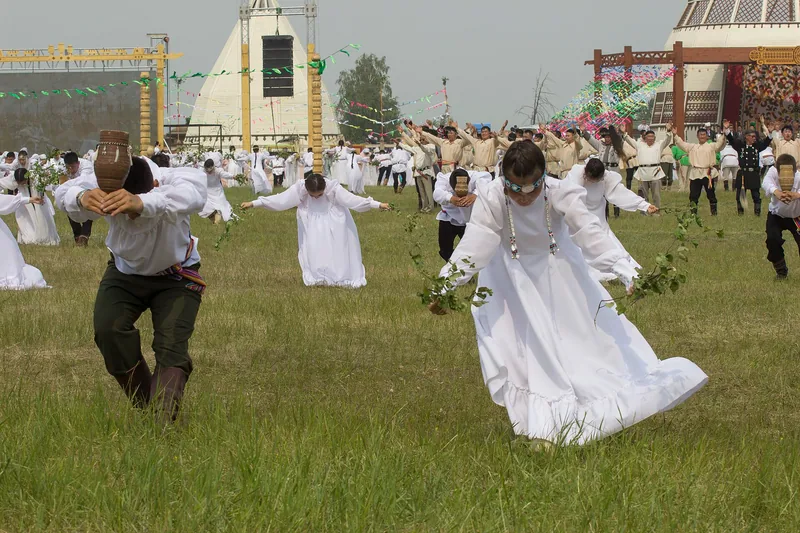

In June, in the longest days of the year, the Sakha people celebrate Ysyakh, a festival often called the summer New Year. It welcomes the rebirth of nature after a long, hard winter, the sun, warmth and a new cycle of life. In effect, the Sakha see in the New Year twice: in winter together with the rest of the country, and in summer according to old tradition. Ysyakh is celebrated by the Sakha and the Dolgans, and the main festivities draw guests from far and wide.
The name is explained in different ways. It is rendered as 'abundance', while materials from the Russian Museum of Ethnography link it to the word for 'to sprinkle, to splash', the central act of the rite: sprinkling with kumys. Researchers trace the roots of Ysyakh to the culture of early nomadic herders in Southern Siberia and Central Asia, to fertility rites and to a collective prayer to the Sky, the Sun and the forces of nature. Today it combines ancient ritual, sport, song and a great public celebration.
Algys and kumys
Ysyakh opens with the algys, a blessing spoken by a person dressed in white: depending on the account, an elder or a so-called white shaman. Addressing the bright Aiyy deities, he asks for a good year, plenty and well-being for the people. The festival's chief ritual drink is kumys, fermented mare's milk. It is held in a wooden vessel called a choron and sprinkled over the ground, plants, livestock and people, the fire is 'fed' with it, and then everyone drinks it together for shared good fortune.
The festival's decorations carry meaning too. According to descriptions, women and children adorn trees with salama, a garland of nine bunches of horsehair. Special importance is given to the rite of greeting the sun at dawn: the first rays are believed to give a person strength and a blessing for the whole year ahead. In this way Ysyakh unites people, nature and the sky in a single act, as the sprinkling, the prayer and the sunrise become a shared start to the new year for a whole community.
Osuokhai: dance, song and verse
The most recognisable part of Ysyakh is the osuokhai, a circle dance that combines movement, song and poetry. Dancers form a ring, hold hands or link arms and move together, putting the left foot forward. Attention centres on the lead singer, who improvises verses while the others take up and repeat his lines. The dance itself is understood as a greeting to the sun and a sign of the start of summer and a new cycle of life, which is why Ysyakh is hard to imagine without it.
The osuokhai is also a contest. Lead singers compete for the finest poetic phrase and the best song, and dancers for the biggest circle. In June 2012, during the festival in Yakutsk, 15,293 people joined a single osuokhai, and Guinness World Records registered it as the largest dance of its kind. A huge ring in which thousands of people repeat the words of one lead singer shows well how, in this dance, a single voice becomes a shared one.
Ysyakh Tuymaady at Us Khatyn
The republic's main celebration is Ysyakh Tuymaady in Yakutsk. It takes place at Us Khatyn, a site within the urban district of the Yakut capital. A whole cultural and ethnic complex has been built there for the festival: the sacred Altan-serge pole, a traditional Mogol-urasa dwelling, a racecourse for horse races and many tusulge, ritual grounds set up by various organisations. During Ysyakh this wide stretch of land turns into an open-air festival town.
After the morning rite the festival moves on to games and contests. Ysyakh features horse races, national wrestling, three kinds of jumping and stick-pulling, while guests sing, dance the osuokhai and try national dishes. Everyone finds something of their own: some come for the rite and the blessing, others for the sport, the songs and time with family. The festival usually falls in June, around the days of the summer solstice, and the exact dates in Yakutsk are announced in advance.
Olonkho and a living tradition
Alongside Ysyakh in Sakha culture stands the heroic epic olonkho, another pillar of the oral tradition. It is one of the oldest epic arts of the Turkic peoples: tales of ancient warriors, deities, spirits and animals can run to as many as 15,000 lines of verse. The performers, called olonkhosuts, alternate singing with recitative, needing acting and singing talent, eloquence and a gift for improvisation. In 2005 UNESCO proclaimed olonkho a masterpiece of the oral and intangible heritage, and in 2008 the epic was inscribed on the Representative List.
Neither tradition has had an easy history. According to encyclopedic sources, Ysyakh was almost forgotten in the late Soviet years, and its revival began in 1990, when a large festival was held in Yakutsk once again. UNESCO notes that olonkho has few practitioners today and that they are mostly elderly, so passing the epic on to young people matters a great deal. Ysyakh, with its shared circle, its song and its spoken word, helps Sakha culture pass from one generation to the next.
Sources & context
- Russian Museum of Ethnography — press release on the Ysyakh festival (PDF)
- UNESCO — Olonkho, Yakut heroic epos
- Guinness World Records — Largest Ohuokhai dance (2012)
- YSIA Afisha — The Us Khatyn site
- Wikipedia — Yhyakh
A russia.direct editorial selection based on open sources. Checked 5 October 2026. Practical suggestions are a decision guide, not a promise of outcomes.
Editorial principles