The Dymkovo toy: Vyatka's white clay and the Svistunya festival
How a spring festival of clay whistles gave rise to Vyatka's clay toys, why they were whitened with chalk mixed in milk, and what the museum in Kirov keeps.
Cultural feature · checked 5 October 2026 · 5 min read
Published 5 October 2026
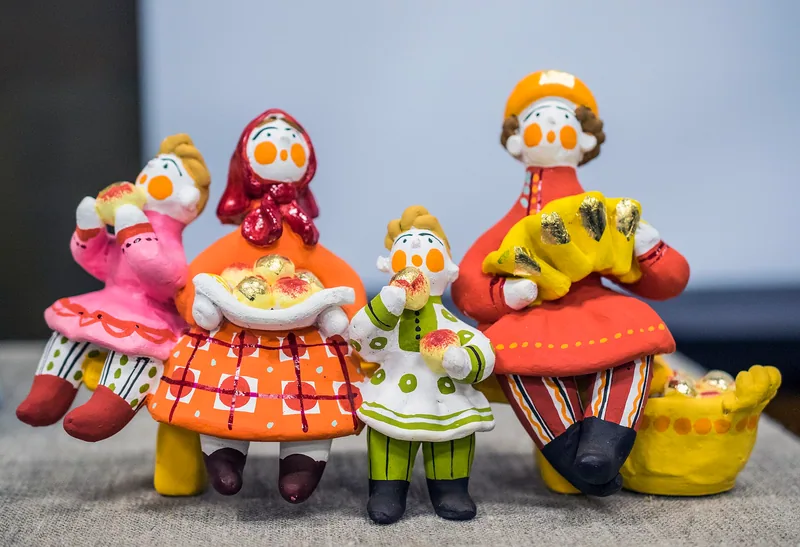

A snow-white lady in a full skirt marked with red circles and blue checks, a nanny with a baby, a turkey with its tail spread, a ram with golden horns — a Dymkovo toy is hard to mistake for anything else. It is bright, festive and a little solemn, like a village fair on a sunny day. Every figure is modelled by hand from clay, fired, whitened and painted, so no two are ever exactly alike, even when the same craftswoman made them.
The toy's birthplace is the settlement of Dymkovo on the bank of the Vyatka River, now within the city limits of Kirov. The craft is considered one of the oldest in Russia: its age is usually put at about four hundred years. For a long time the clay figures were not souvenirs but part of a spring festival that brought the whole town together. Since then the toy has survived decline and revival and gained strict rules and its own museum, yet it remains the handiwork of Vyatka's craftswomen.
A festival of whistles
The toy's origins are linked to a spring festival called Svistunya, roughly 'the whistling'. According to local legend, it began in memory of townspeople killed in the Khlynov clash of 1418; other retellings give different dates, 1392 and 1421. The festival, according to the journal Etnograficheskoe Obozrenie, was held on the bank of the Vyatka on the fourth Saturday after Easter. A memorial service came first, and then the merrymaking began: everyone blew clay whistles and birch-bark pipes.
For the festival, Dymkovo craftswomen modelled whistles in the shape of horses, riders, rams, goats and ducks and painted them brightly. Around them toys were sold, people sang, danced and held fist fights. The first written mention of Svistunya, according to English-language Wikipedia, dates from 1811, though the custom itself is believed to be much older. In time the festival lost its former meaning and ended in the late 1920s, but the toy did not disappear; it carried on developing in its own right.
Clay, sand and fire
The work starts with local bright-red clay, carefully mixed with fine brown river sand. A figure is not pulled out of a single lump: it is modelled in parts. The body, head, arms, skirt, headdress or tail are rolled separately, and then the pieces are joined, with liquid red clay acting as the binder. That is why Dymkovo ladies have such full skirts, as if built from several bells, and the turkeys have fan-shaped tails made of separate petals.
The finished figure is dried for a long time: depending on its size and complexity, this takes anywhere from two to fifty days. Hurrying is risky, because a toy that has not dried properly may crack in the fire. The figures are then fired at around 700–900 degrees Celsius. After firing the clay becomes strong and ringing, but it is still reddish brown. Before it turns into the familiar snow-white Dymkovo toy, it has yet to be whitened and painted.
Chalk in milk and bright patterns
In the old days the fired figure was whitened with chalk mixed in milk. The coating went on as an even matt layer and served as the ground for painting. Today tempera white is used instead, applied in two or three coats. Paints were once made with egg and thinned with kvass; now ready-made colours and soft brushes are used. The finishing touch is small diamond-shaped pieces of gold leaf or imitation gold glued over the pattern, which give the toy its festive sparkle.
The painting is built from simple geometric elements — circles, dots, stripes, checks, wavy lines and diamonds. The palette consists of red, yellow, blue, light blue, green, emerald and orange. Ancient meanings are attributed to the patterns: circles recall the sun and moon, diamonds are associated with fertility, waves with the sky and moisture. The subjects follow a canon too: ladies, nannies, water carriers, gentlemen, horses, deer, roosters and turkeys. A dog, for example, may be depicted, but a cat may not.
Revival and a museum in Kirov
By the early 20th century the craft had almost died out: according to the Znanie society, only one craftswoman stayed true to the tradition — Anna Afanasyevna Mezrina, who passed the skill on to her daughters. Between 1917 and 1926 the artist Alexei Ivanovich Denshin compiled albums of drawings of the toys, which helped the revival of the 1930s. A cooperative was set up in 1933, and in 1958 a department called 'Folk Art Craft: Dymkovo Toy' was created within the Union of Artists.
In 2011 the museum 'Dymkovo Toy: History and Present' opened in Kirov. Its collection holds more than 700 items, about 250 of which are on permanent display — both old figures and work by today's craftswomen. The hall is decorated with a large 1982 mural by the artist V. Kharlov showing the history of the craft and portraits of famous craftswomen of the past. The museum hosts meetings with makers and sessions for visitors, and in 2013 a virtual 3D museum was added as well.
Sources & context
- Znanie.Wiki (Znanie Russian Society) — Dymkovo toy
- Etnograficheskoe Obozrenie (Institute of Ethnology and Anthropology, RAS), 1988 — article on the Vyatka Svistunya festival
- Tonkosti — 'Dymkovo Toy: History and Present' museum
- Wikipedia — Dymkovo toy (Russian)
- Wikipedia — Dymkovo toys
A russia.direct editorial selection based on open sources. Checked 5 October 2026. Practical suggestions are a decision guide, not a promise of outcomes.
Editorial principles