The nuclear icebreaker Lenin: the first of the atomic fleet in Murmansk
The world's first nuclear-powered surface ship is now a museum by Murmansk's sea terminal.
Cultural feature · checked 30 September 2026 · 4 min read
Published 30 September 2026
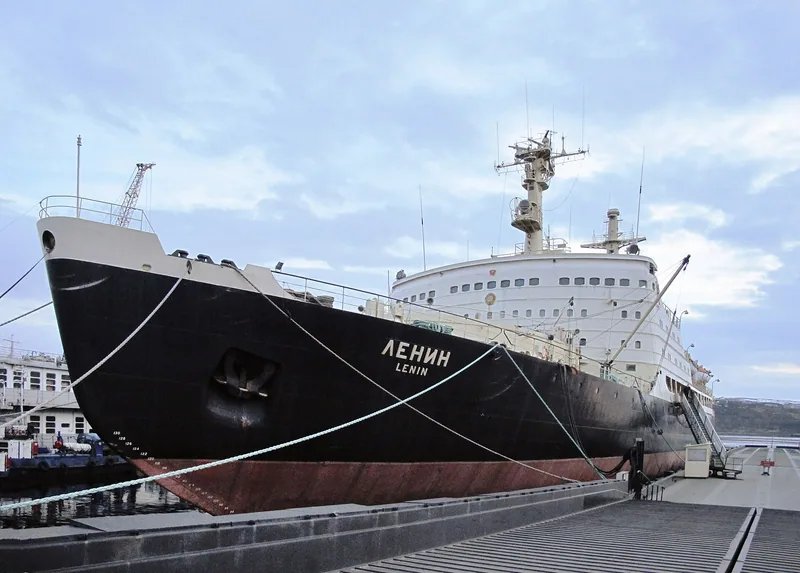

At the pier of Murmansk's sea terminal lies a ship known far beyond the Kola Peninsula. This is the nuclear icebreaker Lenin, the world's first nuclear-powered surface ship and the first civilian nuclear vessel. For three decades it led convoys through Arctic ice, and today it welcomes guests as a museum. Its silhouette has become as much a part of the city's panorama as the hills around the Kola Bay.
For Murmansk the icebreaker is more than a sight. It is the city's only cultural heritage site of federal significance and a living page in the history of the Northern Sea Route. A walk along its decks and corridors gives a sense of how people lived and worked when they first trusted the atom to carry them through polar ice. It is perhaps one of the few museums where the history of technology and the history of people are told on the same deck.
Born on Leningrad slipways
The icebreaker was built in Leningrad at the Admiralty Shipyards in the second half of the 1950s. It was launched in 1957, and in September 1959 the ship left the yard for its first trials. In that same year, 1959, it entered service and began working in the Arctic. For a country whose coastline faces the Arctic Ocean for thousands of kilometres, such a ship was of enormous importance.
Its main innovation was the power plant. At first the icebreaker carried three OK-150 reactors, and in 1970 they were replaced by two OK-900 reactors. The nuclear heart gave it something earlier icebreakers could only dream of: the ability to stay at sea for long periods without taking on fuel. The replacement was an important stage in the ship's life and allowed it to serve for almost two more decades.
Thirty years in the ice
The icebreaker escorted ships along the Northern Sea Route, extending the short Arctic navigation season. In 1960–1965 alone it covered more than 157,000 kilometres on Arctic voyages. The experience gathered by its crews became the foundation for the work of later generations of nuclear icebreakers. Each voyage helped deliver cargo to northern ports and settlements for which the sea route was often the main link with the rest of the country.
The ship's service was recognised: in April 1974 it was awarded the Order of Lenin. In 1989, after three decades at work, Lenin was decommissioned, and soon a new chapter began — turning the veteran into a museum open to everyone. The decision to preserve the icebreaker not only saved a unique ship but also made it a place where shipbuilding and the Arctic are explained to new generations.
What you can see on board
Tours take visitors through living and working spaces. According to Murmansk's tourist portal, guests see the crew mess, the power control station, the medical unit, the club rooms, the captain's saloon, the wardroom and the captain's bridge. The ship also had a sauna, a photo lab, a projection room and a library — a small town for long voyages. The interiors speak about the everyday life of a crew who spent months at sea far from home as eloquently as any document.
Today the ship houses the Arctic Exhibition Centre "Nuclear Icebreaker Lenin", a division of the Rosatom enterprise Atomflot. On board there is also an information centre on nuclear energy and the exhibition "Atom and the Arctic", which tells the story of the icebreaker fleet, the Northern Sea Route and the Arctic itself. In this way the museum links past and present: the story of the first nuclear icebreaker continues with a conversation about today's Arctic.
Planning a visit
The icebreaker is moored in the city centre, at the sea terminal pier on Portovy Proyezd, so a visit is easy to combine with a walk along the Kola Bay waterfront. It is best to check the tour format, schedule and booking procedure in advance on the museum's official page at Rosatomflot. The icebreaker's address is Portovy Proyezd 25, next to the sea terminal.
A ship is a ship: its ladders and passageways are built for sailors, so comfortable shoes will come in handy. If time allows, linger on the pier after the tour: from here you can see the port and the Kola Bay, down which the icebreaker once set out on its Arctic voyages.
Sources & context
- Murmansk tourist portal — Nuclear icebreaker Lenin
- Visit Murmansk — Lenin icebreaker museum
- Wikipedia — Lenin (1957 icebreaker)
A russia.direct editorial selection based on open sources. Checked 30 September 2026. Practical suggestions are a decision guide, not a promise of outcomes.
Editorial principles